Industrial IoT Market Trends Driving Industry 4.0 and Digital Transformation
What Is Driving the Growth of the Global Industrial IoT Market?
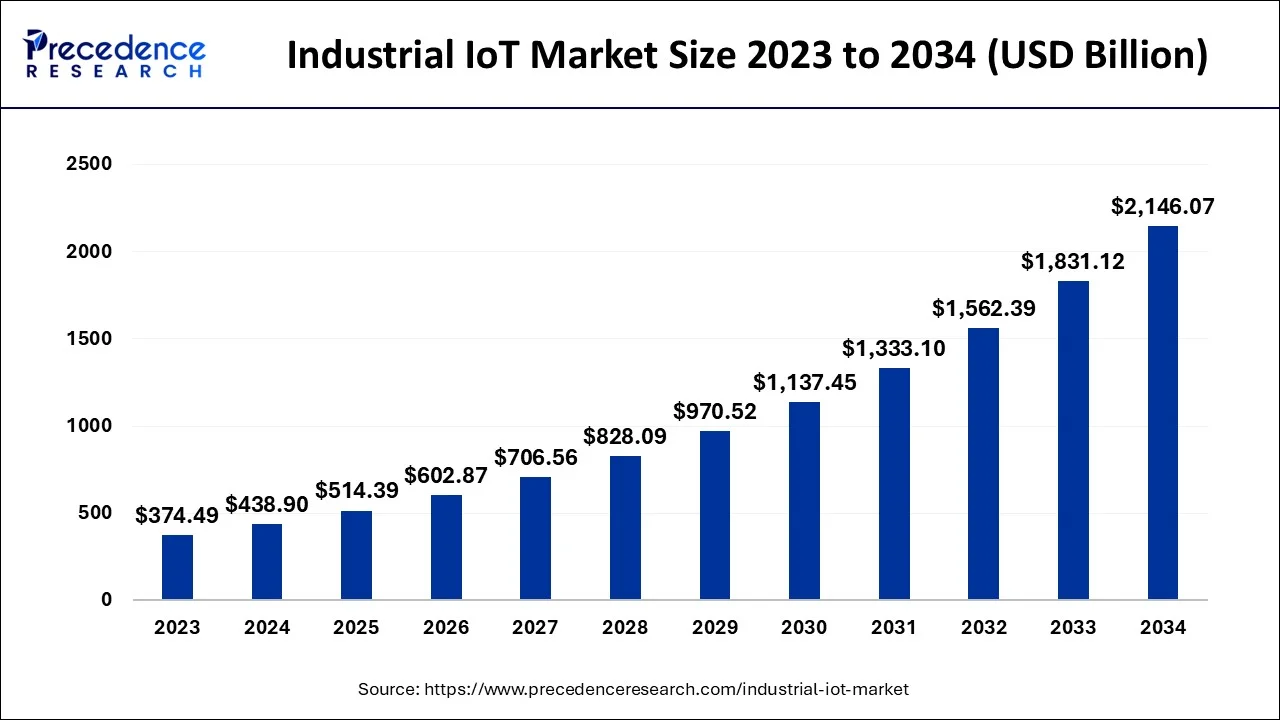
The global industrial IoT market size was estimated at USD 514.39 billion in 2025 and is predicted to increase from USD 602.87 billion in 2026 to approximately USD 2,430.21 billion by 2035, expanding at a CAGR of 16.8% from 2026 to 2035. The market is driven by growing digital transformation, government support for smart manufacturing, and rising investment in IoT devices across industries.
Key Takeaways
- By region, North America led the industrial IoT market in 2025, holding a major share of around 34% in 2025.
- By region, Asia Pacific is expected to grow at the highest rate during the forecast period.
- By component, the solution segment dominated the market with the largest share in 2025.
- By component, the services segment is expected to grow at the fastest rate during the forecast period.
- By end-use, the manufacturing segment dominated the market with the highest share in 2025.
- By end-use, the logistics & transportation segment is anticipated to experience the fastest growth during the forecast period.
- By connectivity, the wireless technology segment dominated the market with the highest share in 2025.
- By connectivity, the wired technology segment is expected to rise with the highest CAGR during the forecast period.
- By deployment, the on-premises segment led the market with a major share in 2025.
- By deployment, the cloud-based segment is anticipated to grow at the fastest CAGR during the forecast period.
Market Overview
The industrial IoT market connects physical industrial equipment with digital intelligence to improve operational efficiency, productivity, and decision-making. Smart sensors embedded in machinery collect real-time data on parameters such as temperature, pressure, vibration, and energy consumption, enabling continuous asset monitoring and enhanced supply chain visibility. These connected systems support real-time inventory management, optimize production based on demand, and improve overall operational performance. Additionally, edge computing processes data closer to the source, enabling faster responses, while AI-powered predictive maintenance and cloud platforms help reduce equipment failures, minimize downtime, and lower maintenance costs, making them key drivers of market growth.
Despite these advantages, integrating Industrial IoT solutions with existing legacy infrastructure remains a significant challenge. Organizations must invest considerable engineering resources to ensure compatibility between conventional industrial equipment and modern internet-based communication protocols. As manufacturing facilities become increasingly connected, businesses are adopting zero-trust security frameworks, multi-layer encryption, and advanced firewall technologies to safeguard critical assets and sensitive operational data.
Moreover, connecting operational technology (OT) networks with enterprise IT systems expands the cybersecurity attack surface, increasing the risk of data breaches, intellectual property theft, ransomware attacks, and operational disruptions. Another major challenge is the lack of universal interoperability standards, as seamless communication between equipment from multiple manufacturers is essential for creating fully integrated, intelligent, and self-optimizing industrial ecosystems. Overcoming these technical and security barriers will be crucial to unlocking the full potential of the Industrial IoT market.
Industrial IoT Market Growth Factors
- With better sensor technology, the data being collected from industrial machinery is said to be sitting in a database without falsification, as far as operational intelligence and reliability are concerned.
- AI and Machine Learning integrate context for prescriptive diagnostics, optimization of processes, and less downtime, hence strengthening adoption in all industries.
- With the expansion of 5G networks, data travel becomes seemingly untethered, thus supporting latency-critical applications and connected industrial ecosystems.
- Rising demand in automation in manufacturing and other industries is geared towards the reduction of errors, smoothing processes, and increasing productivity.
- Government-led initiatives such as smart city projects and increased investment in digital transformation act as a catalyst for further advancement of IIoT deployment in varying domains.
Market Report Coverage and Key Metrics
| Report Coverage | Details |
| Market Size in 2025 | USD 514.39 Billion |
| Market Size in 2026 | USD 602.87 Billion |
| Market Size by 2035 | USD 2430.21 Billion |
| Growth Rate from 2026 to 2035 | CAGR of 16.8% |
| Base Year | 2025 |
Market Regional Analysis: North America, Europe, Asia-Pacific
U.S. Industrial IoT Market Size and Growth 2026 to 2035
The U.S. industrial IoT market size is evaluated at USD 122.42 billion in 2025 and is predicted to be worth around USD 521.98 billion by 2035, rising at a CAGR of 17.43% from 2026 to 2035
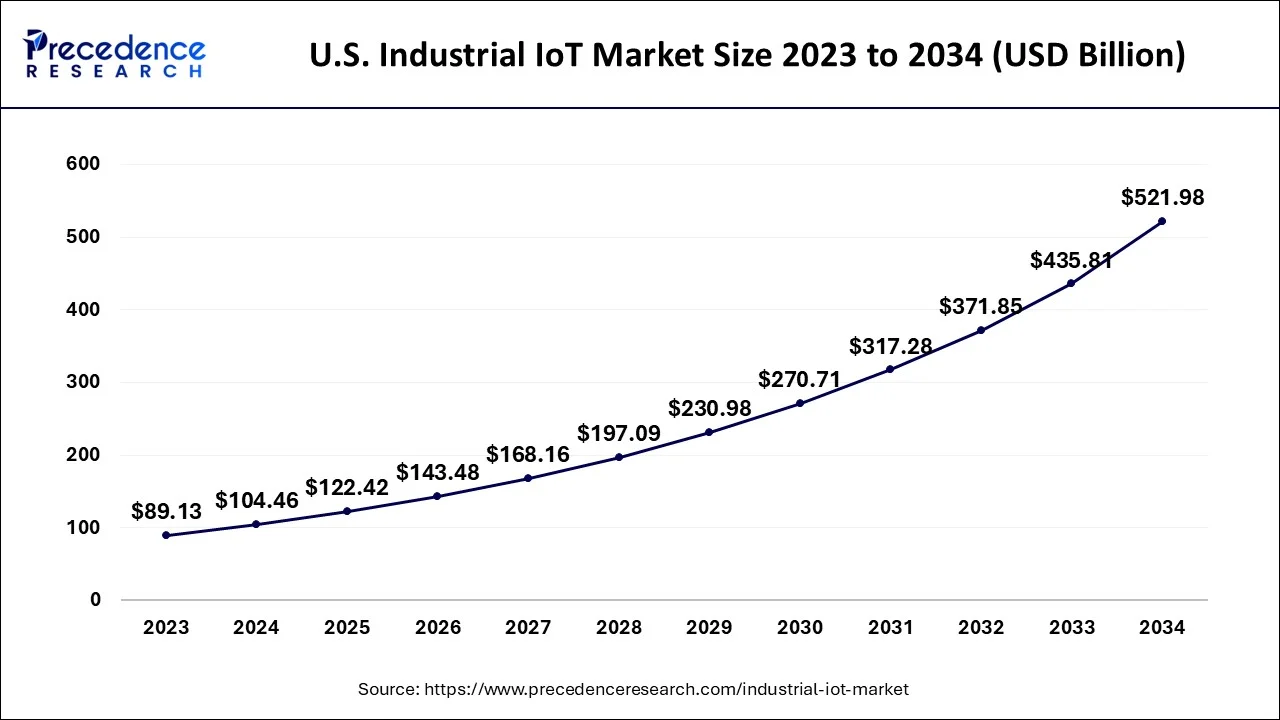
North America dominated the Industrial IoT market in 2025, driven by widespread adoption of smart manufacturing technologies, strong investments in industrial automation, and advanced digital infrastructure. The United States led the regional market due to substantial spending on IoT technologies, early implementation of connected industrial systems, and the presence of leading Industrial IoT solution providers. Growing adoption of predictive maintenance, cloud computing, artificial intelligence, and edge computing across manufacturing, energy, automotive, and logistics sectors continues to strengthen regional growth. In addition, the expanding ecosystem of startups and technology innovators developing Industrial IoT platforms is expected to create new opportunities throughout the forecast period.
Asia Pacific is projected to register the fastest CAGR during the forecast period. Rapid industrialization, expanding manufacturing activities, and increasing investments in Industry 4.0 technologies are driving market growth across the region. China continues to strengthen its position as a global manufacturing hub by accelerating factory automation and digital transformation initiatives, while India is attracting significant manufacturing investments due to its cost-effective labor, expanding industrial infrastructure, and supportive government policies. Incentives for smart manufacturing, favorable tax reforms, and rising adoption of connected factories across industries are expected to accelerate Industrial IoT deployment across the Asia Pacific region over the coming years.
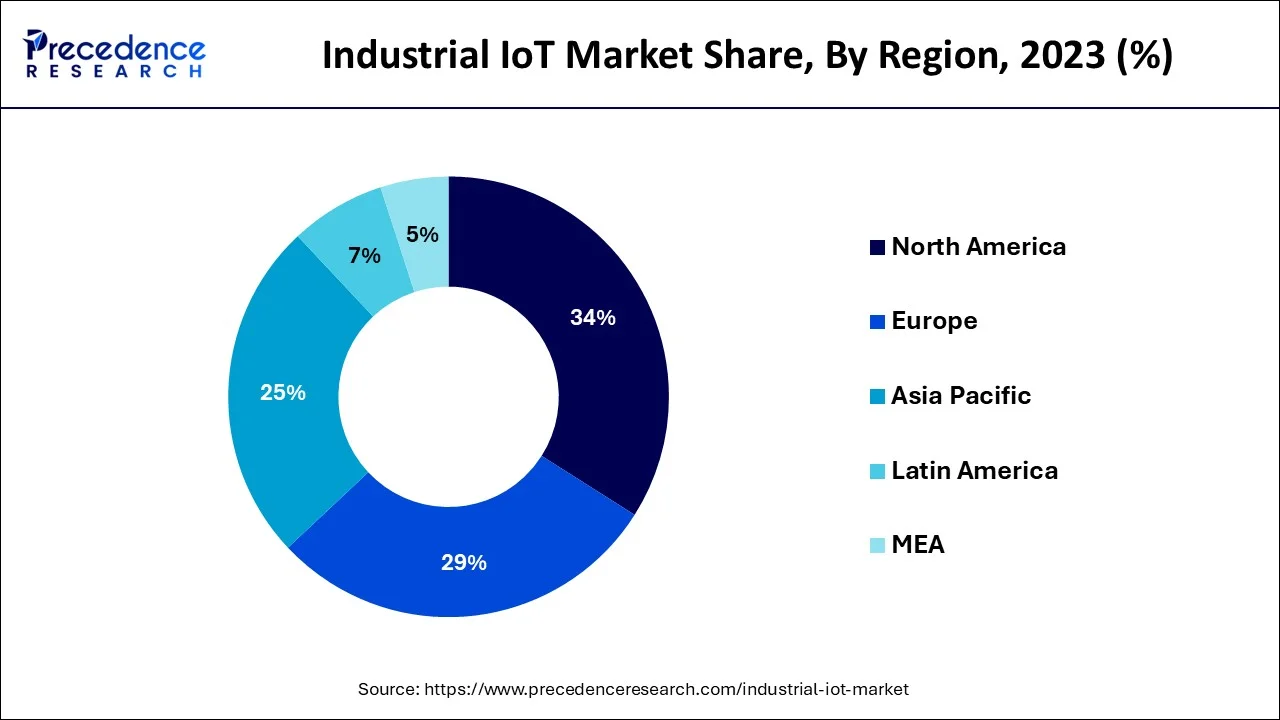
Europe is expected to witness steady growth in the Industrial IoT market, supported by increasing adoption of Industry 4.0 technologies, smart factory initiatives, and digital transformation across key industries. Countries such as the UK, Germany, and the Netherlands are leading regional Industrial IoT deployment, while the Nordic countries and Eastern Europe are rapidly expanding their adoption of connected industrial technologies. Manufacturing, healthcare, financial services, energy, retail, and agriculture are increasingly implementing Industrial IoT solutions to improve operational efficiency, automate processes, and enable data-driven decision-making.
Growing investments in IoT infrastructure, cloud computing, artificial intelligence, and industrial automation are further strengthening the regional market. Supported by favorable government initiatives and increasing enterprise spending on digital technologies, Europe is expected to maintain robust growth throughout the forecast period, with Industrial IoT adoption continuing to expand across both established and emerging industrial sectors.
Market Competitive Landscape: Leading Companies and Strategies
The industrial IoT market is highly competitive, with technology providers, industrial automation companies, and digital solution vendors focusing on developing integrated and intelligent industrial ecosystems. Leading market participants are expanding their capabilities through strategic partnerships, acquisitions, research and development, and continuous product innovation to address challenges such as legacy system integration, interoperability, and cybersecurity. The growing demand for scalable, secure, and interoperable Industrial IoT platforms that enable real-time monitoring, predictive maintenance, and automated operations continues to intensify market competition.
Major companies are investing significantly in edge computing, artificial intelligence (AI), cloud computing, 5G connectivity, and industrial analytics to enhance smart manufacturing and industrial automation capabilities. The development of edge AI solutions enables real-time data processing at production sites, reducing latency and dependence on centralized cloud infrastructure while improving operational efficiency. In addition, advancements in industrial sensors, smart gateways, industrial routers, and high-speed communication technologies are accelerating the deployment of connected factories and intelligent industrial environments. These technological innovations, combined with a strong focus on digital transformation and operational resilience, are expected to drive sustained competition and long-term growth in the Industrial IoT market.
Industrial IoT Market Companies
- ABB
- General Electric
- IBM Corporation
- Intel Corporation
- Rockwell Automation, Inc.
- Siemens
- Microsoft
- Cisco Systems, Inc.
- NEC Corporation
- KUKA AG
Recent Developments in the Industrial IoT Market (2025–2026)
- In June 2026, NTT DOCOMO BUSINESS, TRANSATEL, cellular IoT connectivity, and Zscaler, Inc., are cooperating to launch Cellular SASE for IoT, a new solution for the global IoT market. The solution provides cloud security and flexible connectivity for IoT devices and mobile endpoints. (Source: https://www.ntt.com)
- In May 2026, LG CNS focuses on expanding into North American AX manufacturing with AI smart factory solutions, helping SMES with the digital revolution. On May 18–19, LG CNS attended the IoT Tech Expo 2026 in San Jose as the only Korean exhibitor. (Source: https://vir.com.vn)
- In January 2026, Siemens and NVIDIA are strengthening their cooperation to develop the Industrial AI Operating System. This partnership uses AI to transform the complete industrial value chain, from engineering to manufacturing, invention, operations, and supply chains, for next-generation industrial operations. (Source: https://press.siemens.com)
- In September 2025, the industrial IoT sector is adopting software-defined edge nodes for cost-effective, flexible, reusable, secure, and data-generation-centric applications due to security concerns. (Source: https://www.engineering.com)
- In September 2025, Indiesemic launches India’s first IoT Evolution Board at Semicon India 2025, integrating an indigenous VEGA processor, Bluetooth, and LoRa connectivity, aiming to accelerate prototyping, strengthen security, and reduce import reliance. (Source: https://smestreet.in)
Segments Covered in the Report
By Component
- Solution
- Remote Monitoring
- Data Management
- Analytics
- Security Solutions
- Others
- Services
- Professional
- Managed
- Platform
- Connectivity Management
- Application Management
- Device Management
By End-Use
- Manufacturing
- Energy & Power
- Oil & Gas
- Healthcare
- Logistics & Transport
- Agriculture
- Others
By Region
- North America
- Europe
- Asia-Pacific
- Latin America
- Middle East & Africa (MEA)
Check this Report too: Bicycle Market
Get this report to explore global market size, share, CAGR, and trends, featuring detailed segmental analysis and an insightful competitive landscape overview @ https://www.precedenceresearch.com/sample/2190
You can place an order or ask any questions, please feel free to contact us at sales@precedenceresearch.com |+1 804 441 8518