
Water Purifier Market Size, Growth Trends, and Forecast 2026 to 2035
The global water purifier market size was valued at USD 38 billion in 2025 and is projected to grow from USD 40.96 billion in 2026 to approximately USD 79.85 billion by 2035, registering a CAGR of 7.71% during the forecast period. The market is witnessing strong expansion due to growing concerns over water pollution, rising prevalence of waterborne diseases, increasing urbanization, and continuous advancements in purification technologies. Consumers and businesses alike are investing in modern water purification systems to ensure access to clean, safe, and healthy drinking water.
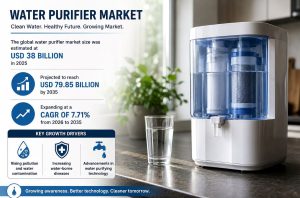
Water Purifier Market Overview
Water purifiers are advanced filtration systems designed to remove physical, chemical, and biological contaminants from drinking water, ensuring it is safe for human consumption. Modern purification technologies including reverse osmosis (RO), ultraviolet (UV), ultrafiltration (UF), activated carbon filtration, and gravity-based systems effectively eliminate bacteria, viruses, heavy metals, pesticides, chlorine, sediments, and dissolved impurities while improving the taste and odor of water.
Growing industrialization, rapid urbanization, aging water infrastructure, and increasing contamination of freshwater sources have significantly increased the demand for reliable water purification systems worldwide. Consumers are becoming increasingly aware of the long-term health risks associated with contaminated drinking water, prompting greater adoption of advanced household and commercial purification solutions.
The market is also benefiting from rising disposable incomes in developing economies, expanding smart home adoption, and increasing investments in water treatment infrastructure. Manufacturers continue introducing innovative products equipped with IoT connectivity, AI-powered monitoring, and energy-efficient technologies, making water purifiers more intelligent, convenient, and sustainable than ever before.
Water Purifier Market Size and Forecast
| Year | Market Size (USD Billion) |
|---|---|
| 2025 | 38.00 |
| 2026 | 40.96 |
| 2035 | 79.85 |
| CAGR (2026–2035) | 7.71% |
Download the Sample: https://www.precedenceresearch.com/sample/2975
Water Purifier Market Value Chain Analysis
- Raw Material Procurement: Manufacturers source filtration membranes, activated carbon, UV lamps, pumps, electronic sensors, storage tanks, plastic components, and smart monitoring systems from specialized suppliers while ensuring compliance with international safety and environmental standards.
- Product Design and Technology Development: Companies continuously invest in research and development to improve filtration efficiency, reduce water wastage, enhance energy efficiency, and integrate smart technologies such as IoT connectivity, AI-enabled monitoring, and predictive maintenance capabilities.
- Manufacturing and Assembly: Water purification systems are manufactured through highly automated production facilities where filtration cartridges, electronic controls, purification chambers, and monitoring systems are assembled and tested to ensure consistent performance and product reliability.
- Distribution and Retail Network: Manufacturers distribute products through online platforms, specialty retailers, supermarkets, electronics stores, distributors, and direct sales channels to maximize market reach across residential, commercial, and industrial sectors.
How AI is Transforming the Water Purifier Market
- Artificial Intelligence (AI) is revolutionizing the water purifier industry by transforming conventional filtration systems into intelligent water quality management solutions. AI-powered water purifiers continuously monitor water quality parameters, optimize purification cycles, predict maintenance requirements, and deliver personalized user experiences through real-time analytics.
- Machine learning algorithms analyze historical water usage patterns, contaminant levels, and environmental conditions to automatically adjust purification settings for maximum efficiency. AI also helps manufacturers improve predictive maintenance by notifying users before filter performance declines, reducing downtime and enhancing customer convenience.
- The integration of AI with IoT-enabled sensors allows users to monitor water quality remotely through smartphone applications, receive filter replacement alerts, track water consumption, and optimize purifier performance based on changing water conditions.
Key Benefits of AI in Water Purifiers
Intelligent Water Quality Monitoring
- Real-time contaminant detection
- Continuous TDS monitoring
- Automatic purification adjustment
- Improved water safety
Predictive Maintenance
- Smart filter replacement alerts
- Reduced maintenance costs
- Longer equipment lifespan
- Improved operational efficiency
Smart Home Integration
- Mobile application control
- Voice assistant compatibility
- Remote diagnostics
- Automated performance monitoring
Personalized Water Management
- Usage pattern analysis
- Customized purification settings
- Water consumption tracking
- Energy optimization
How Government Initiatives are Supporting Market Growth
Governments across the globe are increasingly prioritizing access to safe drinking water through infrastructure investments, public awareness campaigns, and stringent water quality regulations. These initiatives are creating favorable conditions for the growth of the global water purifier market.
Programs such as India’s Jal Jeevan Mission, the United Nations Sustainable Development Goals (SDGs), and national clean water policies across Asia, Europe, and North America are encouraging the adoption of advanced household and commercial water purification systems. Governments are also strengthening regulations related to industrial wastewater treatment and drinking water quality, prompting businesses and consumers to invest in advanced purification technologies.
In addition, rising investments in smart city projects, digital water infrastructure, and wastewater recycling programs are expected to further accelerate market expansion throughout the forecast period.
What Factors are Driving the Growth of the Water Purifier Market?
- Rising Water Pollution: Rapid industrialization, urban expansion, agricultural runoff, and chemical contamination are deteriorating freshwater quality worldwide, increasing demand for effective water purification solutions.
- Growing Health Awareness: Consumers are becoming increasingly aware of waterborne diseases and the long-term health risks associated with contaminated drinking water, encouraging greater investment in advanced purification technologies.
- Urbanization and Population Growth: Growing urban populations place increasing pressure on municipal water infrastructure, creating significant opportunities for residential and commercial water purification systems.
- Technological Advancements: Continuous innovations in reverse osmosis, UV purification, activated carbon filtration, IoT integration, AI monitoring, and energy-efficient technologies are enhancing product performance and customer adoption.
Water Purifier Market Major Growth Factors
Increasing Consumer Expectations
- Better water quality
- Smart monitoring capabilities
- Low maintenance systems
- Improved energy efficiency
Growing Demand for Preventive Healthcare
- Safe drinking water
- Reduced disease transmission
- Better family health
- Improved quality of life
Expansion of Smart Water Technologies
- AI-enabled purification
- IoT connectivity
- Mobile application monitoring
- Predictive maintenance
Rising Investments in Water Infrastructure
- Municipal water improvement
- Wastewater recycling
- Smart city development
- Sustainable water management
Latest Trends in the Water Purifier Market
- Shift Toward Smart Water Purifiers: Manufacturers are increasingly introducing smart purification systems equipped with IoT connectivity, AI-powered monitoring, and mobile applications that enable users to track water quality, monitor filter life, and receive maintenance alerts in real time.
- Multi-Stage Filtration Technologies: Consumers are adopting purification systems that combine RO, UV, UF, and activated carbon technologies to provide superior protection against heavy metals, microorganisms, pesticides, and emerging contaminants.
- Sustainable Product Development: Manufacturers are focusing on eco-friendly purification technologies that reduce water wastage, improve energy efficiency, utilize recyclable materials, and extend filter lifespan to support global sustainability goals.
- Compact and Premium Designs: Modern consumers increasingly prefer aesthetically designed, space-saving purification systems that seamlessly integrate into contemporary kitchens while delivering high-performance filtration.
Sustainability Trends Transforming the Industry
Sustainability has become a major focus area for water purifier manufacturers as they strive to reduce environmental impact while improving access to safe drinking water. Companies are investing in energy-efficient technologies, recyclable filtration materials, reduced wastewater generation, and longer-lasting filter systems.
Digital monitoring solutions and predictive maintenance capabilities are also helping reduce unnecessary filter replacements, optimize water usage, and minimize operational waste. At the same time, manufacturers continue to develop purification technologies capable of supporting long-term water conservation initiatives.
Sustainability Initiatives
Green Manufacturing
- Energy-efficient production
- Reduced plastic usage
- Sustainable packaging
- Carbon footprint reduction
Water Conservation
- Reduced wastewater generation
- Improved recovery rates
- Efficient filtration membranes
- Smart water optimization
Circular Economy
- Recyclable filter materials
- Extended filter life
- Component recycling
- Sustainable product design
Growing Demand for Safe Drinking Water Driving Market Expansion
Increasing concerns regarding contaminated water supplies, industrial pollution, aging water infrastructure, and climate-related water challenges are encouraging consumers to prioritize safe drinking water more than ever before. Households, commercial establishments, healthcare facilities, educational institutions, and industrial users are investing heavily in advanced purification systems that deliver reliable, high-quality drinking water.
At the same time, growing awareness of preventive healthcare, rising disposable incomes, expanding urban populations, and continuous technological innovation are expected to sustain strong demand for water purification systems throughout the forecast period. As smart technologies become more affordable and accessible, AI-enabled and IoT-connected water purifiers are likely to become standard features in modern homes and businesses worldwide.
Water Purifier Market Opportunities
The increasing focus on public health, technological innovation, and sustainable water management presents significant opportunities for manufacturers and service providers operating in the global water purifier market.
Expansion of Smart Water Purification
- The growing popularity of connected homes is creating substantial opportunities for AI-enabled and IoT-integrated water purification systems. Smart purifiers that offer mobile app control, predictive maintenance alerts, voice assistant compatibility, and real-time water quality monitoring are expected to witness strong demand over the coming decade.
Growing Demand in Emerging Economies
- Rapid urbanization, rising disposable incomes, and increasing awareness regarding waterborne diseases are encouraging greater adoption of water purification systems across emerging markets such as India, China, Indonesia, Brazil, Vietnam, and several African countries. These markets are expected to become key growth engines for manufacturers.
Commercial and Industrial Applications
- Apart from residential demand, commercial establishments—including hotels, restaurants, hospitals, educational institutions, offices, and manufacturing facilities—are increasingly investing in advanced purification systems to comply with health regulations and improve water quality for employees and customers.
Sustainable Water Management
- Growing emphasis on water conservation, wastewater recycling, and environmentally friendly purification technologies is encouraging manufacturers to develop energy-efficient systems with reduced water wastage, recyclable filters, and longer operating lifespans.
Why the Water Purifier Market is Growing
The water purifier market is growing due to increasing concerns about water pollution, rising cases of waterborne diseases, and greater awareness of the importance of safe drinking water. Rapid urbanization, industrial pollution, and aging water infrastructure have affected water quality in many regions, encouraging households and businesses to invest in reliable purification systems. Governments are also promoting clean water initiatives and improving water safety standards, further supporting market growth.
Technological advancements are another major factor driving the market. Modern water purifiers now feature smart technologies such as AI-based monitoring, IoT connectivity, real-time water quality tracking, and energy-efficient filtration systems. In addition, rising disposable incomes, growing health consciousness, and the expanding demand for clean water in residential, commercial, and industrial sectors are accelerating the adoption of advanced water purification solutions worldwide.
Recent Developments in the Water Purifier Market
- February 2026: Samsung introduced the Bespoke AI Water Purifier, featuring AI-powered purification, built-in Bixby functionality, touchscreen controls, and integrated ice-making capabilities to deliver an enhanced smart home experience.
- May 2026: Xiaomi expanded its smart home ecosystem with the launch of the Mi Home Water Purifier 2 1600G, offering high-flow reverse osmosis technology, intelligent monitoring, and permanent kitchen installation.
- May 2025: SK Magic collaborated with Paris Saint-Germain (PSG) to launch a limited-edition ultra-compact direct water purifier, combining premium design with advanced purification technology.
- May 2025: Xiaomi launched the Mijia Water Purifier S1 (1000G), delivering up to 2.78 liters of purified water per minute while integrating smart monitoring capabilities for connected households.
- May 2025: JIMMY introduced the R9 Countertop RO Water Purifier, designed with compact architecture, multi-stage purification, and premium countertop functionality for modern homes.
- September 2024: LG Electronics expanded its water purifier portfolio in India with nine new models featuring stainless steel storage tanks, enhanced hygiene protection, and improved energy efficiency.
Leading Companies in the Water Purifier Market
Major companies operating in the global water purifier market include:
- Tata Chemicals Ltd.
- Suez Water Technologies & Solutions
- Panasonic Corporation
- LG Electronics
- Kent RO Systems Ltd.
- HaloSource Inc.
- Eureka Forbes Limited
- Best Water Technology (BWT)
- A. O. Smith Corporation
- Amway Corporation
- Brita
- Pentair Plc.
Read More: U.S. Concierge Medicine Market
Segments Covered in the Report
By Product Type
- Activated Carbon Filters
- UV Water Purifier
- RO Water Purifier
By End-User
- Commercial
- Residential
By Region
- North America
- Europe
- Asia-Pacific
- Latin America
- Middle East and Africa
Future Outlook
The global water purifier market is expected to maintain strong and consistent growth through 2035 as governments, businesses, and consumers increasingly prioritize access to safe drinking water. Rising concerns regarding water scarcity, environmental pollution, industrial contamination, and public health will continue driving long-term market expansion.
Artificial intelligence, Internet of Things (IoT), predictive maintenance, and smart monitoring technologies are expected to transform conventional purification systems into intelligent water management solutions capable of continuously optimizing filtration performance and improving user convenience.
Manufacturers are likely to accelerate investments in sustainable product development, water-efficient purification technologies, recyclable filtration materials, and energy-saving designs to align with evolving environmental regulations and consumer preferences.
You can place an order or ask any questions. Please feel free to contact us at sales@precedenceresearch.com | +1 804 441 9344

