
Pharma 4.0 Market Size Worth USD 81.20 Billion by 2034, Driven by AI Integration and Digital Transformation in Drug Development
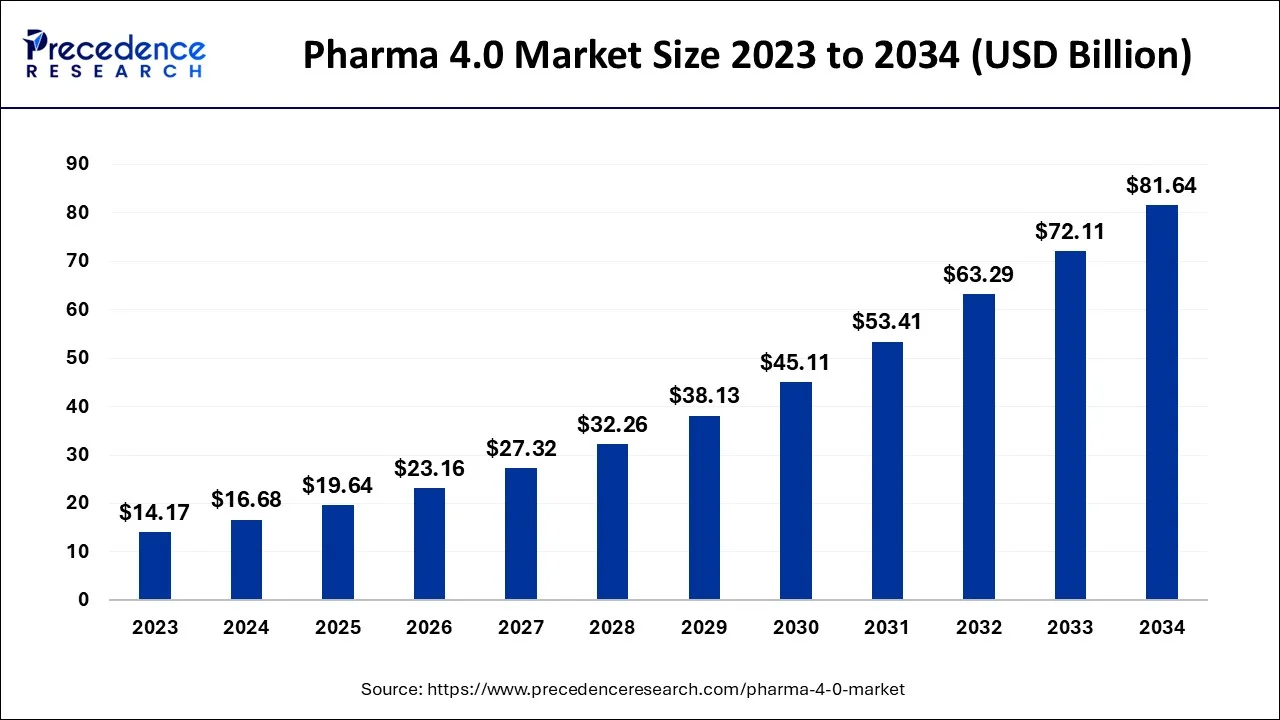
The global pharma 4.0 market size is projected to grow from USD 19.64 billion in 2025 to approximately USD 81.20 billion by 2034, expanding at a CAGR of 19.20% during the forecast period. This rapid growth is fueled by increasing adoption of artificial intelligence (AI), automation, and smart manufacturing technologies across the pharmaceutical and biotechnology industries.
Pharma 4.0 often referred to as the digital transformation of pharma manufacturing and R&D, represents a paradigm shift, enhancing efficiency, accelerating drug discovery, and ensuring regulatory compliance through connected, data-driven systems.
Pharma 4.0 Market Highlights:
- In terms of revenue, the pharma 4.0 market is valued at 19.64 billion in 2025.
- It is projected to reach 81.20 billion by 2034.
- The market is expected to grow at a CAGR of 19.20% from 2025 to 2034.
- North America dominated the market with the highest market share of 35.29% in 2024.
- Asia Pacific is expected to witness significant growth in the market during the predicted timeframe.
- By technology, the artificial intelligence segment is anticipated to show considerable growth in the market over the forecast period.
- By application, the drug discovery and development segment is anticipated to show considerable growth in the market over the forecast period.
- By end-user, the biotechnology companies segment is anticipated to show considerable growth in the market over the forecast period.
Pharma 4.0 Market Size Analysis (USD Million) 2021 to 2024
Global Pharma 4.0 Market Revenue, By Technology, 2022-2024 (USD Million)
| Technology | 2022 | 2023 | 2024 |
| Cloud Computing | 1,454.69 | 1,715.70 | 2,025.25 |
| Artificial Intelligence (AI) | 3,367.26 | 3,955.60 | 4,650.64 |
| Big Data Analytics | 1,829.26 | 2,163.93 | 2,561.98 |
| Internet of Things (IoT) | 5,398.80 | 6,334.37 | 7,438.17 |
Global Pharma 4.0 Market Revenue, By Application, 2022-2024 (USD Million)
| Application | 2022 | 2023 | 2024 |
| Drug Discovery and Development | 3,401.05 | 4,015.29 | 4,744.45 |
| Clinical Trials | 2,052.60 | 2,416.06 | 2,846.28 |
| Manufacturing | 6,596.35 | 7,738.24 | 9,085.30 |
Global Pharma 4.0 Market Revenue, By End-User, 2022-2024 (USD Million)
| End User | 2022 | 2023 | 2024 |
| Pharmaceutical Companies | 6,228.46 | 7,302.07 | 8,567.95 |
| Biotechnology Companies | 4,113.40 | 4,846.63 | 5,715.35 |
| CROs and CMOs | 1,708.14 | 2,020.89 | 2,392.74 |
The Full Study is Readily Available | Download the Sample Pages of this Report@ https://www.precedenceresearch.com/checkout/3187
Why is the Pharma 4.0 Market Important?
Pharma 4.0 signifies the pharmaceutical industry’s shift toward digitization, automation, and real-time analytics. In an era where drug development cycles are long and costly, this transformation brings speed, efficiency, and reliability.
The adoption of smart factories, digital twins, IoT-enabled monitoring, and AI-powered analytics is enabling pharma companies to minimize errors, improve compliance, and deliver personalized therapies more effectively. As regulatory authorities, including the U.S. FDA, embrace digital frameworks, the integration of Pharma 4.0 becomes essential for maintaining competitiveness and innovation.
What is Driving Market Growth?
One of the strongest growth drivers is the integration of artificial intelligence into drug discovery and development. By processing massive datasets, AI tools are able to identify promising compounds, predict biological activity, and shorten discovery timelines that once took years. Automation in manufacturing also plays a critical role, where AI reduces human involvement, improves precision, and ensures consistency in output.
The broader digital transformation of pharmaceutical manufacturing is another key factor. Industry 4.0 principles such as robotics, predictive maintenance, and cloud computing are being applied to create “smart factories” with connected, autonomous systems that minimize downtime and maximize efficiency. Big data analytics further enhances this ecosystem by providing real-time insights into production quality, supply chain performance, and patient outcomes.
Another major driver is the rising demand for biologics, cell and gene therapies, and other advanced treatments that require highly adaptive manufacturing systems. Pharma 4.0 technologies provide the agility and scalability needed to produce these therapies efficiently. Together, these drivers are pushing the market toward widespread adoption of next-generation digital solutions
What are the Benefits of Pharma 4.0?
The benefits of pharma 4.0 can be summarized through improvements in speed, efficiency, quality, scalability, and collaboration. By leveraging AI and automation, companies are able to significantly reduce the time required for drug development, enabling faster entry into the market. Efficiency is enhanced as smart manufacturing minimizes waste, optimizes resource use, and reduces downtime.
Quality standards also improve under pharma 4.0, as real-time monitoring systems ensure strict regulatory compliance and reduce the risk of errors. Scalability is another advantage, with flexible systems able to adapt quickly to the production of biologics and personalized therapies. Collaboration is strengthened through cloud-based platforms that allow global research teams, contract research organizations (CROs), and manufacturers to share data seamlessly, accelerating the pace of innovation across the value chain.
What Challenges Exist?
Despite its promise, the adoption of pharma 4.0 is not without challenges. High installation and maintenance costs represent a major barrier, particularly for small and mid-sized pharmaceutical companies that may lack the resources for large-scale digital transformation. Skilled labor is another obstacle, as managing AI-driven platforms, robotics, and advanced analytics requires significant workforce training.
Regulatory complexity also poses a challenge, as harmonizing global frameworks for AI-enabled processes is still in progress. While regulators such as the FDA are supportive, ensuring safety and adherence remains paramount. Additionally, the shift toward digital platforms increases exposure to cybersecurity threats, raising concerns around data integrity and intellectual property protection. These challenges highlight the need for phased adoption strategies, strong partnerships, and government incentives to ensure broader implementation.
The Future Outlook
Looking ahead, the pharma 4.0 market is set to evolve from early adoption toward industry-wide standardization by 2034. The integration of blockchain into supply chains will improve transparency and traceability, while digital twins will enable manufacturers to simulate production processes in virtual environments before physical deployment. IoT-enabled predictive maintenance will further reduce costs and improve reliability, ensuring continuous improvement across operations.
By the next decade, fully automated, AI-driven pharmaceutical ecosystems are expected to be commonplace. These advancements will not only speed up drug discovery but also make personalized medicine more accessible, transforming the industry into one that is more connected, efficient, and patient-centric.
Pharma 4.0 Market Scope
| Report Coverage | Details |
| Market Size in 2025 | USD 19.64 Billion |
| Market Size in 2024 | USD 16.68 Billion |
| Market Size by 2034 | USD 81.20 Billion |
| Growth Rate from 2025 to 2034 | CAGR of 19.20% |
| Largest Market | North America |
| Base Year | 2024 |
| Forecast Period | 2025 to 2034 |
| Segments Covered | Technology, Application, End-User, and Region |
| Regions Covered | North America, Europe, Asia-Pacific, Latin America, and Middle East & Africa |
Regional Insights
Why Did North America Dominate the Pharma 4.0 Market in 2024?
North America continues to dominate the global pharma 4.0 market, holding a 35.29% share in 2024. The region’s leadership is driven by its strong technological infrastructure, well-established pharmaceutical industry, and high levels of investment in R&D. Pharmaceutical companies in the region have been among the earliest adopters of automation, AI, and smart manufacturing systems. With regulators such as the U.S. Food and Drug Administration (FDA) actively encouraging the integration of digital frameworks, companies across the region are finding it easier to incorporate next-generation technologies while remaining compliant with regulatory standards.
United States: A Digital Transformation Powerhouse
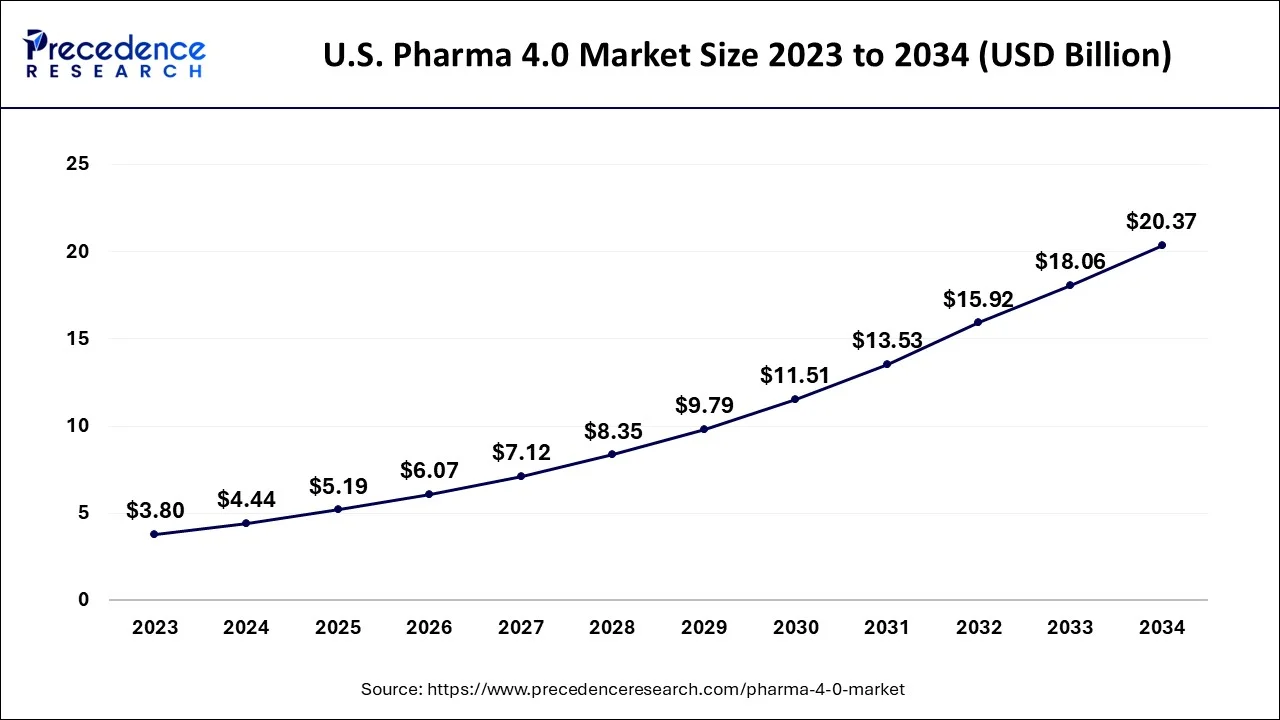
Within North America, the United States stands out as the primary driver of market growth. Valued at USD 4.44 billion in 2024, the U.S. pharma 4.0 market is forecast to reach USD 20.14 billion by 2034, expanding at a CAGR of 16.30%. The country’s leadership is underpinned by a combination of advanced digital infrastructure, a strong biotechnology sector, and a favorable regulatory environment.
Why Is Asia-Pacific the Fastest-Growing Region in the Pharma 4.0 Market?
Asia-Pacific, however, is expected to witness the fastest growth. Countries like China, India, Japan, and South Korea are embracing digital transformation to modernize their pharmaceutical sectors. Government-backed reforms in China, combined with its vast patient base and rising demand for personalized medicine, are accelerating the adoption of pharma 4.0. Similarly, India’s growing biotech sector and strong R&D base position the region as a future hub for digital pharma innovation.
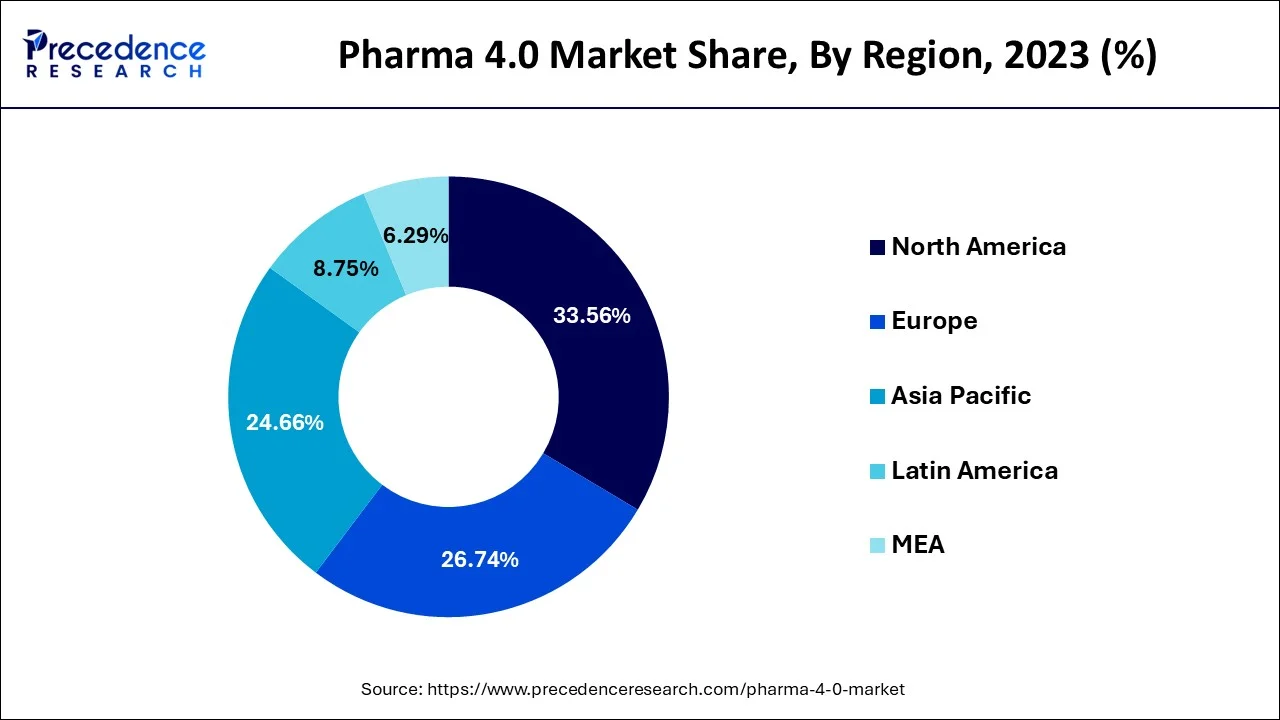
Europe remains a strong market as well, with Germany leading adoption through government support, advanced regulatory reforms, and the growing use of AI and blockchain in clinical trials and drug supply chains. Latin America and the Middle East & Africa are in earlier stages of adoption but are beginning to leverage localized production and international partnerships to move toward pharma 4.0 standards.
Segmentation Analysis
- By technology, artificial intelligence is the fastest-growing segment, driven by its applications in predictive modeling, drug discovery, and generative AI for novel formulations. Cloud computing and big data analytics also play vital roles in enabling real-time collaboration and decision-making, while IoT continues to enhance monitoring and predictive maintenance in smart factories.
- By application, drug discovery and development leads the market, as companies increasingly invest in AI-powered platforms to accelerate R&D. Clinical trials and manufacturing are also evolving rapidly, benefiting from cloud platforms and automation.
- By end-user, biotechnology companies represent the fastest-growing segment, adopting pharma 4.0 to handle the complexity of biologics, cell and gene therapies, and personalized medicine. Pharmaceutical companies remain significant contributors, while contract research and manufacturing organizations (CROs and CMOs) are embracing digital platforms to support flexible and scalable production.
Competitive Landscape
Key Players
-
Microsoft Corporation
-
Oracle Corporation
-
ABB
-
Honeywell International Inc.
-
Cisco Systems, Inc.
-
Siemens Healthcare GmbH
-
GE Healthcare
-
IBM Corporation
-
Amazon Web Services, Inc.
Market Dynamics by Player Tier
-
Top-Tier Players: Microsoft, IBM, Siemens — driving AI, cloud, and automation integration.
-
Mid-Tier Players: ABB, Honeywell — focusing on smart manufacturing solutions.
-
Low-Tier & Niche Players: Specialized AI startups partnering with pharma giants for drug discovery platforms.
Ecosystem Dynamics
-
R&D and Innovation: Pharma 4.0 enables faster drug discovery pipelines through AI and big data analytics.
-
Access & Affordability: Digital transformation lowers operational costs, improving access to therapies.
-
Distribution Trends: Blockchain and IoT improve traceability and supply chain transparency.
-
Digital Health Integration: Cloud platforms support remote monitoring, decentralized trials, and global data sharing.
Recent Developments
-
March 2025 – Caliber launched four digital solutions (CalGenie, CaliberMetrix, CaliberPulse, CalWare360) to strengthen its Pharma 4.0 portfolio.
-
February 2025 – Betacom & Siemens Industries introduced a secure 5G network hub at MxD, accelerating connected manufacturing.
-
May 2024 – Sanofi partnered with Formation Bio and OpenAI to apply AI for faster drug development across the entire lifecycle.
For inquiries regarding discounts, bulk purchases, or customization requests, please contact us at sales@precedenceresearch.com

- ESG Software Market 2025: Comprehensive Key Players Ecosystem and Revenue Outlook - May 20, 2026
- ESG Software Market Worth Around USD 31.96 Billion by 2035 - May 20, 2026
- Hematopoietic Stem Cell Transplantation Market Size to Attain USD 24.32 Billion by 2035 as Precision Medicine and AI Reshape Blood Cancer Treatment - May 20, 2026
