
Healthcare Quality Management Market Size to USD 4.39 Billion by 2034
Innovation, AI, and Regulatory Drivers Accelerate Healthcare’s Quest for Safer, Data-Driven Patient Outcomes through QMS Platforms
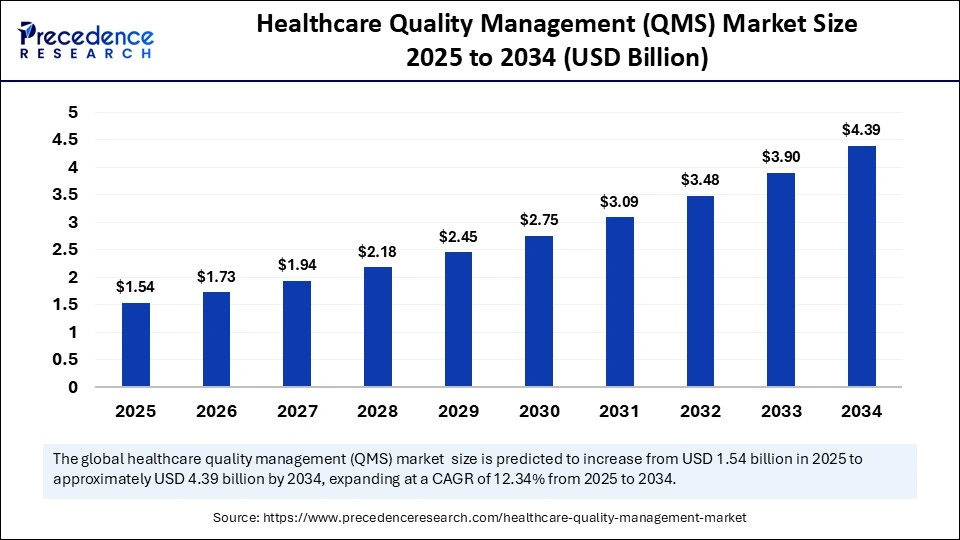
The global Healthcare Quality Management market is poised to leap from USD 1.54 billion in 2025 to a projected USD 4.39 billion by 2034, expanding at a robust CAGR of 12.34%. North America continues to command nearly 40% market share, while Asia Pacific emerges as the fastest-growing region, driven by regulatory initiatives, digital transformation, and AI-powered quality management.
Precision and Compliance Fuel Rapid Expansion
Healthcare organizations face mounting pressure to drive improvements in patient safety, regulatory compliance, and operational efficiency amid growing volumes of health data and heightened patient expectations. According to analysts at Precedence Research, these demanding dynamics are turbocharging the adoption of digital QMS solutions that blend automation, multi-source data integration, and cloud deployment to modernize quality management across care delivery and life sciences.
Healthcare Quality Management Market Key Insights
-
Global market size: Estimated at USD 1.54 billion in 2025, forecast to hit USD 4.39 billion by 2034.
-
CAGR (2025–2034): 12.34% over the period.
-
Top region: North America leads with 39.4% market share; U.S. alone surpasses USD 450 billion in 2025.
-
Fastest-growing region: Asia Pacific, propelled by digital health investments and evolving accreditation norms.
-
Leading component: Software/solutions command 68.4% of the market, while services are growing rapidly.
-
Most popular deployment: Cloud-based QMS holds a 52.7% share due to scalability and cost efficiency.
-
Key functionality: Document management (20.8%) leads applications; performance analytics and AI predictive compliance are fastest-rising.
-
Top end user: Hospitals represent 41.6% of the QMS market, with biopharma gaining traction.
-
Powerful tech integration: AI & predictive analytics account for 26.9% of the 2024 market.
How Is AI Transforming Healthcare Quality Management?
Artificial intelligence is radically reshaping QMS platforms by allowing healthcare providers to move from reactive audit-based assurance to proactive, data-driven intervention. With over 1,000 AI-enabled medical devices now cleared for use and the FDA itself deploying AI for scientific review, regulatory confidence in AI-driven tools is on the rise.
Modern QMS platforms leverage machine learning to automate compliance tracking, risk prediction, and real-time alerting. In 2025, collaborations like the Cleveland Clinic and AKASA’s generative AI project and the Oracle Health-led AI platform in the UAE exemplify how generative technologies are driving efficient coding, robust health management, and enhanced audit trails ushering in a new era of intelligent, continuous quality assurance.
What Forces Are Accelerating Market Growth?
-
Regulatory Mandates: Stricter standards and rising incidence of avoidable patient harm underscore QMS as essential, with WHO data showing that half of adverse events could be prevented through better quality controls.
-
Digital Transformation: EHR integration, cloud-first deployments, and connected hospital systems fuel the need for advanced QMS for performance optimization and compliance.
-
Patient-Centered Culture: Modern QMS solutions incorporate patient-reported outcomes and engagement metrics, ensuring that safety and satisfaction are at the heart of quality initiatives.
-
Value-based Care: Government and payer-led quality measurement and reimbursement standards require robust tracking, analytics, and documentation areas in which QMS platforms excel.
Healthcare Quality Management Market Scope
| Report Coverage | Details |
| Market Size in 2025 | USD 1.54 Billion |
| Market Size in 2026 | USD 1.73 Billion |
| Market Size by 2034 | USD 4.39 Billion |
| Market Growth Rate from 2025 to 2034 | CAGR of 12.34% |
| Dominating Region | North America |
| Fastest Growing Region | Asia Pacific |
| Base Year | 2025 |
| Forecast Period | 2025 to 2034 |
| Segments Covered | Component, Deployment Mode, Functionality/Application, End Use Industry, Technology and Region |
| Regions Covered | North America, Europe, Asia-Pacific, Latin America, and Middle East & Africa |
How Are Market Opportunities and Trends Evolving?
Is Patient Experience Becoming Central to Quality Management?
Today’s QMS platforms put patient satisfaction, outcome tracking, and feedback loops front and center, helping health systems tailor care and boost engagement as never before.
Can Cloud and AI Overcome Scalability Challenges?
Cloud-native QMS platforms are rapidly gaining favor for their flexibility, cost savings, and support for distributed yet unified quality oversight. AI modules now offer predictive analytics and anomaly detection that can scale across vast hospital networks or life sciences enterprises.
Is Interoperability the Next Market Breakthrough?
Integration across hospital IT, medical devices, EHRs, and even supply chain systems is propelling QMS to become the operational backbone for quality and compliance with FHIR and HL7-certified interoperability fast becoming the norm.
Healthcare Quality Management Market Regional and Segmentation Analysis
North America: Maintains leadership due to regulatory pressure, payer incentives, and industry digitalization. Notable U.S. trends include the FDA’s quality mandates, Joint Commission signals, and large-scale investment in incident workflow and compliance automation.
Asia Pacific: Fastest-growing region driven by digital health programs, accreditation policies, and massive hospital modernization from India’s NABH-certified digital hospitals to large-scale health-IT platforms across China and Southeast Asia.
Europe: Prioritizes traceability, post-market surveillance, and compliance with EU MDR/IVDR, pushing device firms to streamline technical documentation through enterprise QMS adoption—especially in Germany’s booming medtech sector.
Middle East & Africa: Modernization of health licensing and digital quality standards is underway, with the UAE leading via unified credentialing and national health information platforms.
Revenue by Region (2025–2034)
| Region | 2025 Value (USD Bn) | 2034 Value (USD Bn) | CAGR (%) |
|---|---|---|---|
| North America | 0.61 | 1.73 | 12.36 |
| U.S. | 0.46 | 1.31 | 12.44 |
| Asia Pacific | Leading CAGR | Fastest Growth | Highest |
Segmentation by Component, Deployment, Function, End User, and Technology
-
Component: Software dominates (68.4%), with managed services and system integration growing swiftly to support adoption and customization.
-
Deployment: Cloud-based (52.7%) is preferred for its real-time collaboration capabilities, followed by hybrid models that combine security and scalability. On-premise remains key where regulatory and data sovereignty needs preclude cloud.
-
Function: Document management leads (20.8%), while performance analytics and risk management tools quickly gain ground, helping organizations move toward continuous improvement and predictive compliance.
-
End User: Hospitals drive the largest share (41.6%), as accountability and accreditation needs skyrocket, followed by biopharma and ambulatory care networks looking for scalable, streamlined solutions.
-
Technology: AI & predictive analytics fuel 26.9% of the market, blockchain emerges for secure traceability and audit compliance, and machine learning for risk prediction is the fastest-growing tech pillar.
Latest Breakthroughs and Leading Players
Recent Innovations:
-
In March 2025, Authenticx launched an AI solution for automated contact center quality management.
-
September 2025: India released a rapid RT-PCR Mpox kit, Siemens Healthineers, Vadodara.
-
March 2025: Philips and Ibex released IntelliSite Pathology 6.0 with AI-powered pathology for boosted diagnostic accuracy.
Enlisted Key Companies:
-
MorCare LLC: U.S.-centric QMS and analytics provider, specializing in AI-powered platforms for hospitals.
-
Karminn Consultancy Network: Dubai-based specialist in healthcare accreditation and digital quality audit platforms.
-
Intelex Technologies, Effivity, Okkala Solutions, MEG, Premier Inc., Qualityze Inc., OdiTek Solutions, Ideagen.
What Challenges and Cost Pressures Are Emerging?
The pace of QMS adoption is throttled by steep upfront and subscription costs, technical integration demands, and organizational resistance to workflow change issues mirrored most starkly in smaller or digitally immature providers. Data privacy, regulatory fragmentation, and the pressure to demonstrate rapid ROI can slow procurement and wider rollout, especially across developing markets.
Case Study
Driving Patient Safety Through Predictive Analytics:
A major U.S. hospital system deployed MorCare’s QMS platform to link incident reporting, real-time risk analytics, and credentialing into a unified dashboard. Within the first year, it recorded a 30% reduction in medication errors and achieved expedited accreditation—demonstrating the concrete impact of intelligent quality management in action.
Get this report to explore global market size, share, CAGR, and trends, featuring detailed segmental analysis and an insightful competitive landscape overview @ https://www.precedenceresearch.com/sample/7106
You can place an order or ask any questions. Please feel free to contact us at sales@precedenceresearch.com |+1 804 441 9344

- ESG Software Market 2025: Comprehensive Key Players Ecosystem and Revenue Outlook - May 20, 2026
- ESG Software Market Worth Around USD 31.96 Billion by 2035 - May 20, 2026
- Hematopoietic Stem Cell Transplantation Market Size to Attain USD 24.32 Billion by 2035 as Precision Medicine and AI Reshape Blood Cancer Treatment - May 20, 2026
