
Load Forecasting Solution Market Set to Reach a Significant Valuation with Robust CAGR Through 2034
Advancements in AI and Machine Learning Drive Precision in Energy Demand Forecasting and Grid Management
The global load forecasting solution market is projected to experience rapid growth with a strong CAGR of approximately 20% from 2025 to 2034, driven by the increasing need for precise energy demand forecasting to enhance grid stability and operational efficiency.
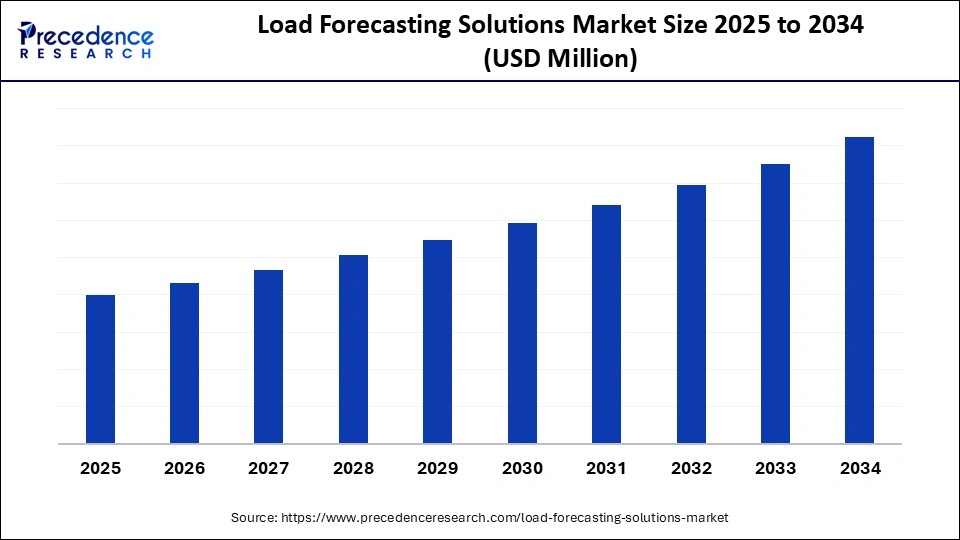
The integration of AI, machine learning, and digital twin technologies is revolutionizing load forecasting, enabling utilities and energy providers to optimize power distribution, incorporate renewable energy sources effectively, and manage growing electricity demand with greater accuracy. North America dominates the market as the largest regional player, while the Asia Pacific region emerges as the fastest-growing market due to significant investments in smart grid infrastructure and renewable energy projects.
Load Forecasting Solution Market Key Insights
-
The load forecasting solution market commanded a major share, with North America holding 54% in 2024.
-
Asia Pacific is anticipated to expand at a remarkable CAGR of 23% between 2025 and 2034.
-
Short-term load forecasting accounted for 50% of the market share in 2024.
-
Machine learning and deep learning modeling approaches contributed 44% market share in 2024, with hybrid physics-informed and ML models growing at 21% CAGR.
-
Real-time operations represent the largest use-case segment, capturing 40% of the market in 2024.
-
Electric vehicle (EV) and electrification impact modeling is the fastest-growing use-case segment, with a 24% CAGR forecast.
-
Direct enterprise sales constitute 60% of the distribution channel market share, while cloud marketplaces are growing at 22% CAGR.
-
Key companies shaping the market include ABB, Schneider Electric, GE Vernova, Oracle Utilities, IBM Watson, Siemens, and Hitachi Energy.
AI’s Role in Market Transformation
Artificial intelligence and machine learning are pivotal in advancing load forecasting solutions. AI-driven platforms analyze vast datasets, including weather patterns, consumption trends, and renewable energy outputs, to produce highly accurate short- and medium-term load forecasts. The incorporation of hybrid models that combine physical grid dynamics with AI techniques enhances prediction reliability and adapts to the changing complexities of modern power grids. These advancements not only improve operational efficiency but also facilitate the management of decentralized energy resources and distributed energy generation, positioning AI as a critical enabler of smart grid evolution.
Load Forecasting Solution Market Growth Factors
The load forecasting solution market is propelled by several key factors:
-
Growing adoption of renewable energy sources necessitating precise forecasting to balance intermittency.
-
Expansion of smart grids and digital twins that support real-time grid management and automation.
-
Increasing electrification and rapid EV adoption driving new load patterns and necessitating advanced modeling.
-
Demand for scalable cloud-based forecasting solutions facilitating faster deployment and enhanced data analytics.
-
Government policies and sustainability initiatives promoting clean energy integration and grid modernization.
What Emerging Opportunities Are Driving the Load Forecasting Solution Market?
Emerging trends such as AI-powered hybrid forecasting integrate machine learning with conventional physics-based models to boost prediction accuracy. Additionally, the rise of EV charging infrastructure presents a unique opportunity for forecasting solutions to optimize power distribution and manage peak loads efficiently. Cloud-based platforms are accelerating market growth by enabling energy providers to deploy flexible, scalable solutions that cater to dynamic grid conditions. Moreover, probabilistic forecasting techniques are gaining traction to provide risk-adjusted insights, helping utilities minimize uncertainties related to variable renewable generation and demand fluctuations.
Load Forecasting Solution Market Regional and Segmentation Insights
North America remains the largest market due to advanced grid infrastructure and early adoption of AI-based forecasting tools.
The Asia Pacific region, led by China, Japan, and India, is the fastest growing with significant investments in renewables and smart grid projects.
The market segments by solution type highlight the dominance of short-term load forecasting, while integrated load and distributed energy resource (DER) forecasting solutions are rising swiftly.
Machine learning and hybrid modeling approaches lead the technological landscape, and real-time operational applications hold the highest market share among use cases. Distribution channels favor direct enterprise sales, but cloud and API-based deployments are rapidly expanding.
Latest Breakthroughs and Market Leaders
ABB sets a benchmark with its AI-based OptiGrid Forecasting Platform leveraging digital twin technology for real-time grid simulation and forecasting. Schneider Electric provides integrated energy management platforms like EcoStruxure Grid, enhancing forecasting and grid automation. GE Vernova delivers precise load analytics for utilities. Oracle Utilities and IBM Watson are also key players incorporating cloud analytics and AI for electricity demand prediction. Other notable companies include Siemens, Hitachi Energy, and emerging startups such as Amperon and Sensewaves that contribute innovative machine learning-driven solutions.
Challenges and Cost Pressures
Despite robust growth, the market faces challenges such as high initial investment costs for advanced forecasting technologies and integration complexities with legacy grid systems. Ensuring data security and managing the diversity of data sources for accurate modeling pose additional pressures. Furthermore, grid operators must balance cost-effectiveness with the demand for increasingly sophisticated, real-time AI-enabled forecasting tools amidst rising cyber threats.
Case Study: ABB’s Digital Energy Twin Technology
In 2025, ABB introduced its OptiGrid Forecasting Platform that fuses AI-driven machine learning with digital twin simulations to enhance load forecasting accuracy. By integrating multiple data sources—weather, consumption, renewable generation—the platform reduced forecasting errors by over 20% and increased grid stability. This innovation not only boosted operational automation but also paved the way for enhanced smart grid management, positioning ABB as a market pioneer in next-generation load forecasting technologies.
Get this report to explore global market size, share, CAGR, and trends, featuring detailed segmental analysis and an insightful competitive landscape overview @ https://www.precedenceresearch.com/sample/7138
You can place an order or ask any questions. Please feel free to contact us at sales@precedenceresearch.com |+1 804 441 9344

- ESG Software Market 2025: Comprehensive Key Players Ecosystem and Revenue Outlook - May 20, 2026
- ESG Software Market Worth Around USD 31.96 Billion by 2035 - May 20, 2026
- Hematopoietic Stem Cell Transplantation Market Size to Attain USD 24.32 Billion by 2035 as Precision Medicine and AI Reshape Blood Cancer Treatment - May 20, 2026
