
Aluminum Market Size to Surpass USD 400 Billion by 2034
Rising Demand from Automotive, Construction, and Renewable Energy Sectors to Propel Market Growth at a Notable CAGR
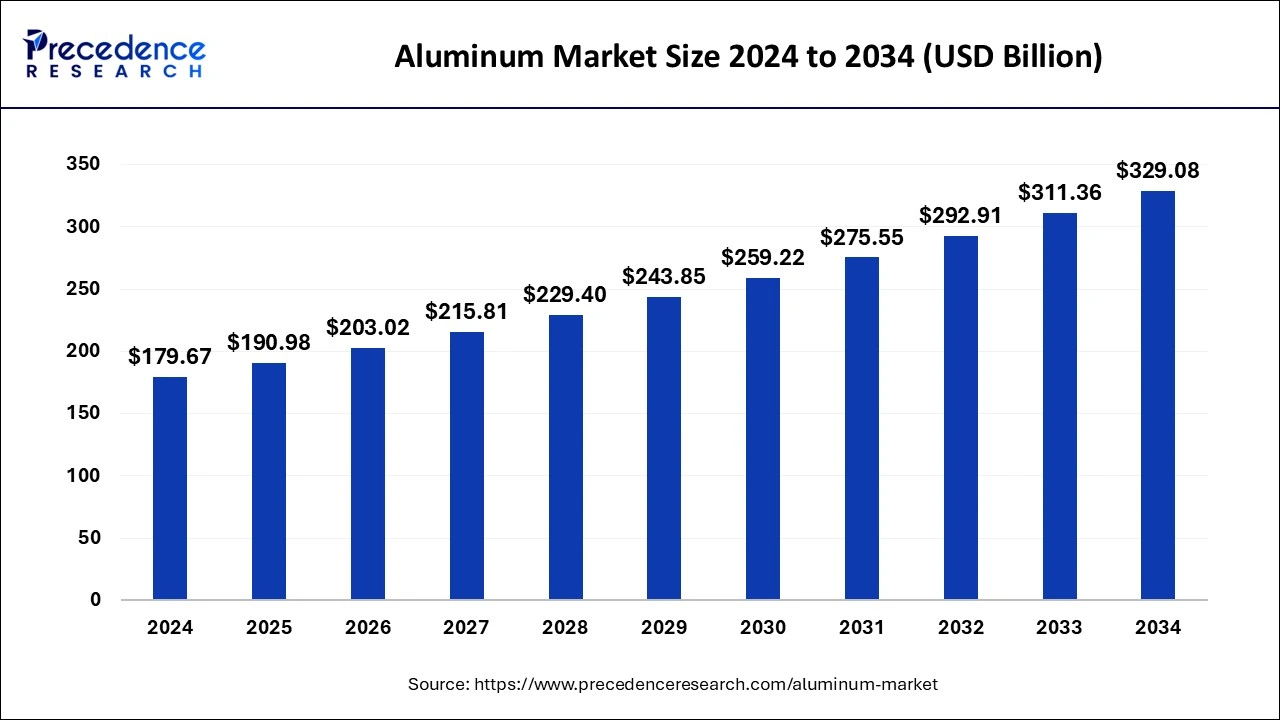
The global aluminum market is witnessing robust expansion, fueled by accelerating industrialization, rising demand for lightweight materials, and increasing emphasis on sustainability. The market is projected to grow at a significant CAGR over the forecast period, reaching an estimated valuation exceeding USD 400 billion by 2034. The surge in infrastructure projects, coupled with rapid electrification in the automotive sector, continues to serve as a primary growth catalyst.
Aluminum’s recyclability, corrosion resistance, and lightweight properties make it a critical material across industries, including transportation, construction, packaging, and electrical applications. Governments worldwide are increasingly supporting green building initiatives and renewable energy projects, further boosting demand.
Key Market Highlights
The aluminum market is expected to grow at a steady CAGR throughout the forecast period, driven by industrial and infrastructure expansion.
Asia Pacific dominates the global market due to strong manufacturing activity and urbanization.
The automotive and transportation segment remains the leading consumer of aluminum due to lightweighting trends.
Secondary (recycled) aluminum production is gaining significant traction due to sustainability initiatives.
Major players are investing heavily in green aluminum production technologies and capacity expansion.
Revenue Insights and Market Breakdown
The aluminum market revenue is segmented based on product type, application, and region. Primary aluminum continues to account for a significant revenue share due to its widespread use in structural and industrial applications. However, secondary aluminum is witnessing faster growth owing to lower energy consumption and environmental benefits.
By application, the transportation segment leads the market, followed by building & construction and packaging industries. Increasing use of aluminum in electric vehicles (EVs) and aerospace manufacturing is further strengthening its revenue contribution.
How is Artificial Intelligence Transforming the Aluminum Market?
Artificial intelligence is playing an increasingly vital role in optimizing aluminum production processes. AI-driven predictive maintenance systems help reduce downtime in smelting plants, while advanced analytics improve energy efficiency—one of the most critical cost components in aluminum manufacturing.
Moreover, AI-enabled supply chain optimization is allowing companies to forecast demand more accurately, manage inventory efficiently, and reduce waste. Smart manufacturing powered by AI is expected to significantly enhance productivity and sustainability across the aluminum value chain.
What Are the Key Growth Drivers Shaping the Aluminum Market?
The aluminum market is primarily driven by the growing demand for lightweight materials in the automotive sector. Automakers are increasingly adopting aluminum to improve fuel efficiency and reduce emissions, especially in electric vehicles.
Additionally, rapid urbanization and infrastructure development in emerging economies are fueling demand for aluminum in construction. The expansion of renewable energy installations, such as solar panels and wind turbines, is also contributing to market growth, as aluminum is widely used in these systems.
Market Scope
| Report Coverage | Details |
| Market Size in 2025 | USD 190.98 Billion |
| Market Size in 2026 | USD 203.02 Billion |
| Market Size by 2035 | USD 347.29 Billion |
| Growth Rate from 2026 to 2035 | CAGR of 6.24% |
| Base Year | 2025 |
| Forecast Period | 2026 to 2035 |
| Segments Covered | Series, Type, Processing Method, End-Use Industry, and Region |
| Regions Covered | North America, Europe, Asia-Pacific, Latin America, and Middle East & Africa |
What Opportunities and Trends Are Emerging in the Aluminum Market?
Is Green Aluminum the Future of Sustainable Manufacturing?
Yes, the shift toward low-carbon and green aluminum production is one of the most significant trends. Companies are investing in renewable energy-powered smelting processes to reduce carbon footprints.
How Is Recycling Reshaping Market Dynamics?
Recycling is becoming a cornerstone of the aluminum industry. Secondary aluminum production requires significantly less energy compared to primary production, making it both cost-effective and environmentally friendly.
Will Electric Vehicles Drive Long-Term Demand?
Absolutely. The rising adoption of EVs is expected to create sustained demand for aluminum due to its role in reducing vehicle weight and improving battery efficiency.
Aluminum Market Insights
Series Insights
The Series 1 aluminum category held the largest share of the global market and is expected to grow at the fastest rate in the coming years. This type of aluminum is widely used in everyday and industrial products such as foil, sheets, drawn tubes, chemical equipment, and household items like coffee pots, creamers, and utensils. Its versatility and usability across industries make it highly dominant.
Processing Method Insights
The extrusion segment accounted for about 31.5% of the market in 2025 and is expected to grow steadily. Extruded aluminum is increasingly used in:
Automotive radiators and air conditioning systems
Pipes and condensers
Nuclear equipment
Communication and sound systems
Its flexibility and strength make it suitable for a wide range of applications.
End-Use Industry Insights
The transportation sector dominated the aluminum market in 2025. This is mainly because aluminum is lightweight yet strong, making it ideal for vehicles. Automakers are using more aluminum to improve fuel efficiency and performance.
Key growth drivers include:
Rising global vehicle ownership
Expansion of automotive manufacturing
Infrastructure development in emerging economies
The packaging industry is also expected to grow rapidly due to aluminum’s non-permeable nature, which makes it ideal for preserving food and beverages.
Regional Insights
Asia Pacific
The Asia Pacific region leads the market and is growing the fastest. The market is expected to increase from USD 126.05 billion in 2025 to USD 231.41 billion by 2035, at a CAGR of 6.26%.
Growth is driven by:
Rapid industrialization and urbanization
Strong construction and automotive sectors
High demand from major countries like China, India, and Japan
China, in particular, has significantly increased its aluminum production, reaching 3.77 million tonnes in December 2024.
North America
Growth in North America is mainly driven by:
High demand from automotive and transportation industries
Increasing use of aluminum in electric vehicles (EVs) to reduce weight
Construction activity is also rising, supporting demand for aluminum.
Europe
Europe is expected to see strong growth due to:
Strict CO₂ emission regulations
Increasing adoption of electric vehicles
Demand from industries like solar energy and packaging
Countries like Germany, France, and the UK are key contributors. The region is also focusing on recycled and sustainable aluminum production.
However, Europe relies heavily on imports. In 2025:
Imports: €29.5 billion
Exports: €18.4 billion
Trade deficit: €11.1 billion
This gap is mainly due to high energy costs and increased aluminum prices.
Latin America
Latin America is growing steadily, supported by:
Expansion of automotive manufacturing
Demand for affordable and fuel-efficient vehicles
Strong trade ties with North America
Countries like Brazil and Mexico are leading the market. Brazil also has strong demand from the consumer electronics sector.
Middle East & Africa
This region is experiencing stable growth due to:
Infrastructure development
Rising vehicle imports
Growth in local manufacturing
Countries like the UAE and Saudi Arabia are key players, with a focus on industrial diversification and recycling technologies.
Supply Chain Overview
The aluminum supply chain includes three main stages:
Raw Material Sourcing
Aluminum production begins with mining bauxite ore, the primary raw material.
Manufacturing
Bauxite is refined and smelted into aluminum, which is then shaped into forms like ingots, billets, and slabs.
Distribution
Finished aluminum is supplied to industries such as:
Automotive
Construction
Packaging
Aerospace
Aluminum Market Companies
- Alcoa Corporation (U.S.)
- Aluminum Corporation of China Limited (CHALCO) (China)
- Century Aluminum Company (U.S.)
- China Hongqiao Group Limited
- China power investment corp. (cpi)
- China zhongwang holdings limited (china)
- Dubai Aluminum Company Limited (U.A.E)
- East Hope Group (China)
- Emirates Global Aluminium (UAE)
- H.P. (Australia)
- Hindalco Industries Ltd. (India)
- Kaiser Aluminium
- Norsk Hydro A.S.A. (Norway)
- Novelis (U.S.)
- Rio Tinto Ltd.
- United Company RUSAL Plc, (Russia)
- Vedanta Aluminium Limited (India)
- Xinfa group co. Ltd.
Segments Covered in the Report
By Series
- Series 1
- Series 2
- Series 3
- Series 4
- Series 5
- Series 6
- Series 7
- Series 8
By Type
- Primary
- Secondary
By Processing Method:
- Flat Rolled
- Castings
- Extrusions
- Forgings
- Pigments and Powder
- Rod and Bar
By End Use Industry:
- Automotive and Transportation
- Construction
- Packaging
- Electrical and Electronics
- Machinery and Equipment
- Consumer Goods
- Others
By Region
- North America
- Europe
- Asia-Pacific
- Latin America
- Middle East & Africa (MEA)
Get Sample Link: https://www.precedenceresearch.com/sample/2209
Also Read : https://www.marketstatsinsight.com/cosmetic-chemicals-market/

- Corporate Wellness Market Surges Toward USD 500.09 Billion by 2035 - April 22, 2026
- Portable Medical Devices Market Surges Toward USD 221.71 Billion by 2035 - April 22, 2026
- Infant Incubator Market Set to Surpass USD 3.27 Billion by 2035 - April 22, 2026