
AI in Medical Imaging Market Surges Toward USD 22.97 Trillion by 2035
What is the Digital Health Market Size in 2026?
The global AI in medical imaging market is entering a transformative growth phase, driven by the convergence of advanced algorithms, increasing imaging data volumes, and rising demand for precision diagnostics. According to Precedence Research insights, the market is projected to witness exponential expansion over the next decade, supported by a strong CAGR of around 34%, reaching nearly USD 19.78 billion by 2033, up from approximately USD 1.36 billion in 2024.
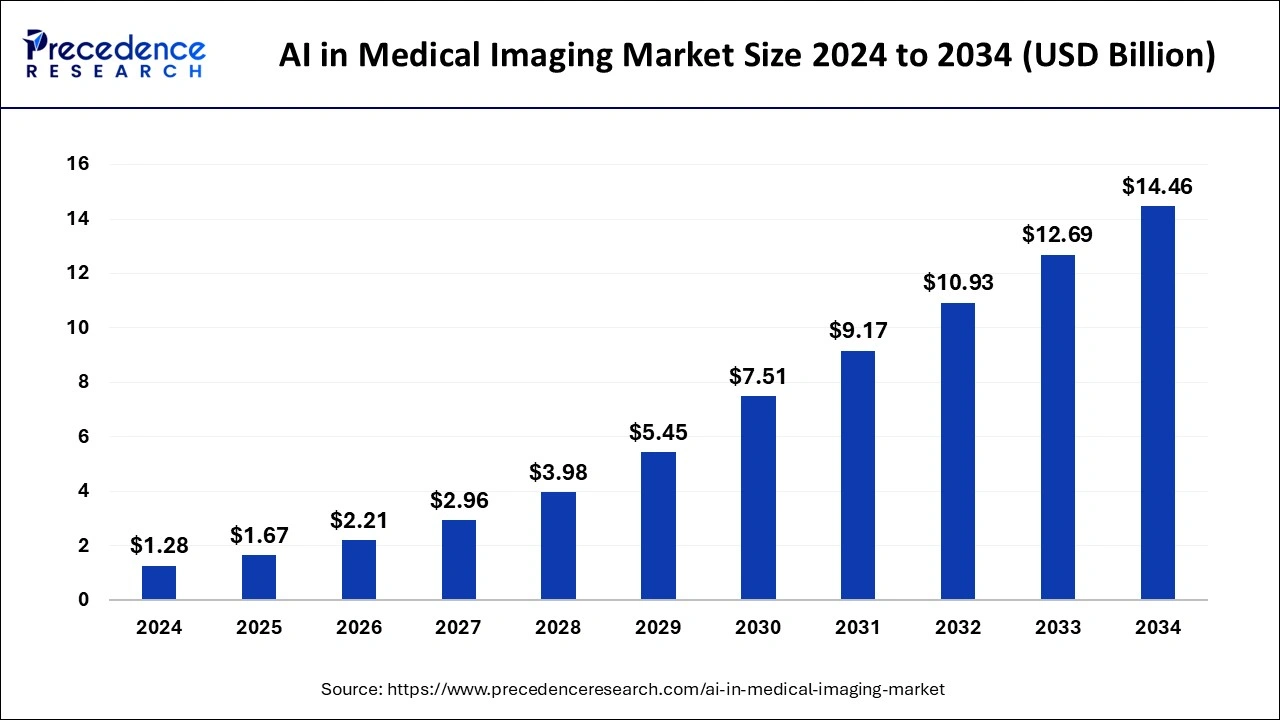
The surge is largely attributed to the growing need for early disease detection, increasing burden on radiologists, and rapid integration of AI technologies across healthcare infrastructures worldwide.
Quick Insights: What’s Driving the AI Imaging Revolution?
The global market was valued at over USD 1.3 billion in 2024 and is expected to grow exponentially through 2033.
North America dominates the global landscape due to strong healthcare IT infrastructure.
Asia Pacific is emerging as the fastest-growing region fueled by digital health expansion.
Deep learning technology accounts for the largest market share due to superior image analysis capabilities.
Hospitals remain the leading end-user segment owing to advanced imaging infrastructure.
Key players include GE HealthCare, Microsoft, Canon Medical Systems, NVIDIA, and Viz.ai.
How is AI Reshaping Medical Imaging Workflows?
Artificial intelligence is revolutionizing radiology by enabling faster, more accurate interpretation of complex imaging datasets. AI-powered tools can reduce radiology reporting time by up to 25%, significantly improving clinical efficiency and patient outcomes.
Moreover, AI systems are increasingly being integrated with cloud platforms and PACS (Picture Archiving and Communication Systems), enabling seamless data processing and real-time diagnostics.
What Role Does AI Play in This Market?
AI plays a foundational role in transforming medical imaging from a reactive diagnostic tool to a proactive clinical decision-making system. Advanced algorithms such as convolutional neural networks (CNNs) are capable of detecting anomalies such as tumors, fractures, and neurological disorders with remarkable precision.
Additionally, AI enhances workflow automation by triaging cases, prioritizing critical findings, and reducing human error. The integration of natural language processing (NLP) is also enabling simplified radiology reporting, making insights more accessible to clinicians and patients alike.
What Are the Key Growth Drivers Accelerating Market Expansion?
Rising Demand for Early and Accurate Diagnosis
Chronic diseases such as cancer and cardiovascular disorders require early detection, pushing healthcare providers toward AI-powered imaging solutions.
Explosion of Imaging Data
The growing volume of CT scans, MRIs, and X-rays is overwhelming radiologists, creating a strong need for AI-assisted interpretation.
Shortage of Skilled Radiologists
Healthcare systems worldwide face a talent gap, making AI a critical support tool for diagnostic efficiency.
Technological Advancements in Deep Learning
Continuous innovation in machine learning and neural networks is improving diagnostic accuracy and adoption rates.
AI in Medical Imaging Market Scope
| Report Coverage | Details |
| Market Size in 2025 | USD 2.01 Trillion |
| Market Size in 2026 | USD 2.57 Trillion |
| Market Size by 2035 | USD 22.97 Trillion |
| Growth Rate from 2026 to 2035 | CAGR of 27.57% |
| Base Year | 2025 |
| Forecast Period | 2026 to 2035 |
| Segments Covered | Clinical Area, Technology Type, Deployment Type, Imaging Modality, Functionality, Product Type, End User, and Region |
| Regions Covered | North America, Europe, Asia-Pacific, South America, and Middle East & Africa |
What Opportunities and Trends Are Shaping the Future of the Market?
Can AI Enable Fully Autonomous Imaging Systems?
Yes, emerging innovations such as autonomous X-ray and ultrasound systems are paving the way for minimal human intervention in diagnostics.
Is Telemedicine Driving AI Imaging Adoption?
Absolutely. The rise of remote diagnostics and telehealth platforms is accelerating AI deployment in imaging workflows.
Will AI Expand Beyond Radiology?
AI is increasingly being applied in oncology, cardiology, and pathology, broadening its clinical impact.
Segmental Insights
Clinical Area Insights
The lung and pulmonology segment held the largest share of the AI in medical imaging market in 2025, accounting for about 22%. This dominance is mainly due to the high number of chest imaging procedures conducted worldwide. The growing prevalence of respiratory diseases such as pneumonia, COPD, and tuberculosis has significantly increased the demand for AI-supported diagnostics.
Within this segment, non-cancer lung conditions contributed the most, as AI tools have improved early detection and helped clinicians make better decisions. The widespread use of chest X-rays and CT scans has also reinforced the leading position of this segment.
Meanwhile, the oncology segment is expected to grow at the fastest pace in the coming years. The increasing global burden of cancer and the need for early and precise diagnosis are major driving factors. AI technologies are increasingly being used for tumor detection, segmentation, and monitoring treatment progress. Advancements in precision medicine and personalized care are further accelerating this growth.
Technology Type Insights
Deep learning technologies dominated the market in 2025, with convolutional neural networks (CNNs) accounting for nearly 48% of the share. CNNs are highly effective for image recognition, classification, and segmentation tasks, making them a core component of medical imaging AI solutions. Their accuracy and reliability have made them the foundation for most applications in this field.
Among emerging technologies, explainable AI (XAI) is expected to grow the fastest. As healthcare professionals demand more transparency in clinical decision-making, XAI helps by making AI outputs easier to understand and trust. Additionally, increasing regulatory focus on ethical and accountable AI is boosting the adoption of explainable models.
Deployment Mode Insights
On-premise deployment led the market in 2025, holding around 58% of the share. Hospitals prefer on-site systems because they offer better control over sensitive patient data and ensure compliance with strict data security regulations. These systems also integrate more easily with existing hospital IT infrastructure.
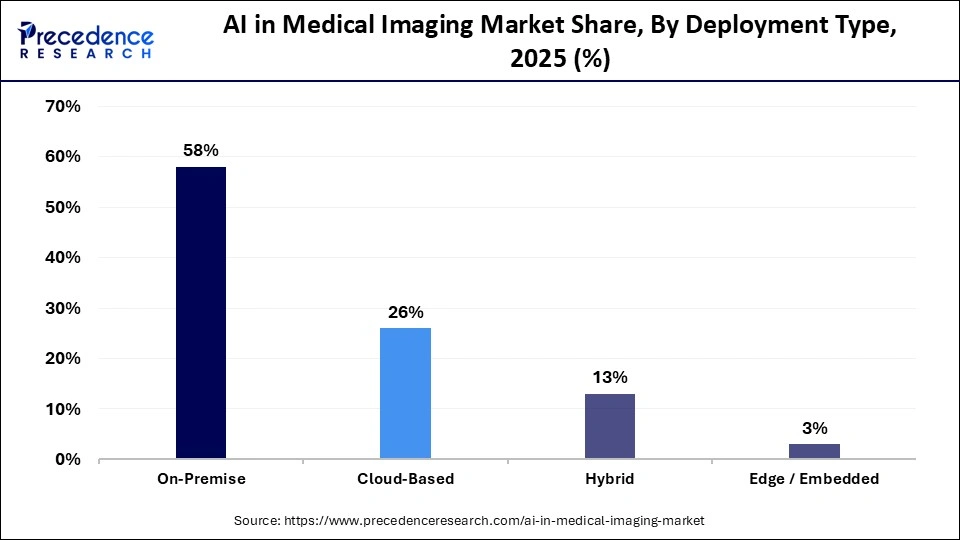
However, edge or embedded AI deployment is projected to grow at the fastest rate. This approach allows real-time image processing with minimal delay, enabling quicker clinical decisions. It is especially useful in emergency and critical care environments where time is crucial.
Imaging Modality Insights
CT scans dominated the market in 2025, capturing about 37% of the share. Their widespread use in diagnosing lung diseases, cancer, and trauma contributes to high imaging volumes. AI integration in CT imaging improves detection accuracy and enhances workflow efficiency, supporting its leading position.
On the other hand, MRI is expected to witness the fastest growth in the coming years. Its increasing use in neurology, oncology, and musculoskeletal imaging is driving demand. AI helps improve image quality, reduce scan time, and enhance diagnostic precision, further encouraging adoption.
Functionality Insights
Image analysis emerged as the leading functionality segment in 2025, accounting for around 51% of the market. It plays a central role in AI imaging by enabling detection, segmentation, and measurement of abnormalities. Healthcare providers increasingly rely on automated analysis to reduce workload and improve accuracy.
Product Type Insights
Software solutions dominated the market with a 77% share in 2025. Their ease of integration into existing systems, scalability, and ability to receive regular updates without requiring hardware changes make them highly attractive to healthcare providers.
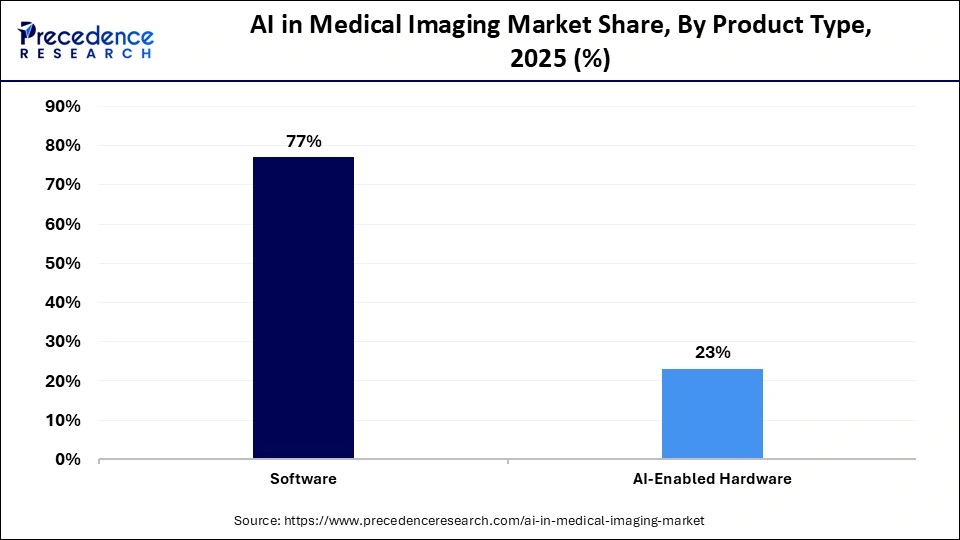
Meanwhile, AI-enabled hardware is expected to see notable growth. The integration of AI processors directly into imaging devices enables faster, real-time image analysis, driving demand for smarter imaging equipment.
End User Insights
Hospitals were the largest end users in 2025, accounting for about 65% of the market. Their high patient volumes, advanced infrastructure, and strong financial capabilities allow them to adopt AI technologies at scale. They use AI to improve diagnostic accuracy and streamline operations.
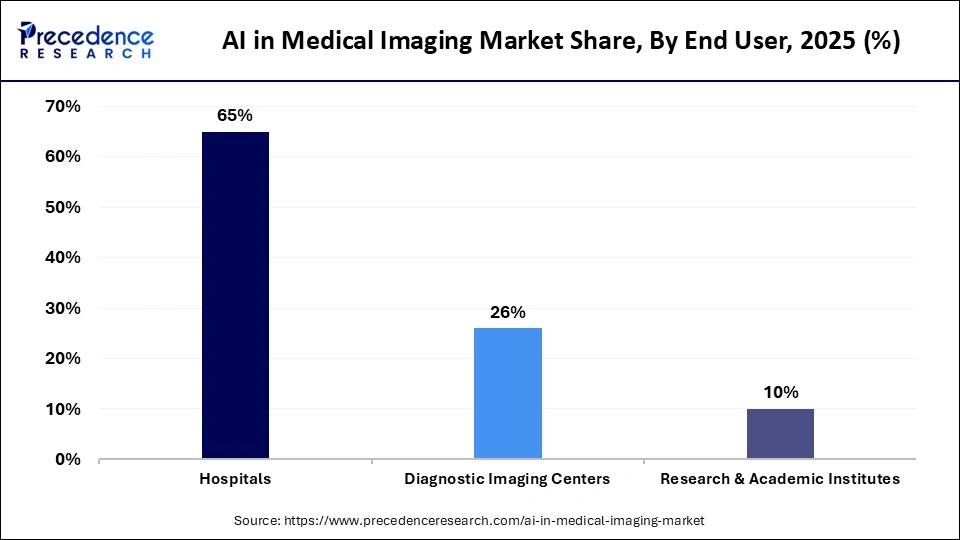
Diagnostic imaging centers are expected to grow the fastest. Increasing demand for outpatient and specialized imaging services is driving this trend. These centers are adopting AI to enhance efficiency, reduce turnaround times, and stay competitive.
Regional Insights
North America
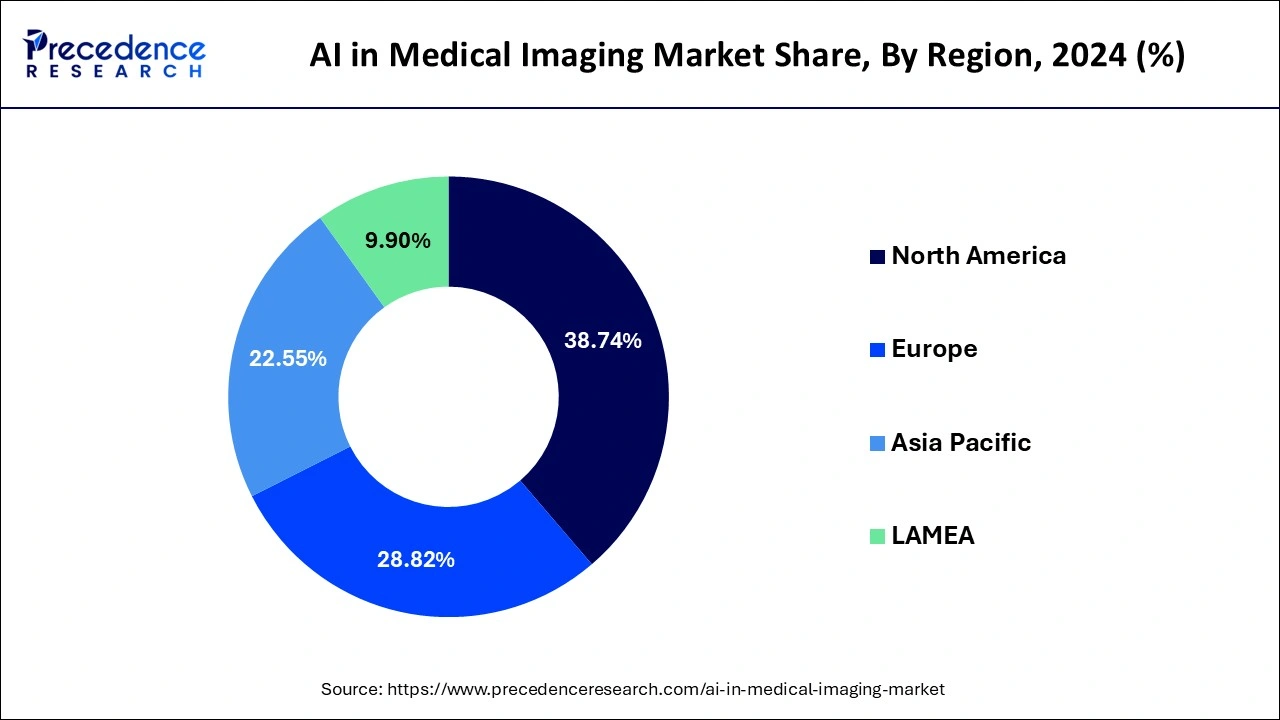
North America led the global market in 2025, holding a 45% share. This is largely due to the presence of major industry players, supportive government policies, and widespread adoption of AI technologies. The United States and Canada are expected to remain key contributors to market growth, driven by strong investments in research, innovation, and healthcare infrastructure.
Asia Pacific
Asia Pacific is the fastest-growing region in the AI medical imaging market. Growth is fueled by rising healthcare demands, technological advancements, and supportive government initiatives. Countries like India, China, and Australia are actively adopting AI to improve diagnostic accuracy and efficiency.
In India, the expansion of health-tech startups and government programs like the Ayushman Bharat Digital Mission are driving adoption. Similarly, China and Australia are leveraging AI in hospitals and public healthcare systems to enhance clinical outcomes.
Europe
Europe is expected to experience steady growth, supported by strong healthcare systems, favorable regulations, and collaborative research efforts. Countries such as Germany, the UK, and Spain are leading in AI adoption.
Germany is particularly advanced in integrating AI into radiology, focusing on improving diagnostic accuracy and operational efficiency. In the UK, the National Health Service is implementing AI solutions to enhance healthcare delivery, while Spain is investing in AI research to drive innovation.
South America
South America is emerging as a promising market, driven by increasing healthcare digitization and the need for better diagnostic accuracy. Governments and private organizations are investing in AI-enabled imaging solutions to improve early disease detection and workflow efficiency.
Brazil stands out as a key market in the region due to its large healthcare system and growing demand for diagnostic services. The country is increasingly adopting AI tools for imaging analysis and large-scale screening programs.
Middle East & Africa
The Middle East & Africa region is gradually expanding in the AI medical imaging market. Growth is supported by healthcare modernization efforts, increased investment in diagnostic infrastructure, and the need to address workforce shortages.
South Africa is a leading market within this region, leveraging AI to improve diagnostic speed and accuracy, particularly for diseases such as tuberculosis, cancer, and cardiovascular conditions. As digital health adoption increases, the region is expected to see steady growth.
AI in Medical Imaging Market Companies
- Agfa-Gevaert Group
- Ada Health
- Enlitic Inc
- CELLMATIQ GMBH
- GENERAL ELECTRIC COMPANY
- IBM
- NVIDIA CORPORATION
- MICROSOFT
- KONINKLIJKE PHILIPS N.V.
- SIEMENS
Segment Covered in the Report
By Clinical Area
- Lung/Pulmonary
- Lung cancer
- Non-cancer lung diseases
- Brain/Neurology
- Stroke/Haemorrhage
- Dementia & Neurodegenerative Diseases
- Brain Tumors/Lesions
- Heart/Cardiology
- Coronary Artery Diseases
- Heart Failure & Functional Assessment
- Congenital & Structural Heart Diseases
- Oncology
- Musculoskeletal
- Gastroenterology/Hepatology
- Ophthalmology
- Other Specialities (Obstetrics/Gynaecology, Urology, Dermatology)
By Technology Type
- Machine Learning
- Deep Learning
- CNN
- RNN/LSTM
- Transformers/ViTs
- Generative Models (GANs, Diffusers)
- Natural Language Processing (NLP)
- Hybrid/ Multimodal AI
- Explainable AI (XAI)
By Deployment Type
- On-premise
- Cloud-based
- Hybrid
- Edge/Embedded
By Imaging Modality
- X-ray
- CT Scan
- MRI
- Ultrasound
- PET/SPECT
- Other Imaging Modalities
By Functionality
- Image Acquisition & Reconstruction
- Image Enhancement &Processing
- Image Analysis
- Segmentation
- Detection
- Classification
- Quantification
- Workflow & Reporting
- Predictive & Prognostic Analytics
By Product Type
- Software
- AI Analysis Software
- AI Workflow & Reporting Tools
- AI-enabled Hardware
- Imaging Device with Embedded AI (CT, MRI, X-ray, Ultrasound)
- Edge/AI Workstations
- AI Accelerators
By End User
- Hospitals
- Diagnostic Imaging Centers
- Research & Academic Institutes
By Geography
- North America
- Europe
- Asia-Pacific
- South America
- Middle East & Africa (MEA)
Get Sample :
Also Read : https://www.marketstatsinsight.com/blood-group-typing-market/
