
Carbon Footprint Assessment Services Market Size, Share and Trends 2025 to 2034
The global carbon footprint assessment services market is accelerating as regulatory mandates, investor pressure, and corporate sustainability goals drive demand for accurate emissions tracking and reporting.
The carbon footprint assessment services market is experiencing robust growth, fueled by the urgent need for organizations to measure, monitor, and report greenhouse gas emissions across their operations and supply chains. As global climate targets and regulatory frameworks become more stringent, companies are increasingly adopting carbon accounting and sustainability analytics to meet compliance requirements and demonstrate environmental leadership. The market is expected to grow at a compound annual growth rate (CAGR) of 13% from 2025 to 2034, with Europe leading in market share and Asia Pacific emerging as the fastest-growing region.
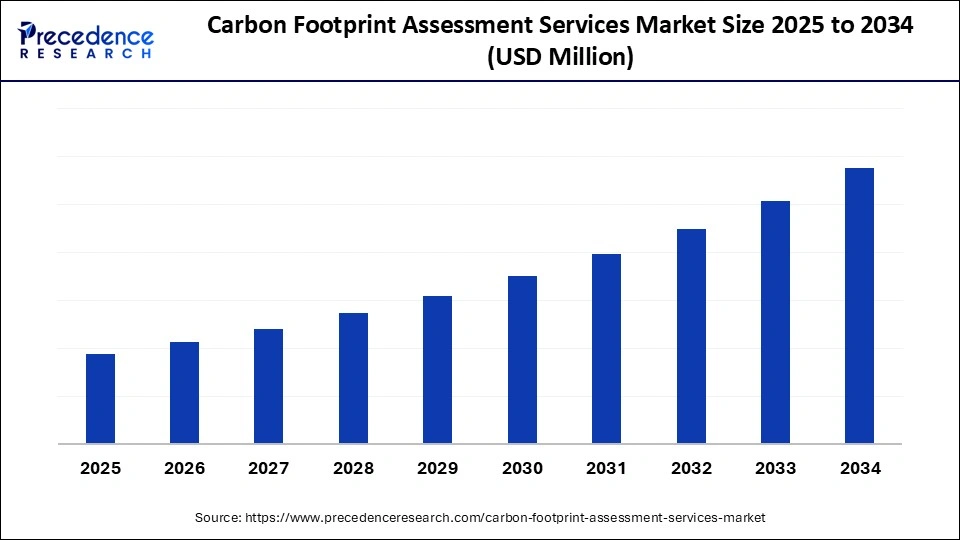
Carbon Footprint Assessment Services Market Key Insights
- Europe held the largest market share (33%) in 2024, while Asia Pacific is expected to grow the fastest.
-
Baseline carbon footprint assessment accounted for over 35% of the market in 2024.
-
Manufacturing & heavy industry led end-use sectors with 30% market share, while retail & consumer goods is growing at 11% CAGR.
-
Large enterprises dominate the client segment (55% share), but medium-sized enterprises are growing at 12% CAGR.
-
On-site engagements captured 48% of the market, but remote/digital services are growing at 13% CAGR.
AI’s Transformative Role in Carbon Footprint Assessment
Artificial intelligence is rapidly reshaping the carbon footprint assessment landscape. AI-powered platforms are automating the classification of large purchase datasets into emission factors, enabling real-time, granular emissions tracking without manual intervention. For example, ClimateSeeds GEMS software leverages AI to streamline emissions calculations across all categories, while Deloitte UK’s AI Carbon Footprint Calculator estimates the footprint of AI projects themselves, highlighting the need for carbon accounting even within digital transformation initiatives.
Generative AI is also making waves—CO2 AI’s solution can calculate emissions for thousands of products in minutes, addressing the challenge of limited supplier data. These innovations are transforming carbon accounting from a compliance exercise into a strategic tool for decarbonization, making AI-enabled assessment services essential for corporate sustainability strategies.
Market Growth Factors
-
Regulatory Pressure: Mandated ESG disclosures and climate-related reporting standards (e.g., EU Green Deal, India’s BRSR, SEC climate risk rules) are driving adoption of carbon footprint assessment services.
-
Investor and Stakeholder Expectations: Investors increasingly demand transparency and accountability in emissions reporting, pushing companies to invest in robust assessment tools.
-
Corporate Sustainability Goals: Net-zero commitments and environmental leadership are becoming key differentiators for brands, especially in retail and manufacturing.
-
Digital Transformation: Cloud-based platforms, IoT devices, and AI analytics are making emissions tracking more accurate, efficient, and scalable.
Carbon Footprint Assessment Services Market Scope
| Report Coverage | Details |
| Dominating Region | Europe |
| Fastest Growing Region | Asia Pacific |
| Base Year | 2024 |
| Forecast Period | 2025 to 2034 |
| Segments Covered | Service Type, End-Use Industry, Client Size, Delivery Mode, and Region |
| Regions Covered | North America, Europe, Asia-Pacific, Latin America, and Middle East & Africa |
Opportunity and Trend: What’s Driving the Market?
Why are companies investing in carbon footprint assessment services?
Companies are investing to comply with regulatory mandates, meet investor expectations, and demonstrate environmental leadership. Accurate emissions data helps organizations identify reduction opportunities, manage supply chain risks, and strengthen brand reputation.
Which industries are leading the adoption?
Manufacturing and heavy industry are the largest adopters due to their high emissions, but retail and consumer goods are growing rapidly as brands focus on supply chain transparency and sustainable sourcing.
How is technology changing the market?
Digital platforms, AI, and blockchain are enabling real-time emissions tracking, automated reporting, and greater transparency. These technologies are reducing costs and making carbon accounting accessible to organizations of all sizes.
Regional Analysis
Europe: Europe leads the market with a 33% share, driven by strong climate policies, mandatory sustainability reporting, and early adoption of carbon management systems. Germany is a standout, with its net-zero goals and robust regulatory environment.
Asia Pacific: The region is growing at a 13% CAGR, fueled by industrial expansion, energy transition, and government initiatives. China’s national carbon trading system and push for carbon neutrality are key drivers.
North America: The U.S. is leading growth, with proactive climate policies, corporate mandates, and technological infrastructure supporting rapid adoption of carbon accounting solutions.
Middle East & Africa: The UAE is emerging as a regional leader, with its Net Zero by 2050 initiative and participation in global climate conferences driving awareness and adoption.
Segmental Analysis
Service Type Insights
Baseline Carbon Footprint Assessment Leads the Market
Baseline Carbon Footprint Assessment holds the largest share at around 35%. It remains essential for quantifying direct and indirect emissions, forming the foundation for sustainability planning, target setting, and compliance with global reporting standards.
Rising Demand for Product-Level Assessments
Product or Service-Level Carbon Footprint Assessments are gaining strong traction as companies seek eco-labels, support sustainable product development, and improve the environmental transparency of individual product lines.
Scope 3 Emissions Mapping is the Fastest-Growing Service
Scope 3 supply-chain emissions assessment is the fastest-growing category, projected at an 11% CAGR. Organizations increasingly prioritize full value-chain accountability driven by frameworks such as the GHG Protocol and CDP.
Growth in LCA and Verification Services
Lifecycle Assessment (LCA) Services and Verification, Certification & Audit Services are expanding steadily. LCAs help evaluate environmental impacts across product lifecycles, while verification services strengthen credibility and compliance with standards such as ISO 14064.
End-Use Industry Insights
Manufacturing & Heavy Industry Lead the Market
Manufacturing and heavy industries dominate the market with nearly 30% share due to their high emissions and strong push toward efficiency improvements, compliance with emission caps, and cost management under carbon pricing systems.
Retail & Consumer Goods is the Fastest-Growing Segment
Retail and consumer products are expanding at an 11% CAGR. Brands increasingly prioritize supply-chain transparency and adopt digital carbon-tracking tools to support sustainable sourcing and meet ESG commitments.
Rapid Adoption Across Logistics, Commercial Services, and Agriculture
Transportation, logistics, and commercial services are showing strong uptake as firms optimize routes, adopt cleaner fuels, improve building efficiency, and integrate renewable energy. Agriculture and forestry players are also participating more actively in emissions tracking and sustainable land management.
Client Size Insights
Large Enterprises Hold the Largest Share
Large enterprises account for nearly 55% of market demand as they face stringent disclosure requirements and need comprehensive carbon accounting across multiple geographies.
Medium-Sized Enterprises Are Growing Fastest
Mid-sized companies show about 12% CAGR, driven by regulatory pressure, supply-chain requirements from larger partners, and access to affordable digital sustainability tools.
Small & Micro Enterprises Entering the Market
Smaller businesses are beginning to adopt simplified digital carbon-tracking solutions, enabling wider supply-chain accountability and supporting national and global reduction goals.
Delivery Mode Insights
On-Site Engagement Dominates Delivery Mode
On-site assessment holds around 48% market share. Physical inspections provide accurate data collection and verification, making them especially valuable for manufacturing and energy-intensive sectors.
Remote Digital Services Growing Rapidly
Virtual assessments and cloud-based tools are expanding at about 13% CAGR. Real-time dashboards, IoT data capture, and AI-enabled analytics are driving the rapid digitalization of carbon assessment.
Hybrid Models Gaining Preference
Hybrid models combining remote data collection with targeted on-site verification—offer flexibility, cost efficiency, and comprehensive validation, making them an ideal choice for large enterprises with global supply chains.
Latest Breakthroughs and Key Players
Recent innovations include Databricks’ Data Intelligence Platform for Energy, which uses generative AI to optimize grid reliability and reduce transmission losses, and IBM’s acquisition of Prescinto, an Indian SaaS firm, to enhance its Maximo Application Suite with AI-enabled diagnostics for renewable energy assets.
Top Companies in the Market:
-
CCH Tagetik
-
Enablon
-
IBM Envizi ESG Suite
-
IBM Consulting
-
Ellipse
-
IsoMetrix
-
EcoVadis
-
ERP-centric carbon footprint software providers
Challenges and Cost Pressures
Accurately measuring Scope 3 emissions across global supply chains remains a complex, resource-intensive process, especially for smaller firms with limited technical resources. Challenges include limited supplier reporting, inconsistent data quality, and fragmented digital infrastructure. These barriers slow adoption and increase costs, particularly for organizations without sophisticated internal data systems.
Case Study: Digital Transformation in Manufacturing
A leading European manufacturer adopted a hybrid model of on-site and remote carbon footprint assessments, leveraging AI-powered analytics to track emissions across its global supply chain. The company reduced audit costs by 30% and improved reporting accuracy, enabling it to meet regulatory requirements and strengthen its sustainability credentials.
Get this report to explore global market size, share, CAGR, and trends, featuring detailed segmental analysis and an insightful competitive landscape overview @ https://www.precedenceresearch.com/sample/7129
You can place an order or ask any questions. Please feel free to contact us at sales@precedenceresearch.com |+1 804 441 9344

- Battery Swapping Market Size to Touch USD 24.74 Billion by 2035 - March 5, 2026
- Dental Air Polishing System Market Size to Reach USD 1603.54 Million by 2035 - March 4, 2026
- Cryoballoon Ablation System Market Size to Surpass USD 2.49 Billion by 2035, Propelled by 5.70% Growth in Minimally Invasive Cardiac Care - March 2, 2026
