
Healthcare Facilities Management Market Surges Toward USD 889.6 Billion by 2035
Market Poised for Strong Expansion as Digitalization and Outsourcing Reshape Facility Operations
The global healthcare facilities management market is witnessing significant momentum, driven by the increasing demand for efficient healthcare infrastructure, rising outsourcing trends, and the integration of advanced technologies. The market is projected to grow at a notable CAGR over the forecast period, fueled by the need for cost optimization, regulatory compliance, and enhanced patient experience across hospitals and healthcare institutions.
Healthcare providers are increasingly focusing on non-core service outsourcing such as maintenance, cleaning, security, and technical operations, allowing them to concentrate on patient care. This shift, combined with the adoption of smart building technologies, is accelerating market expansion globally.
Key Market Highlights
The healthcare facilities management market is expected to grow at a strong CAGR during the forecast period, driven by rising healthcare infrastructure investments worldwide.
North America leads the global market due to advanced healthcare systems and early adoption of outsourced facility services.
Asia-Pacific is anticipated to grow at the fastest rate, supported by expanding hospital networks and government healthcare initiatives.
Hard services segment dominates due to the critical need for asset maintenance and infrastructure reliability.
Outsourced facilities management is gaining traction as healthcare providers aim to reduce operational costs.
Leading players are focusing on digital transformation, sustainability, and integrated service models.
What is Driving the Growth of the Healthcare Facilities Management Market?
The market growth is primarily fueled by the rapid expansion of healthcare infrastructure, particularly in emerging economies. Governments and private players are investing heavily in hospital construction and modernization, increasing the demand for facility management services.
Additionally, the growing complexity of healthcare environments—requiring strict hygiene standards, regulatory compliance, and continuous equipment maintenance—has made professional facilities management indispensable. The trend toward outsourcing is also gaining momentum as healthcare organizations seek to improve operational efficiency and reduce costs.
How is AI Transforming Healthcare Facilities Management?
Artificial Intelligence (AI) is playing a transformative role in optimizing healthcare facility operations. AI-powered predictive maintenance systems help identify equipment failures before they occur, reducing downtime and ensuring uninterrupted healthcare services. This not only improves operational efficiency but also enhances patient safety.
Moreover, AI-driven analytics enable better resource allocation, energy management, and workflow optimization within healthcare facilities. Smart sensors and IoT-enabled systems, combined with AI, are helping hospitals transition into intelligent, responsive environments that enhance both staff productivity and patient experience.
Market Growth Factors
Increasing Healthcare Infrastructure Development
Rapid urbanization and population growth are leading to increased investments in hospitals, clinics, and diagnostic centers, thereby boosting demand for facilities management services.
Rising Demand for Outsourced Services
Healthcare providers are increasingly outsourcing non-core activities to specialized service providers to reduce costs and improve service quality.
Stringent Regulatory Standards
Strict healthcare regulations related to hygiene, safety, and environmental standards are driving the need for professional facility management solutions.
Technological Advancements
Integration of IoT, AI, and automation in facility management systems is enhancing operational efficiency and driving market growth.
Market Scope
| Report Highlights | Details |
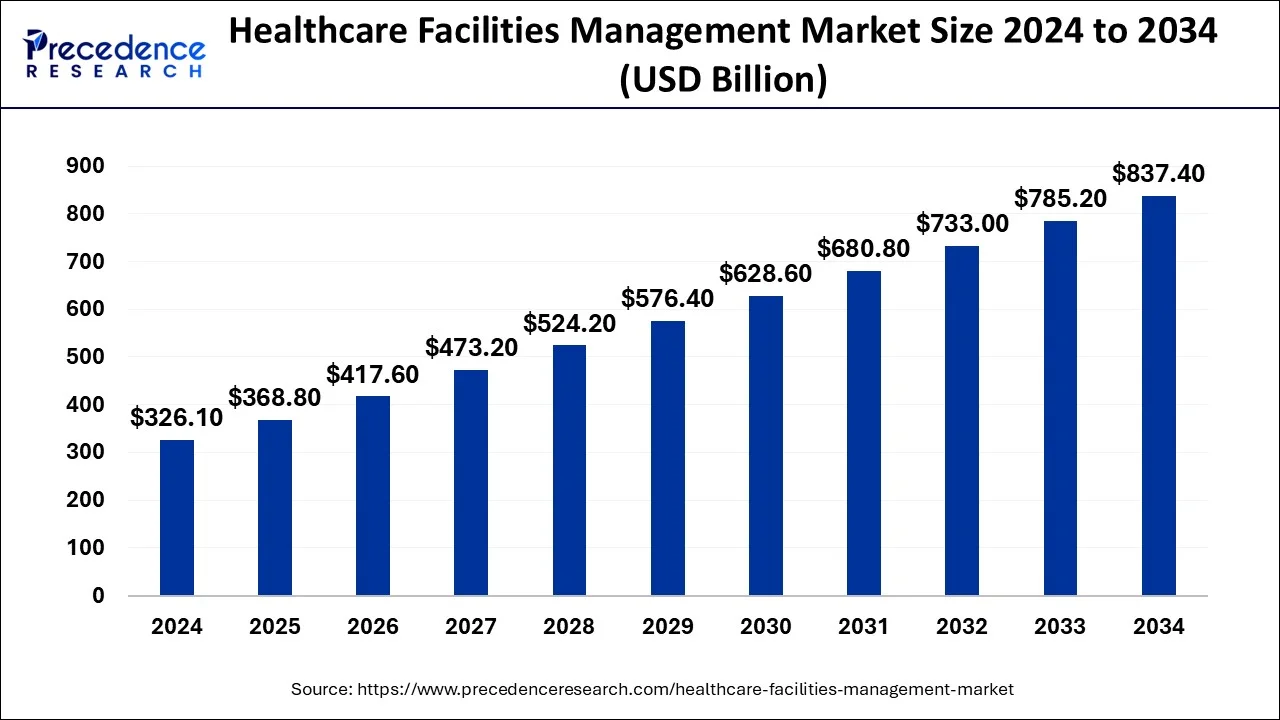
| Market Size in 2025 | USD 368.80 Billion |
| Market Size in 2026 | USD 417.6 Billion |
| Market Size in 2035 | USD 889.6 Billion |
| Growth Rate from 2026 to 2035 | CAGR of 9.2% |
| Largest Market | North America |
| Fastest Growing Market | Asia Pacific |
| Base Year | 2025 |
| Forecast Period | 2026 to 2035 |
| Segments Covered | By Service Type, By End User, By Regions |
| Regions Covered | North America, Europe, Asia-Pacific, Latin America, and Middle East & Africa |
What Are the Emerging Opportunities and Trends in the Market?
Is Sustainability Becoming a Key Focus in Healthcare Facilities?
Yes, healthcare institutions are increasingly adopting green building practices and energy-efficient systems to reduce environmental impact and operational costs.
How is Digital Transformation Influencing the Market?
Digital tools such as smart sensors, cloud-based platforms, and AI analytics are revolutionizing facility management by enabling real-time monitoring and predictive decision-making.
Are Integrated Facility Management Services Gaining Popularity?
Absolutely. Healthcare providers are shifting toward integrated service models that combine multiple facility management functions under a single provider for improved coordination and efficiency.
Market Dynamics
Driver
One of the biggest reasons behind the growth of healthcare facilities management is the increasing elderly population. As people age, they need more medical attention, frequent hospital visits, and long-term care support.
Hospitals, clinics, and nursing homes operate around the clock and must maintain high standards of cleanliness, safety, and efficiency. With more senior citizens, there is a rising need for long-term care centers, which in turn increases demand for services like cleaning, maintenance, security, and energy management.
Countries such as Japan, China, and the United States are experiencing rapid growth in their aging populations, further driving this demand.
Restraint
A major challenge in this market is the high cost of implementing advanced technologies. Tools like AI systems, robotics, and IoT-based facility management can significantly improve operations, but they require heavy investment.
Many small hospitals and clinics cannot afford these systems, especially if they lack the infrastructure to support them. In addition, trained professionals are needed to operate these technologies, which adds to the cost.
If these systems fail or require upgrades, repairs can be expensive and time-consuming. As a result, many healthcare providers delay adopting modern solutions, slowing down overall market growth.
Opportunity
The future of healthcare facilities management looks promising. Hospitals and clinics are increasingly adopting smarter and more efficient systems to maintain safety and preparedness.
Technologies such as AI, robotics, augmented reality, and voice-based systems are expected to become more common. At the same time, there is a strong push toward building environmentally friendly, energy-efficient hospitals.
Telehealth is also expanding, which requires better digital infrastructure within healthcare facilities. Governments across many regions are investing in upgrading hospitals and building new ones, creating significant growth opportunities for facility management companies.
Service Insights
Healthcare facilities management services are broadly divided into hard services and soft services.
Hard Services
Hard services involve the technical and structural maintenance of healthcare facilities. These are essential for ensuring safe and efficient operations.
They include:
Maintenance of HVAC systems (heating, ventilation, and air conditioning)
Electrical systems and backup power (like generators)
Plumbing and water systems
Building structure maintenance (walls, roofs, floors, etc.)
Fire safety systems (alarms, detection, and suppression)
These services require skilled professionals and are critical for maintaining a safe healthcare environment.
Soft Services
Soft services focus on day-to-day operational support. These include:
Cleaning and pest control
Laundry services
Medical waste management
Catering
Security
Administrative support
In 2025, soft services accounted for the largest market share due to their constant demand. However, hard services are expected to grow steadily in the coming years.
End-User Insights
Hospitals and Clinics (Market Leaders)
Hospitals and clinics dominate the market because they require continuous maintenance and support services. From cleaning and HVAC systems to waste management and infection control, these facilities depend heavily on integrated facility management.
As patient numbers increase and hospital networks expand, the demand for outsourced facility management services continues to rise.
Long-Term Care Facilities
Long-term care facilities are expected to grow the fastest. These facilities support elderly individuals and patients who need assistance with daily activities and medical care.
With the global aging population increasing, the demand for such facilities—and the services that support them—is rising rapidly.
Market Size and Growth
The global healthcare facilities management market was valued at USD 105.4 billion in 2025 and is expected to reach around USD 256 billion by 2035, growing at a CAGR of 9.28%.
Regional Insights
North America (Market Leader)
North America is expected to remain the leading region due to its advanced healthcare infrastructure and high healthcare spending.
The United States plays a major role, with large hospital networks investing in technology and outsourcing services to improve efficiency and meet regulations.
Europe
Europe’s growth is driven by modernization of healthcare infrastructure and a strong focus on sustainability.
Hospitals are adopting energy-efficient systems and improving waste management while ensuring infection control. Countries like Germany are leading due to their advanced systems and commitment to operational excellence.
Asia-Pacific
Asia-Pacific is witnessing rapid growth due to increasing healthcare investments and rising demand for quality medical facilities.
Countries like China are heavily investing in healthcare infrastructure and adopting smart technologies. Growing populations and urbanization are further boosting demand.
Middle East & Africa
This region is expanding due to government investments in healthcare infrastructure and increasing medical tourism.
There is a strong focus on building modern hospitals, improving hygiene standards, and adopting integrated facility management solutions.
Latin America
Latin America is emerging as a promising market due to improvements in healthcare infrastructure and growing private sector involvement.
Countries like Brazil are seeing increased demand for outsourced facility management services as hospitals modernize and expand.
Healthcare Facilities Management Market Companies
- ABM Industries Inc
- ISS World Services A/S
- Jones Lang LaSalle, IP, Inc
- Manutencoop Facility Management S.p.A.
- Medxcel Facility Management
- Mitie Group plc
- Aramark Corporation
- Compass Group plc
- Ecolab, Inc.
- OCS Group
- Secro Group plc
- Sodexo
- Vanguard Resources
- UEM Edgenta Berhad
Segments Covered in the Report
By Service Type
- Hard Services
- Mechanical and Electrical Maintenance
- Plumbing, Air Conditioning Maintenance
- Fire Protection Systems
- Others
- Soft Services
- Laundry
- Waste Management
- Cleaning & Pest Control
- Catering
- Security
- Others
By End User
- Hospitals and Clinics
- Long-Term Healthcare Facilities
- Others
By Regional Outlook
- North America
- U.S.
- Canada
- Europe
- U.K.
- Germany
- France
- Asia Pacific
- China
- India
- Japan
- South Korea
- Middle East & Africa
- Latin America
Get Sample Link: https://www.precedenceresearch.com/sample/1026
Also Read : https://www.marketstatsinsight.com/silver-wound-dressing-market/
