
Quantum Computing Market Size to Reach USD 19.44 Billion by 2035
What is the Quantum Computing Market Size in 2026?
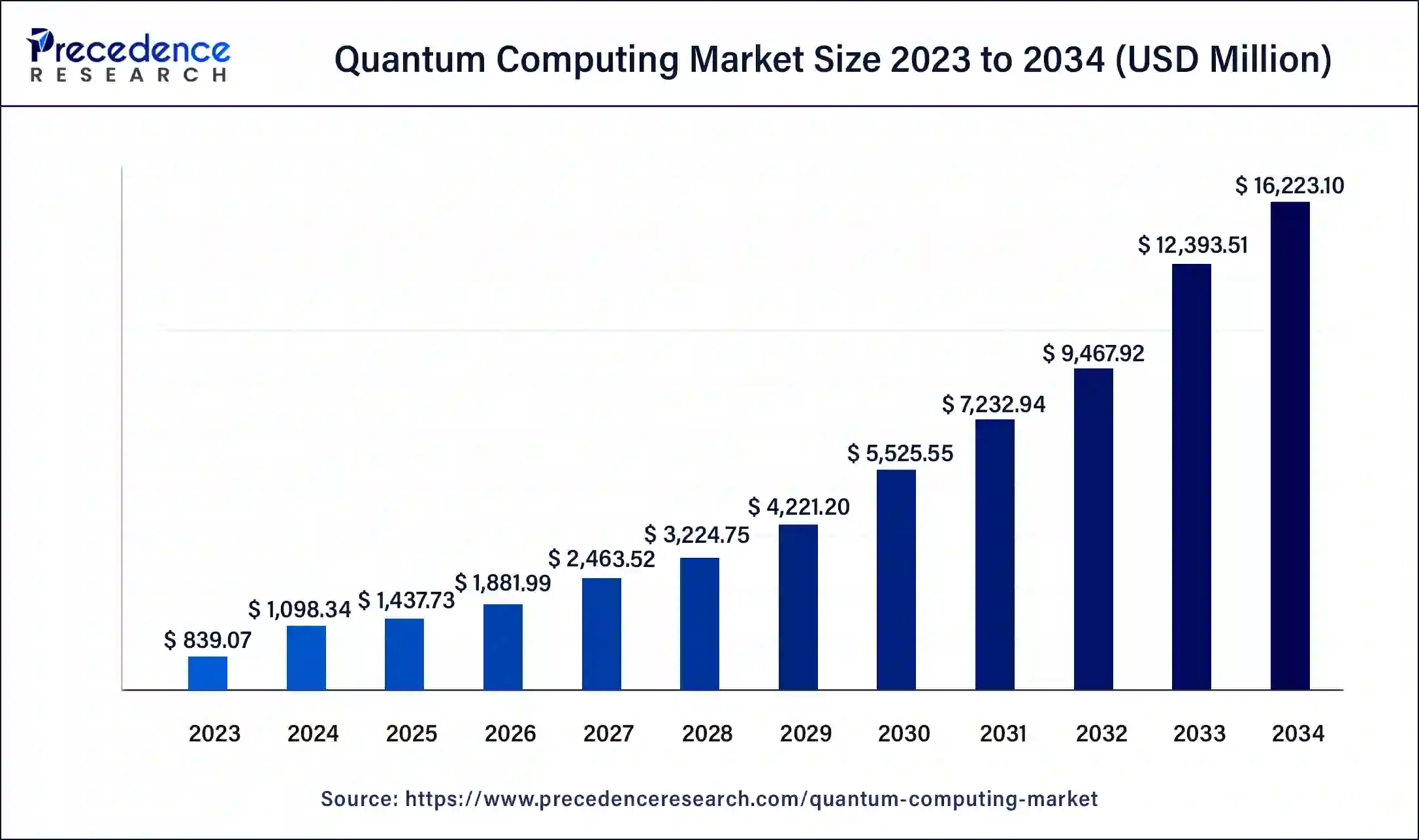
The global quantum computing market is experiencing unprecedented growth, driven by rapid technological advancements, increasing investments, and expanding enterprise applications. According to Precedence Research, the market is projected to grow from USD 16.4 billion in 2024 to approximately USD 125.2 billion by 2034, registering a robust CAGR of 36.8% during the forecast period.
The accelerating demand for high-performance computing, coupled with breakthroughs in quantum algorithms and hardware, is propelling market expansion. Industries such as pharmaceuticals, banking, and logistics are increasingly leveraging quantum computing to solve complex optimization problems and enhance decision-making capabilities.
What’s Driving the Quantum Leap?
The global quantum computing market was valued at USD 16.4 billion in 2024 and is projected to reach USD 125.2 billion by 2034, growing at a CAGR of 36.8%. North America dominates the market due to strong R&D investments and early adoption of advanced technologies. The gate-based quantum computing segment leads the technology landscape, while cloud-based deployment is gaining rapid traction. Among key players, IBM, Google, and Microsoft are at the forefront of innovation.
How is Artificial Intelligence Accelerating the Quantum Computing Market?
Artificial Intelligence (AI) is playing a transformative role in the evolution of quantum computing. AI algorithms are being used to optimize quantum circuits, improve error correction techniques, and accelerate the development of quantum hardware. This synergy is enabling researchers to overcome some of the most critical limitations in quantum systems, such as decoherence and noise.
Moreover, AI-powered simulation tools are helping enterprises explore quantum use cases without requiring full-scale quantum infrastructure. This convergence is expected to fast-track commercialization and expand accessibility, particularly through hybrid quantum-classical computing models.
What Are the Key Growth Drivers of the Quantum Computing Market?
The growth of the quantum computing market is fueled by increasing government and private sector investments in quantum research. Countries across the globe are launching national quantum initiatives, significantly boosting funding and innovation.
Additionally, the rising need for ultra-secure communication systems is driving demand for quantum cryptography solutions. The ability of quantum computers to process massive datasets exponentially faster than classical systems is also unlocking new opportunities in drug discovery, financial modeling, and climate forecasting.
What Opportunities and Trends Are Shaping the Future of Quantum Computing?
Is Quantum-as-a-Service (QaaS) the Next Big Trend?
Yes, Quantum-as-a-Service is emerging as a major trend, allowing businesses to access quantum computing capabilities via cloud platforms without heavy infrastructure investments.
Can Quantum Computing Revolutionize Drug Discovery?
Absolutely. Quantum computing enables precise molecular simulations, significantly reducing the time and cost required for drug development.
Are Startups Driving Innovation in the Market?
Indeed, startups are playing a critical role by introducing novel quantum architectures and software solutions, intensifying competition and accelerating technological breakthroughs.
Market Dynamics
Key Drivers
Growing digitization fueling market growth
The COVID-19 pandemic significantly accelerated digital transformation across industries, which in turn boosted the growth of the quantum computing market. Many organizations adopted modern technologies to streamline operations and improve efficiency. The shift to remote work and work-from-home culture also played a major role in increasing reliance on advanced computing solutions, supporting market expansion during this period.
Market Scope
| Report Coverage | Details |
| Market Size in 2025 | USD 1.44 Billion |
| Market Size in 2026 | USD 1.88 Billion |
| Market Size by 2035 | USD 19.44 Billion |
| Growth Rate from 2026 to 2035 | CAGR of 29.73% |
| Base Year | 2025 |
| Forecast Period | 2026 to 2035 |
| Segments Covered | Application, End Use, Offering Type and Region |
| Regions Covered | North America, Europe, Asia-Pacific, Latin America, and Middle East & Africa |
Rising cyber threats driving demand
The global surge in cyberattacks—such as ransomware and phishing—has increased the need for more secure computing systems. Quantum computing is emerging as a powerful solution for enhancing cybersecurity. Companies are actively exploring ways to integrate quantum technologies into security systems. For example, collaborations like the one between Cambridge Quantum Computing and the National Physical Laboratory aim to leverage quantum computing for applications such as cybersecurity, artificial intelligence, traffic optimization, and drug discovery.
Key Market Challenge
Shortage of skilled professionals
One of the biggest challenges facing the quantum computing market is the lack of highly skilled professionals. As the technology is complex and still evolving, there is a growing need for experts who can work on applications such as AI, cybersecurity, modeling, and optimization using quantum systems.
Key Opportunities
Increasing demand across industries
Quantum computing is gaining traction across multiple industries, including defense, BFSI (banking, financial services, and insurance), healthcare, energy, and chemicals. Businesses are increasingly relying on advanced computing technologies to solve complex problems that traditional supercomputers cannot handle.
In addition, rapid industrial growth in emerging economies and rising government investments in quantum research are expected to further boost market expansion in the coming years.
Application Insights
Quantum computing is playing an important role in machine learning through quantum algorithms. These algorithms help handle complex models with large numbers of variables more efficiently. As a result, organizations can process and analyze data faster and with greater accuracy.
End-Use Insights
The BFSI sector currently holds a significant share of the market and is expected to grow further. This is largely due to the early adoption of quantum computing in banking and finance, particularly for enhancing cybersecurity and protecting sensitive financial data. Quantum cryptography offers a much higher level of security compared to traditional methods.
The healthcare and pharmaceutical industries are also expected to see strong growth. Quantum computing can improve diagnosis speed, enable personalized treatment, and reduce healthcare costs by providing faster and more accurate solutions.
Offering Type Insights
Quantum computing is increasingly being used in areas such as drug development, material science, aerospace, chemicals, and energy. It is also gaining importance in improving cloud-based systems.
For instance, Amazon.com, Inc. entered the Quantum Computing as a Service (QCaaS) space with its platform Amazon Braket, which allows researchers and developers to experiment with quantum systems from different providers in one place.
The system segment is expected to dominate the market due to its growing use in AI, machine learning, and advanced manufacturing. These systems provide more accurate decision-making compared to traditional computers, enabling better research and innovation.
U.S. Market Growth (2026–2035)
The U.S. quantum computing market was valued at USD 617.5 million in 2025 and is projected to reach approximately USD 8.5 billion by 2035, growing at a CAGR of nearly 30%.
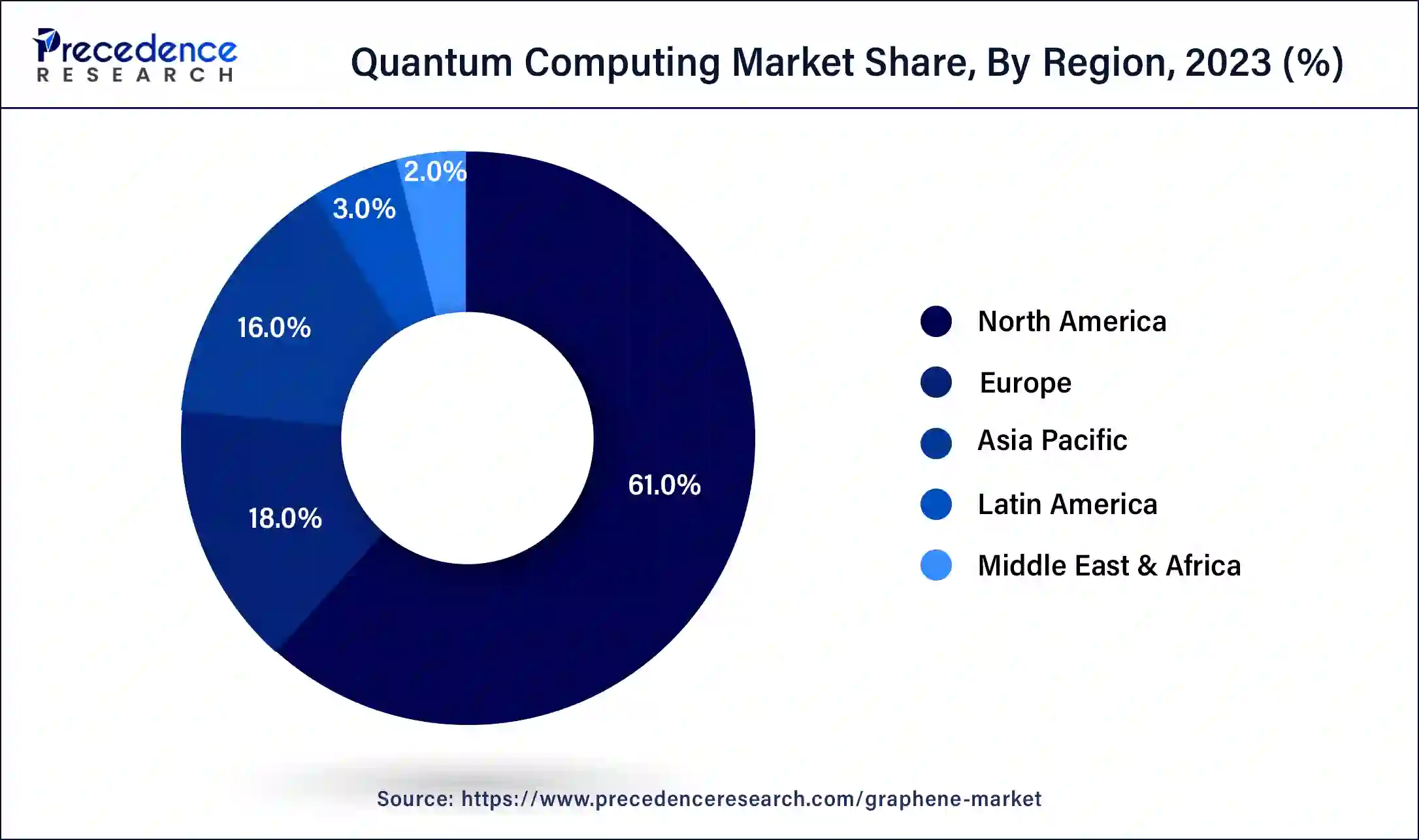
North America held the largest market share (61%) in 2025, driven by strong government support and funding initiatives such as the National Quantum Initiative Act. The region also benefits from leading research institutions like Massachusetts Institute of Technology, California Institute of Technology, and Stanford University, which are actively advancing quantum research and training skilled professionals.
Regional Insights
Europe
Europe is experiencing steady growth due to increased adoption of quantum technologies in industries such as healthcare, chemicals, and pharmaceuticals. Government initiatives like the European Commission’s Quantum Flagship program are supporting research and innovation. Countries like Germany, France, and the Netherlands are investing heavily in infrastructure and talent development.
Germany, in particular, plays a key role, with institutions like Forschungszentrum Jülich and Fraunhofer Society driving advancements through collaborations with major tech companies.
Asia-Pacific
The Asia-Pacific region is rapidly adopting quantum computing, supported by strong government initiatives and investments. China is leading the region with significant funding and national strategies aimed at achieving self-sufficiency in quantum technology. Strategic partnerships and R&D investments are expected to accelerate growth in this region.
Value Chain Analysis
Inbound Logistics
This stage involves sourcing and managing specialized components required to build quantum systems.
Key players include AGC Inc. and Nippon Electric Glass.
Procurement
Procurement focuses on acquiring quantum hardware and software, often through cloud-based services rather than direct purchases.
Key players include Meta Platforms, Inc. and NVIDIA Corporation.
Technology Development
This involves research, design, and engineering of quantum hardware and software using quantum mechanics principles.
Key players include Samsung Electronics, LG Electronics, and Sony Group Corporation.
Operations
Operations focus on executing quantum algorithms on hardware to solve real-world problems.
Key players include Samsung, Sony, and Panasonic Corporation.
Quantum Computing Market Companies
- IBM Corporation (New York, U.S.)
- D-Wave Systems Inc. (Burnaby, Canada)
- Cambridge Quantum Computing Ltd. (Cambridge, U.K.)
- Intel Corporation (California, U.S.)
- Rigetti & Co, Inc. (California, U.S.)
- Google LLC (California, U.S.)
- Quantica Computacao (Tamil Nadu, India)
- Zapata Computing (Massachusetts, U.S.)
- XANADU (Toronto, Canada)
- Accenture Plc. (Dublin, Ireland)
Segment Covered in the Report
By Application
- Machine Learning
- Optimization
- Biomedical Simulations
- Financial Services
- Electronic Material Discovery
- Other (Traffic Optimization, Weather Forecasting, and others.)
By End Use
- Healthcare and Pharmaceuticals
- Chemicals
- Defence
- BFSI
- Energy and Power
- Others
By Offering Type
- Consulting Solutions
- Systems
By Region
- North America
- Europe
- Asia-Pacific
- Latin America
- Middle East & Africa (MEA)
Get Sample Link: https://www.precedenceresearch.com/sample/2377
Also Read : https://www.marketstatsinsight.com/electric-vehicle-charging-infrastructure-market/
