
Ultrasound Probe Disinfection Market Size to Cross USD 2.32 Billion by 2035 | 10.32% CAGR Fuels Surge Amid Rising HAI Concerns
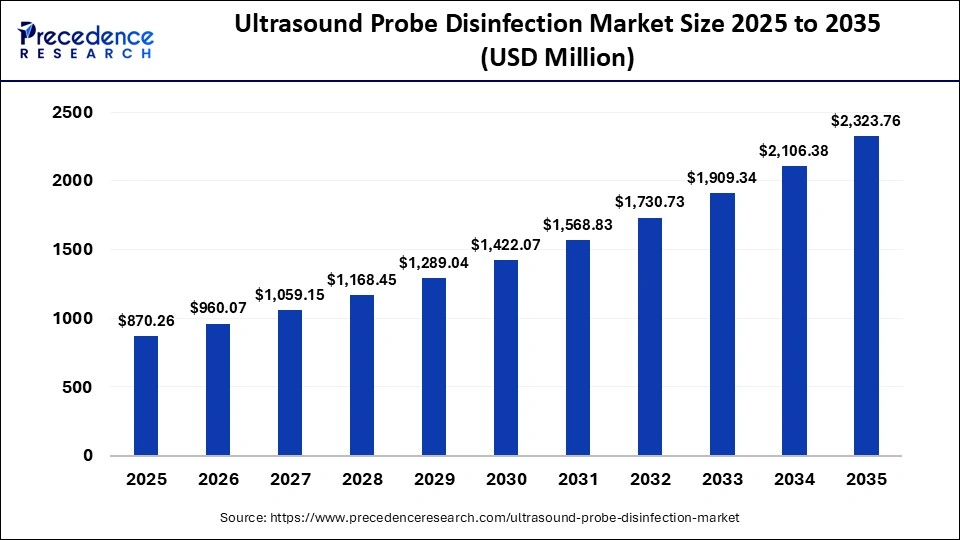
The global ultrasound probe disinfection market reached USD 870.26 million in 2025 and projects to expand from USD 960.07 million in 2026 to USD 2,323.76 million by 2035, achieving a robust CAGR of 10.32%. Surging adoption of infection-control protocols, mandatory reprocessing standards, and escalating ultrasound procedures in radiology, cardiology, and point-of-care settings propel this growth.
Key Insights
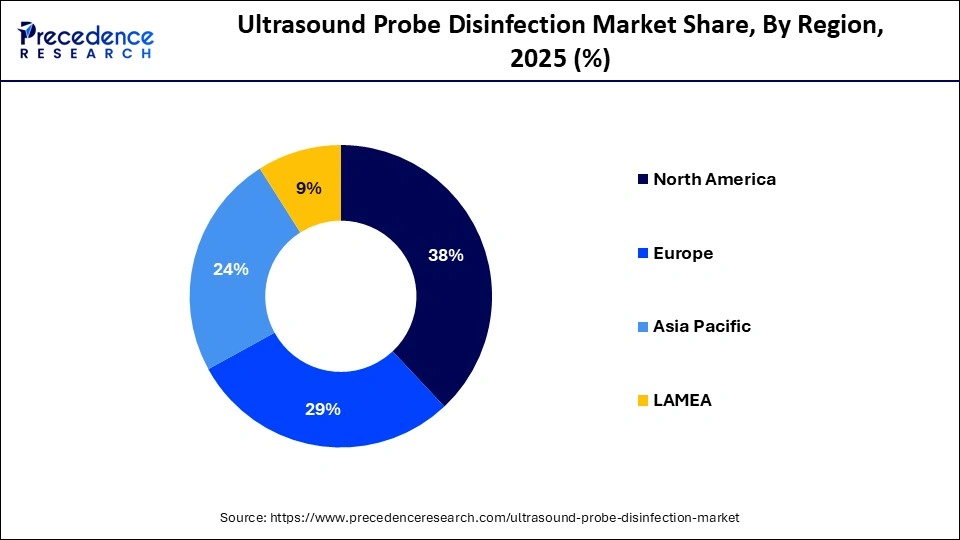
- North America commanded 38% market share in 2025, driven by stringent FDA and CDC regulations.
- Asia Pacific emerges as the fastest-growing region, fueled by healthcare modernization in China and India.
- Instruments held 44% revenue dominance, while hospitals and clinics captured 45% of end-use share.
- Intermediate/low-level disinfection led methods, with high-level disinfection poised for rapid expansion.
Market Scope
| Market Metric | 2025 Value | 2035 Projection | CAGR (2026-2035) |
|---|---|---|---|
| Global Size | USD 870.26 Mn | USD 2,323.76 Mn | 10.32% |
| North America | USD 330.70 Mn | USD 894.65 Mn | 10.46% |
| U.S. | USD 248.02 Mn | USD 675.46 Mn | 10.54% |
AI’s Pivotal Role in Precision Disinfection
Artificial intelligence revolutionizes ultrasound probe disinfection through smart sensors that monitor probe usage, log cleaning cycles, and enforce compliance in real time. These systems deliver alerts, predictive maintenance, and tamper-proof audit trails, slashing human error and bolstering regulatory adherence.
AI extends to adaptive algorithms optimizing cycles based on contamination levels and probe types, enhancing efficiency while integrating with IoT for seamless workflow monitoring. This tech-forward shift supports sustainable, chemical-free methods amid rising HAI awareness.
What Drives Ultrasound Probe Disinfection Market Growth?
Rising hospital-acquired infections (HAIs) and regulatory mandates from FDA, CDC, and WHO demand rigorous probe reprocessing, spurring automated HLD and UV-C adoption. Ultrasound procedure volumes surge in obstetrics, emergency care, and minimally invasive treatments, amplifying disinfection needs. Point-of-care ultrasound (POCUS) expansion in remote settings further accelerates portable, efficient solutions.
Which Opportunities and Trends Reshape the Landscape?
How are automated systems transforming workflows? Innovations like closed-container platforms and UV-C disinfectors cut manual errors, boost turnaround, and ensure compliance.
What trends favor emerging markets? Asia Pacific’s infrastructure boom and chronic disease rise propel demand for cost-effective HLD tech.
Why prioritize sustainability? Chemical-free UV-C and hydrogen peroxide mists gain traction, reducing waste amid green healthcare pushes.
Ultrasound Probe Disinfection Market Insights
Product Insights
Why Did the Instruments Segment Lead the Market?
The instruments segment dominated the ultrasound probe disinfection market in 2025 due to rapid innovation in UV-C systems, automated HLD units, and closed-container platforms. These advanced tools reduce manual effort, minimize human error, and ensure consistent compliance with infection-control standards. As hospitals push for safer and more efficient workflows, demand for automated reprocessors and smart probe-handling systems continues to rise.
Why Is the Service Segment Growing Fast?
The service segment is set for strong growth because many healthcare facilities lack trained staff and infrastructure for proper in-house disinfection. Outsourced services offer standardized HLD, reliable quality checks, and advanced technologies without extra investment, making them an attractive option for busy centers focused on infection prevention.
Methods Insights
Why Do Intermediate/Low-Level Disinfection Methods Lead?
Intermediate and low-level disinfection methods held the largest share in 2025 because they are practical, cost-effective, and suitable for everyday clinical use. They offer an efficient balance of safety and affordability for facilities managing routine probes without complex sterilization needs.
Why Is High-Level Disinfection Growing Quickly?
High-level disinfection (HLD) methods are expanding rapidly due to rising demand for safer reprocessing of semi-critical and critical probes. Regulatory pressures, concerns over HAIs, and innovations like UV-C, hydrogen peroxide mist, and automated chambers are making HLD faster, safer, and easier to adopt.
End-Use Insights
Why Did Hospitals and Clinics Generate the Most Revenue?
Hospitals and clinics led the market because they handle high patient volumes, face strict regulatory compliance, and operate large probe inventories. Their focus on preventing HAIs drives the adoption of automated and high-level disinfection systems that ensure safety and rapid turnaround times.
Why Are Diagnostic Imaging Centers Growing the Fastest?
Imaging centers are the fastest-growing users as they expand diagnostic throughput and rely on compact, easy-to-use disinfection systems. Increased awareness of infection control beyond hospitals and the rapid rise of portable POCUS applications are further accelerating adoption.
Region Insights
North America Market Size
North America’s ultrasound probe disinfection market is valued at USD 330.70 million in 2025, projected to reach USD 894.65 million by 2035 at a 10.46% CAGR.
Why Does North America Dominate?
North America leads due to advanced healthcare infrastructure, early technology adoption, and strict infection-control guidelines from agencies like the CDC and FDA. High HAI rates and widespread use of automated UV-C and hydrogen-peroxide HLD systems further support its dominance.
U.S. Market Overview
The U.S. market is valued at USD 248.02 million in 2025 and is expected to hit USD 675.46 million by 2035, growing at 10.54% CAGR. Strong regulatory enforcement, high ultrasound utilization, and local innovation hubs drive rapid adoption of automated HLD and digital traceability systems.
Asia Pacific Insights
Asia Pacific is the fastest-growing region due to rapid healthcare modernization, rising ultrasound volumes, and government mandates promoting automated HLD. Increased demand for POCUS in emergency care and rural settings is also boosting uptake of portable, fast disinfection technologies.
China Trends
China’s market is expanding quickly as hospitals adopt automated systems to reduce HAIs and improve workflow efficiency. Massive healthcare investments and digital monitoring tools support long-term growth.
Europe Insights
Europe is growing significantly due to strict HAI prevention policies and the demand for automated, chemical-free UV-C disinfection systems. High ultrasound usage in cancer screening, prenatal care, and emergency medicine strengthens market adoption. In Germany alone, 400,000–600,000 HAIs annually highlight the need for reliable disinfection.
UK Trends
The UK market is driven by rising ultrasound demand, aging populations, and HAI concerns. NHS initiatives supporting high-level, traceable reprocessing continue to boost system adoption.
MEA Insights
The Middle East & Africa market is gaining momentum as countries invest in modern healthcare infrastructure and international accreditation standards. Growing ultrasound use and rising awareness of infection control are increasing demand for automated and standardized disinfection solutions.
Saudi Arabia Trends
Saudi Arabia shows strong growth driven by higher surgical volumes, extensive ultrasound-guided procedures, and Vision 2030 healthcare modernization goals.
Latin America Insights
Latin America is growing due to high HAI rates and rising adoption of standardized disinfection protocols in countries such as Brazil, Mexico, and Argentina. Increasing ultrasound use in maternal care, emergency medicine, and chronic disease management is pushing facilities toward modern HLD technologies and imported automated systems.
Top Companies in the Ultrasound Probe Disinfection Market & Their Offerings
- Nanosonics: Provides the trophon automated high-level disinfection system, which supplies ultrasound probes with vaporized HLD using H2O2.
- Germitec: Offers UV-C-based electronic disinfection systems such as Chronos, which offers high-level disinfection (fast and chemical-free).
- CIVCO Medical Solutions: Provides probe reprocessing solutions, such as ASTRA automated disinfectors and barriers to safe and consistent ultrasound probe disinfection.
- Tristel Plc: Sells high-level disinfectant solutions that use chlorine dioxide, like Trio Wipes and Fuse, in ultrasound probe cleaning.
- ASP (Fortive): Aspersive furnishes high-level disinfection systems such as STERRAD and EVOTECH systems that endorse safe, standardized probe reprocessing.
Other Major Companies
- ASP (Fortive)
- Nanosonics
- CIVCO Medical Solutions
- Tristel Plc
- Ecolab Inc.
- Germitec
- CS Medical LLC
- Steelco S.p.A.
- STERIS
- IMA-X
- EDM Medical Solutions
- GE HealthCare
- UV Smart
- Lumicare
Segments Covered in the Report
By Product
- Instruments
- Automated Reprocessors
- UV-C Disinfectors
- Manual Reprocessors/Soaking Stations
- Ultrasound Probe Storage Cabinets
- Consumables
- Consumable, By Formulations
- Disinfectant Liquids
- Disinfectant Wipes
- Disinfectant Sprays
- Consumables, By Detergent
- Enzymatic Detergents
- Non-enzymatic Detergents
- Consumable, By Formulations
- Service
By Method
- High-Level Disinfection
- Intermediate Level Disinfection/Low-Level Disinfection
By End-use
- Hospitals and Clinics
- Diagnostic Imaging Centers
- Others
By Region
- North America
- Europe
- Asia-Pacific
- Latin America
- Middle East and Africa
Get this report to explore global market size, share, CAGR, and trends, featuring detailed segmental analysis and an insightful competitive landscape overview @ https://www.precedenceresearch.com/sample/7236
You can place an order or ask any questions. Please feel free to contact us at sales@precedenceresearch.com |+1 804 441 9344

- Battery Swapping Market Size to Touch USD 24.74 Billion by 2035 - March 5, 2026
- Dental Air Polishing System Market Size to Reach USD 1603.54 Million by 2035 - March 4, 2026
- Cryoballoon Ablation System Market Size to Surpass USD 2.49 Billion by 2035, Propelled by 5.70% Growth in Minimally Invasive Cardiac Care - March 2, 2026
