
Uterine Fibroid Drugs Market Size to Attain USD 11.93 Billion by 2035
Surging Demand for Non-Surgical Solutions Fuels 14.21% CAGR
The global uterine fibroid drugs market, valued at USD 3.16 billion in 2025, is projected to reach USD 11.93 billion by 2035, expanding at a CAGR of 14.21% from 2026 to 2035. Rising prevalence of symptomatic fibroids among women of reproductive age drives this growth, alongside strong demand for effective, non-invasive treatments that manage heavy bleeding, pain, and pelvic pressure. Enhanced diagnostic tools and physician awareness further accelerate the adoption of targeted hormonal therapies.
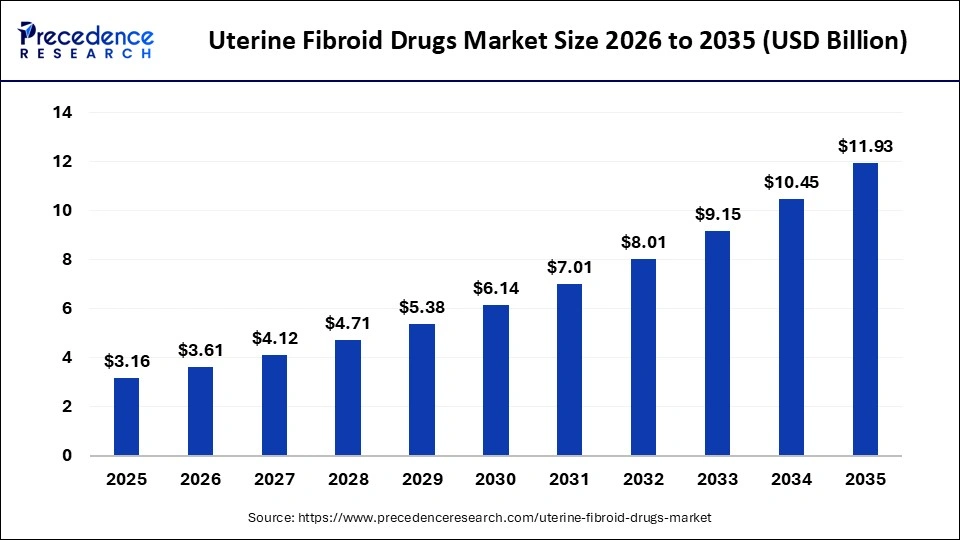
Uterine Fibroid Drugs Market Key Insights
- North America leads with a 35% share in 2025, bolstered by advanced healthcare infrastructure and high diagnostic rates.
- GnRH agonists and antagonists dominate product types at 35% share, while selective progesterone receptor modulators (SPRMs) emerge as the fastest-growing segment.
- Hospital/clinic-based prescriptions hold 55% of deployment, with retail pharmacies poised for rapid expansion.
- Symptomatic treatment for bleeding and pain commands 50% of applications, as patients prioritize immediate relief.
- Hormonal modulation leads technology segments at 45%, with GnRH receptor targeting showing strong growth potential.
- Hospitals and specialty clinics capture over 50% of end-users, while gynecology centers grow briskly.
Uterine Fibroid Drugs Market Scope
| Market Scope | Details |
|---|---|
| 2025 Size | USD 3.16 Billion |
| 2026 Size | USD 3.61 Billion |
| 2035 Size | USD 11.93 Billion |
| CAGR 2026-2035 | 14.21% |
| Top Region | North America (35%) |
| Fastest Region | Asia Pacific |
AI’s Emerging Role in Fibroid Management
Artificial intelligence enhances uterine fibroid diagnosis through radiomics and machine learning, improving accuracy in distinguishing benign lesions from malignancies via imaging analysis. These tools assist clinicians in early detection, optimizing treatment plans and reducing unnecessary procedures.
AI also supports personalized dosing and predictive modeling for drug responses, with digital platforms tracking symptoms like bleeding and pain in real-time. Such innovations promise better patient outcomes, though integration into drug development remains nascent.
What Drives Uterine Fibroid Drugs Market Growth?
Increasing preference for non-surgical options reduces recovery times and surgical risks, boosting pharmaceutical demand . Targeted hormonal therapies provide superior symptom control with fewer side effects, gaining physician trust . Rising awareness, improved diagnostics, and insurance coverage further propel adoption.
What Opportunities and Trends Shape the Future?
How is non-surgical preference reshaping treatment?
Patients favor oral therapies over surgery for faster recovery and fertility preservation.
What trends favor long-term control?
Drugs now target recurrence prevention, with personalized plans based on age and symptoms.
How do new approvals impact access?
Recent nods for oral GnRH antagonists expand options in key markets.
What role does reimbursement play?
Better coverage shifts patients from procedures to drugs.
Key Technological Shifts
| Technological Shift | Description | Impact on Market |
| Oral GnRH antagonists | Development of once-daily oral therapies replacing injectable hormones | Higher patient compliance and faster adoption |
| Add back therapy combinations | Use of hormonal add-back formulations to reduce side effects | Better safety profile and long-term usage feasibility |
| Non-hormonal drug development | Pipeline focused on targeting fibroid growth without hormonal disruption | Expands treatment options for patients with contraindications |
| Personalized dosing algorithms | AI/clinical data used to design individualized treatment plans | More effective symptom control and reduced adverse events |
| Novel drug delivery systems | Long-acting formulations, sustained release mechanisms | Improved therapeutic outcomes and reduced dosing frequency |
| Digital monitoring platforms | Apps and digital tools to track pain, bleeding, and treatment response | Better patient engagement and real-time care adjustment |
Uterine Fibroid Drugs Market Segmentation
Product Type: GnRH agonists/antagonists lead at 35%, excelling in fibroid shrinkage and bleeding reduction; SPRMs grow fastest due to safety profiles.
Deployment: Hospitals/clinics dominate at 55% for supervised care; retail pharmacies surge via convenience.
Application: Symptomatic relief holds 50%; fertility segments expand rapidly.
Mode of Action: Hormonal modulation claims 45%; GnRH targeting accelerates.
End-User: Hospitals lead at 50%; women’s centers grow at high CAGRs.
Uterine Fibroid Drugs Market Regional Highlights
- North America eyes USD 4.24 billion by 2035 (14.34% CAGR), driven by diagnostics.
- Asia Pacific hits USD 3.04 billion, fueled by awareness in India/China .
- Europe targets USD 3.64 billion
- U.S. alone reaches USD 3.18 billion.
Top Companies and Breakthroughs
Key players include AbbVie Inc., Pfizer Inc., Bayer AG, Takeda, Gedeon Richter, Myovant Sciences, Allergan, Ferring, HRA Pharma, Johnson & Johnson, Novartis, Astellas, Eisai, Lupin, Sun Pharma, Mylan (Viatris), Cadila, Biocon, Glenmark, and Sanofi.
-
Kissei Pharmaceutical filed for Linzagolix in Japan (Feb 2025), advancing oral GnRH antagonist.
-
Theramex gained NICE approval for Linzagolix in UK (Aug 2024) and launched Yselty in Germany (Sep 2024).
Challenges and Cost Pressures
Severe side effects like bone loss and hot flashes curb adherence, limiting therapy duration. Stringent regulations demand extensive safety data, hiking costs and delaying approvals. Pricing pressures in emerging markets challenge affordability.
Real-World Case Insights
Studies show mifepristone (50mg biweekly) rivals daily doses in efficacy, achieving amenorrhea in 70-74% of patients over cycles with 65% fibroid volume reduction. Ulipristal acetate (PEARL IV trial) delivered similar results, highlighting drug potential pre-surgery.
Get this report to explore global market size, share, CAGR, and trends, featuring detailed segmental analysis and an insightful competitive landscape overview @ https://www.precedenceresearch.com/sample/7200
You can place an order or ask any questions. Please feel free to contact us at sales@precedenceresearch.com |+1 804 441 9344

- Battery Swapping Market Size to Touch USD 24.74 Billion by 2035 - March 5, 2026
- Dental Air Polishing System Market Size to Reach USD 1603.54 Million by 2035 - March 4, 2026
- Cryoballoon Ablation System Market Size to Surpass USD 2.49 Billion by 2035, Propelled by 5.70% Growth in Minimally Invasive Cardiac Care - March 2, 2026
