
Wi-Fi Adapter Card Market Size Grow To USD 8.95 Billion by 2035
What is the Wi-Fi Adapter Card Market Size in 2026?
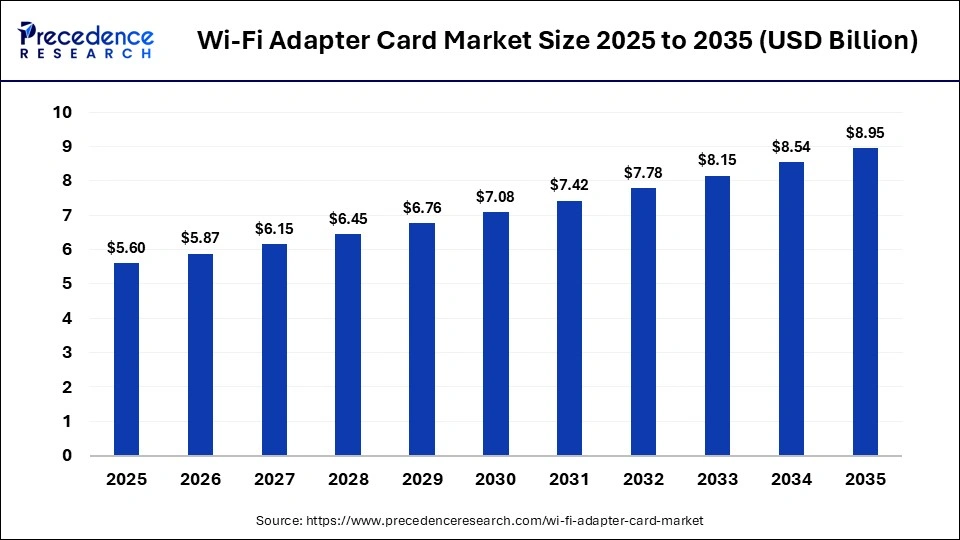
The global Wi-Fi adapter card market size accounted for USD 5.60 billion in 2025 and is predicted to increase from USD 5.87 billion in 2026 to approximately USD 8.95 billion by 2035, expanding at a CAGR of 4.80% from 2026 to 2035. The demand for the market is driven by increasing adoption of wireless devices, technological advancements, and the rising demand for enhanced security features.
Impact of AI in the Wi-Fi Adapter Card Market
AI is enhancing the market by enabling smarter and more efficient wireless connectivity. Network traffic pattern analysis by AI automatically optimizes bandwidth allocation, reduces interference, and improves connection stability by integrating AI technologies into wireless chipsets. AI enhances security by detecting unusual network behavior and potential cyber threats in real-time. AI-driven predictive maintenance improves overall user experience by identifying network issues before they disrupt connectivity. The growing adoption of AI-enabled devices, IoT systems, and high-performance applications such as cloud gaming, AV/VR smart homes, is increasing the demand for advanced Wi-Fi adapter hardware.
Segment Insights
Form Factor Insights
How Did the Internal Wi-Fi Adapter Segment Lead the Wi-Fi Adapter Card Market?
The internal Wi-Fi adapter segment led the market with a market share of approximately 55% in 2025, due to its widespread adoption in modern computing devices. Since these adapters are installed directly into devices such as laptops, desktops, and tablets, they enable an efficient and clutter-free setup while providing stronger signal stability and reliable connectivity. These adapters deliver faster data transfer speeds, lower latency, and improved performance with the support of advanced wireless standards such as Wi-Fi 6 and Wi-Fi 6E for bandwidth-intensive applications like gaming, streaming, and cloud computing. They offer better security, efficient energy usage, and compatibility with device hardware.
Technology Insights
How did the Wi-Fi 6E Segment Dominate the Wi-Fi Adapter Card Market?
The Wi-Fi 6E segment held a dominant position in the market with a market share of approximately 42% in 2025. It enables delivery at a faster speed, lower latency, and improved network efficiency. It provides wider channels and reduced interference, which enable devices to handle higher data traffic and support bandwidth-intensive applications such as cloud gaming and streaming. The rapid growth of connected devices and data usage in homes and enterprises drives the adoption of Wi-Fi 6E, as it enables networks to support multiple devices simultaneously. It maintains stability in connection and high performance in dense environments.
Application Insights
What made the Commercial Segment Dominate the Wi-Fi Adapter Card Market?
The commercial segment held a dominant position in the market with a market share of approximately 38% in 2025. The rapid digital transformation occurring across businesses and organizations is driving the segment. Organizations such as IT, retail, healthcare, and education increasingly rely on high-speed wireless connectivity to support cloud computing, video conferencing, and data sharing. The demand for reliable and high-performance Wi-Fi adaptor cards continues to rise as workplaces expand their wireless infrastructure and deploy more connected devices. Further, the commercial segment expansion is accelerated with the continued growth of hybrid work environments and digital business processes, encouraging organizations to invest in advanced wireless networking hardware.
The industrial segment is expected to grow at the fastest CAGR of 5.0% in the market during the forecast period. Due to the rapid adoption of industrial automation and smart manufacturing technologies, industries are increasingly integrating wireless connectivity into machinery, monitoring systems, and industrial control networks to enable real-time data exchange, remote monitoring, and efficient production management. With the expansion of Industrial Internet of Things (IIoT) and Industry 4.0 initiatives, companies are deploying sensors , devices, and machines that require stable and high-speed wireless connectivity.
Market Overview
A Wi-Fi adapter card is a hardware component that enables computers and other electronic devices to connect to a wireless network without physical cables. It receives radio frequency signals from a wireless router or access point and transmits them into data that the device can use to access the internet. The global Wi-Fi adapter card market is expanding due to increasing demand for high-speed internet, growth in wireless devices, and rising popularity of online and professional gaming. Technological advancements, rising demand for enhanced security features, and smart home technologies are driving adoption. However, the growing integration of built-in wireless capabilities in modern devices may limit demand for standalone adapter cards.
Wi-Fi Adapter Card Market Trends
- Growing demand for high-speed connectivity due to cloud computing , online gaming, and remote work. To ensure stable and fast network access, consumers and enterprises are adopting high-speed Wi-Fi adapter cards.
- Integration of Wi-Fi and Bluetooth in a combo in modern adapter card designs, which enables users to connect multiple wireless devices, such as headsets, controllers, and IoT devices, simultaneously while improving overall device connectivity.
- Manufacturers are integrating security protocols such as WPA3 encryption into Wi-Fi adapters, with rising cybersecurity threats.
- Wi-Fi adapter cards support multiple connected devices and higher network traffic efficiently, with the rapid growth of IoT devices and smart home technologies .
Regional Insights
North America Wi-Fi Adapter Card Market Size and Growth 2026 to 2035
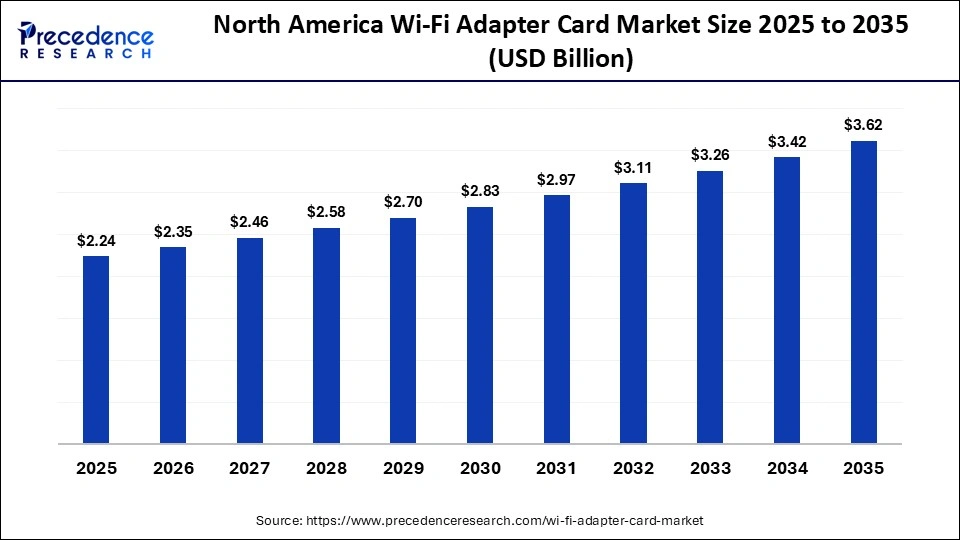
The North America Wi-Fi adapter card market size is estimated at USD 2.24 billion in 2025 and is projected to reach approximately USD 3.62 billion by 2035, with a 4.92% CAGR from 2026 to 2035.
What Factors Have Driven the Dominance of North America in the Market?
North America dominated the Wi-Fi adapter card market with a market share of approximately 40% in 2025. The extensive digital ecosystem and strong broadband infrastructure enable widespread adoption of high-speed wireless connectivity across homes, businesses, and public networks. The early adoption of advanced technologies such as Wi-Fi 6 and Wi-Fi 6E, supported by a large base of consumers and enterprises, is driving the regional growth. The region has high internet penetration, increasing demand for advanced networking hardware such as Wi-Fi adapter cards. The region hosts major technology companies and manufacturers, encouraging continuous innovation and product development.
China’s Wi-Fi Adapter Card Market
China’s market is expanding rapidly. The country h
as a strong digital ecosystem and a large consumer electronics industry, which increases demand for wireless connectivity. The country is witnessing rapid urbanization, increasing internet penetration, and rapid adoption of smart devices, IoT technologies, and home automation systems. The market is further fueled by the increasing use of laptops, PCs, gaming systems, and connected devices in households and businesses. The country has a strong electronics manufacturing ecosystem and hosts major networking equipment producers, accelerating product innovation and adoption of advanced technologies, further supporting market growth.
Wi-Fi Adapter Card Market Companies
- TP-Link Technologies Co., Ltd.
- Netgear Inc.
- ASUSTek Computer Inc. (ASUS)
- D-Link Corporation
- Belkin International Inc.
- Cisco Systems, Inc.
- Linksys (Belkin subsidiary)
- Zyxel Communications Corp.
- Huawei Technologies Co., Ltd.
- Marvell Technology Group Ltd
Segments Covered in the Report
By Form Factor
- Internal Wi-Fi Adapter
- External USB Adapter
By Technology
- Wi-Fi 6E
- Wi-Fi 7
- Wi-Fi 6
- Wi-Fi 5
By Speed
- Above 1200 Mbps
- 600-1200 Mbps
- Below 600 Mbps
By Sales Channel
- Online
- Offline
By Application
- Commercial
- Residential
- Industrial
- Others
Check this report to: Super Disintegrants Market
You can place an order or ask any questions. Please feel free to contact us at sales@precedenceresearch.com |+1 804 441 9344

- Wi-Fi Adapter Card Market Size Grow To USD 8.95 Billion by 2035 - March 17, 2026
- Two Wheeler Anti Lock Braking System Market Size Grow to USD 63.22 Billion by 2035 - March 16, 2026
- AI Control Tower Market Size Grow to USD 33.93 Billion by 2035 - March 13, 2026