
Generative AI in Coding Market Size to Hit USD 479.71 Million by 2035
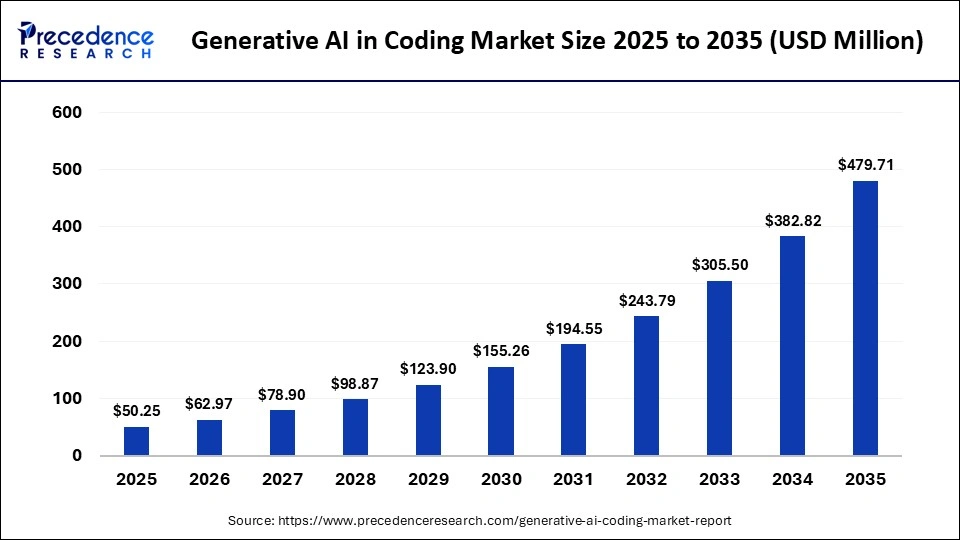
The Generative AI in Coding Market is transforming software development with AI-powered code generation, debugging, and automation, projected to grow at a CAGR of 25.31% through 2035.
Introduction
The Generative AI in Coding Market represents a revolutionary shift in the global software development ecosystem. By leveraging advanced artificial intelligence models such as large language models (LLMs), machine learning systems, and transformer-based architectures, generative AI tools are reshaping how software is written, tested, optimized, and deployed.
Unlike traditional development workflows that rely heavily on manual coding, generative AI enables developers to produce functional code using natural language prompts. This transformation significantly reduces development cycles, minimizes human error, and enhances overall productivity.
As enterprises accelerate digital transformation and adopt automation-first strategies, generative AI in coding has become a critical enabler of modern software engineering.
Read Also: Human Centric Lighting Market
Market Overview
The global Generative AI in Coding Market has witnessed rapid expansion over the past few years due to increasing demand for automation in software engineering workflows.
- Market Size (2025): USD 50.25 million
- Expected Market Size (2026): USD 62.97 million
- Forecast Market Size (2035): USD 479.71 million
- CAGR (2026–2035): 25.31%
This strong growth trajectory reflects the rising dependency on AI-driven development tools across enterprises, startups, and independent developers.
Generative AI tools are increasingly being embedded into Integrated Development Environments (IDEs), cloud platforms, and DevOps pipelines, enabling seamless coding assistance.
Key Growth Drivers
1. Rising Demand for Faster Software Development Cycles
Modern enterprises operate in highly competitive digital environments where speed-to-market is a critical advantage. Generative AI significantly reduces the time required to develop applications by automating repetitive coding tasks such as:
- Boilerplate code generation
- API integration
- Unit test creation
- Code documentation
This allows developers to focus on high-value logic and architecture design.
2. Increasing Adoption of AI-Powered Developer Tools
Tools such as AI coding assistants are becoming standard in development environments. These tools provide:
- Real-time code suggestions
- Error detection and debugging
- Code refactoring recommendations
- Language translation between programming languages
As adoption increases, AI becomes an integral part of everyday coding workflows.
3. Growth of Low-Code and No-Code Platforms
The rise of low-code/no-code ecosystems is strongly supporting market expansion. Generative AI enhances these platforms by enabling:
- Natural language-based application building
- Automated backend logic generation
- Visual-to-code conversion
This democratizes software development beyond professional programmers.
4. Expansion of Cloud-Based Development Environments
Cloud platforms are integrating generative AI to provide scalable coding environments. Benefits include:
- Remote collaboration
- Real-time AI assistance
- Centralized code management
- Enhanced security monitoring
5. Increasing Developer Productivity Pressure
Organizations are under constant pressure to deliver software faster with fewer resources. Generative AI addresses this challenge by:
- Reducing manual workload
- Increasing code reuse
- Improving debugging efficiency
- Accelerating deployment cycles
Market Challenges and Restraints
1. Code Quality and Reliability Issues
While generative AI tools are highly efficient, they may still produce:
- Inconsistent logic
- Redundant code structures
- Syntax errors
- Inefficient algorithms
Human oversight remains necessary to ensure production-grade quality.
2. Security and Compliance Risks
AI-generated code may unintentionally introduce vulnerabilities such as:
- Injection flaws
- Authentication weaknesses
- Data leakage risks
Enterprises must implement strict validation and auditing processes.
3. Intellectual Property Concerns
There are ongoing concerns regarding:
- Ownership of AI-generated code
- Licensing conflicts
- Training data transparency
These issues may impact enterprise adoption in regulated industries.
4. High Dependency on Training Data
The effectiveness of generative AI models depends heavily on:
- Quality of training datasets
- Programming language coverage
- Domain-specific knowledge availability
Limited or biased datasets can reduce accuracy.
Market Opportunities
1. Autonomous Software Engineering
The future of generative AI in coding lies in fully autonomous development systems capable of:
- Requirement analysis
- Architecture design
- Code generation
- Testing and deployment
- Maintenance and optimization
This will redefine traditional software engineering roles.
2. Enterprise AI Integration
Large organizations are rapidly integrating AI coding tools into:
- DevOps pipelines
- CI/CD systems
- Cloud infrastructure
- Enterprise resource planning systems
This creates long-term enterprise contracts and recurring revenue models.
3. Industry-Specific AI Coding Solutions
Customized generative AI tools are emerging for industries such as:
- Banking and finance
- Healthcare systems
- E-commerce platforms
- Telecommunications
- Automotive software
These specialized tools improve accuracy and compliance.
4. Multilingual Code Generation
Future AI systems will support seamless conversion between programming languages such as:
- Python
- Java
- JavaScript
- C++
- Go
This will reduce dependency on specialized developer expertise.
Technology Landscape
1. Large Language Models (LLMs)
LLMs form the backbone of generative coding tools. They are trained on massive code repositories to understand syntax, logic, and patterns.
2. Transformer Architectures
Transformer-based models enable:
- Context-aware code generation
- Long sequence understanding
- Improved accuracy in multi-file projects
3. Retrieval-Augmented Generation (RAG)
RAG systems improve coding accuracy by retrieving relevant code snippets from external databases during generation.
4. Reinforcement Learning from Human Feedback (RLHF)
RLHF helps improve model outputs based on developer feedback, making AI suggestions more reliable over time.
5. Agentic AI Systems
Next-generation systems are evolving into autonomous agents capable of:
- Debugging entire applications
- Refactoring large codebases
- Managing software lifecycle tasks
Market Segmentation Analysis
By Operation
Code Generation
This segment dominates the market due to its ability to automate repetitive programming tasks and accelerate development.
Code Completion
AI tools predict and suggest next lines of code in real time, improving efficiency.
Code Optimization
This segment is growing rapidly as organizations focus on improving performance and reducing resource usage.
By Application
Web Development
One of the fastest-growing segments due to increasing demand for digital platforms and SaaS applications.
Data Science and Analytics
AI assists in writing scripts for data processing, visualization, and machine learning pipelines.
Mobile Application Development
Generative AI is increasingly used to build Android and iOS applications faster.
DevOps and Automation
AI helps in writing deployment scripts, infrastructure as code (IaC), and CI/CD pipelines.
By Industry Vertical
IT and Telecommunications
Largest market share due to heavy reliance on software development tools.
BFSI (Banking, Financial Services, and Insurance)
Uses AI for secure application development and automated compliance systems.
Healthcare
AI assists in building clinical software, data systems, and diagnostic applications.
Retail and E-commerce
Used for building recommendation engines and customer engagement platforms.
Media and Entertainment
Rapid adoption for content platforms, streaming apps, and interactive software.
Regional Analysis
North America
North America dominates the market due to:
- Strong presence of AI companies
- Early adoption of developer tools
- High R&D investments
Europe
Europe is focusing on:
- Ethical AI frameworks
- Industrial automation
- Fintech software innovation
Asia-Pacific
Asia-Pacific is the fastest-growing region driven by:
- Rapid digitalization
- Expanding startup ecosystem
- Government AI initiatives
- Large developer workforce
Latin America & Middle East & Africa
These regions are gradually adopting generative AI tools due to increasing cloud adoption and digital transformation projects.
Competitive Landscape
The market is highly competitive with major technology leaders investing heavily in AI coding solutions. Key players include:
- Microsoft Corporation
- Google LLC
- OpenAI
- IBM Corporation
- NVIDIA Corporation
- Tabnine
- Codium AI
- DeepCode
- Codota
- Replit
These companies are focusing on:
- AI model improvements
- IDE integrations
- Cloud-based AI coding assistants
- Enterprise-grade security features
Recent Developments
- AI coding assistants are being embedded directly into major IDEs.
- Enterprises are deploying AI agents for automated debugging and testing.
- Cloud providers are offering AI-native development environments.
- Open-source communities are contributing to AI code generation models.
Future Outlook (2026–2035)
The Generative AI in Coding Market is expected to evolve from an assistive tool ecosystem into a fully autonomous software engineering framework.
Key future trends include:
- AI-driven full-stack development
- Autonomous debugging systems
- Self-healing applications
- Zero-code enterprise platforms
- AI-managed DevOps pipelines
By 2035, software development may shift from manual coding to AI-orchestrated engineering systems where developers act as supervisors rather than coders.
Conclusion
The Generative AI in Coding Market is undergoing rapid transformation, driven by advancements in artificial intelligence and increasing demand for automation in software development.
With a projected CAGR of 25.31% from 2026 to 2035, the market is set to redefine how software is designed, developed, and deployed globally. Organizations that adopt these technologies early will gain significant advantages in productivity, scalability, and innovation.
Get a Sample Copy: https://www.precedenceresearch.com/sample/8226
For inquiries regarding discounts, bulk purchases, or customization requests, please contact us at sales@precedenceresearch.com
