
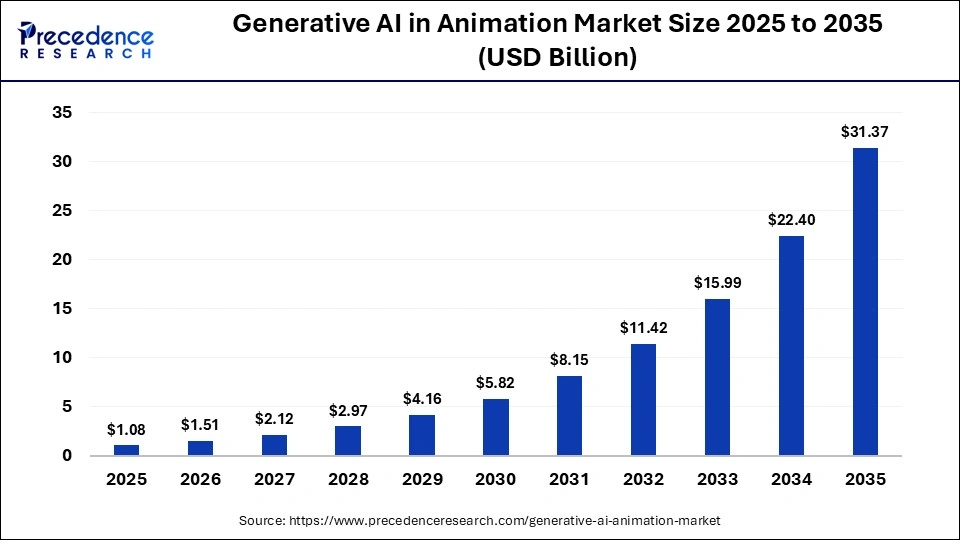
Generative AI in Animation Market Size to Hit USD 31.37 Billion by 2035
The Generative AI in Animation Market is expected to grow exponentially through 2035, driven by AI-powered content creation, automation in animation workflows, and rising demand for realistic digital media.
Introduction
The Generative AI in Animation Market is rapidly transforming the global entertainment, gaming, advertising, and digital content creation industries. By integrating advanced artificial intelligence models such as transformers, Generative Adversarial Networks (GANs), diffusion models, and neural rendering systems, animation workflows are becoming faster, more efficient, and highly scalable.
Generative AI enables creators to automatically produce animations, characters, environments, and motion sequences from simple text prompts or reference inputs. This innovation is significantly reducing production time and cost while enhancing creativity and visual realism.
As demand for immersive digital experiences continues to rise across OTT platforms, gaming studios, and advertising agencies, generative AI is becoming a core technology in modern animation pipelines.
Read Also: Generative AI in Coding Market
Market Overview
The global Generative AI in Animation Market is witnessing strong growth due to increasing adoption of AI-driven creative tools and automation technologies.
- Market Size (2025): USD 1.08 Billion
- Market Size (2026): USD 1.51 Billion
- Forecast Market Size (2035): USD 31.37 Billion
- CAGR (2026–2035): 40.06%
This exponential growth highlights the rapid integration of AI into animation production pipelines across industries such as film production, gaming, advertising, and social media content creation.
Key Market Drivers
1. Rising Demand for Realistic and Immersive Content
Consumers today expect highly realistic, cinematic-quality animations across entertainment platforms. Generative AI enables:
- Realistic character movement and facial expressions
- Natural lighting and environmental simulation
- High-quality 3D rendering in less time
This demand is a major driver for AI adoption in animation studios.
2. Automation of Time-Consuming Animation Tasks
Traditional animation requires manual effort for tasks such as:
- In-between frame generation
- Rotoscoping
- Character rigging
- Lip-sync animation
Generative AI automates these processes, enabling studios to reduce production timelines significantly.
3. Growth of Gaming and Interactive Media Industry
The gaming industry is one of the largest adopters of generative AI in animation. AI is used for:
- Dynamic NPC (non-playable character) generation
- Real-time facial animation
- Procedural environment creation
- Adaptive storytelling systems
This enhances user engagement and improves gameplay realism.
4. Expansion of OTT Platforms and Digital Entertainment
Streaming platforms demand large volumes of animated content across genres and languages. AI helps by:
- Automating localization and dubbing
- Generating multiple animation styles
- Creating personalized content variations
5. Rising Adoption of Text-to-Animation Tools
One of the most transformative trends is text-to-animation generation, where users can describe a scene and AI produces:
- Character movement
- Scene layout
- Camera transitions
- Environmental effects
This is democratizing animation creation for non-professionals.
Market Restraints
1. Inconsistency in AI-Generated Animations
Despite advancements, AI tools still face challenges in:
- Maintaining frame-to-frame consistency
- Preserving character identity
- Ensuring visual continuity in long sequences
2. High Computational Requirements
Training and running generative animation models requires:
- High-performance GPUs
- Large-scale datasets
- Cloud computing infrastructure
This increases operational costs for smaller studios.
3. Ethical and Copyright Concerns
The use of generative AI raises questions regarding:
- Ownership of AI-generated animations
- Use of copyrighted training data
- Potential replacement of human artists
These concerns may slow adoption in regulated industries.
4. Lack of Skilled Professionals
There is a shortage of professionals who understand both:
- Animation pipelines
- AI model development and prompt engineering
This talent gap is a key market challenge.
Market Opportunities
1. AI-Driven Virtual Production
Film and gaming studios are increasingly using AI for:
- Virtual sets
- Real-time character animation
- Digital doubles and avatars
This significantly reduces production costs.
2. Personalized and Interactive Content
AI enables hyper-personalized animations such as:
- User-specific avatars
- Interactive storytelling
- Adaptive advertisements
3. Rise of Virtual Influencers and Digital Humans
Brands are investing in AI-generated influencers for:
- Marketing campaigns
- Social media engagement
- Brand storytelling
4. Expansion into AR/VR Ecosystems
Generative AI enhances immersive experiences in:
- Augmented reality apps
- Virtual reality games
- Metaverse environments
Technology Landscape
1. Generative Adversarial Networks (GANs)
GANs are widely used for:
- Image-to-animation generation
- Character synthesis
- Style transfer in animation
2. Transformer-Based Models
Transformers enable:
- Long-sequence motion prediction
- Context-aware animation generation
- Text-to-animation pipelines
3. Diffusion Models
These models improve:
- Frame quality
- Realistic motion synthesis
- High-resolution animation output
4. Neural Rendering Techniques
Neural rendering helps generate:
- Photorealistic scenes
- Real-time character rendering
- Lighting and texture improvements
5. Agentic AI Systems
Next-generation AI agents are capable of:
- Managing full animation pipelines
- Automatically generating storyboards
- Editing and refining animated sequences
Market Segmentation
By Component
Solutions
AI animation software tools dominate the market due to their ability to automate production workflows.
Services
Services such as model training, consulting, and integration are growing rapidly.
By Type
Transformers
The dominant technology due to its ability to handle sequential animation data effectively.
GANs
Used for generating highly realistic animation outputs.
VAEs and Others
Used for structured and probabilistic animation generation.
By End Use
Gaming
Largest segment due to real-time animation needs.
Advertising
Fast-growing segment using AI for digital ads and marketing content.
Film & Television
Uses AI for VFX, character animation, and CGI production.
OTT Platforms
AI supports scalable content generation for global audiences.
By Region
North America
Leads the global market due to strong AI ecosystem and early adoption.
Asia-Pacific
Fastest-growing region due to expanding gaming industry and digital transformation.
Europe
Focuses on ethical AI development and creative industry innovation.
Competitive Landscape
Key companies operating in the market include:
- NVIDIA Corporation
- Microsoft Corporation
- Google LLC
- Adobe Inc.
- Autodesk Inc.
- Epic Games
- Runway ML
- Unity Technologies
- Meta Platforms Inc.
- DeepMotion
These companies are focusing on:
- AI-powered animation tools
- Real-time rendering engines
- Cloud-based creative platforms
- Metaverse and virtual production systems
Recent Developments
- NVIDIA expanded AI-driven facial animation tools for real-time character generation.
- AI video generation tools are being integrated into professional animation workflows.
- Studios are increasingly adopting AI for pre-visualization and storyboarding.
- Open-source animation AI models are gaining traction in developer communities.
Future Outlook (2026–2035)
The Generative AI in Animation Market is expected to evolve into a fully automated creative ecosystem. Future developments will include:
- Fully AI-generated animated films
- Real-time interactive storytelling systems
- Autonomous animation pipelines
- AI-powered virtual studios
- Hyper-realistic digital humans
By 2035, animation production may shift from manual design processes to AI-driven creative orchestration, where human creators act as directors rather than manual animators.
Conclusion
The Generative AI in Animation Market is entering a period of explosive growth, driven by advances in artificial intelligence, rising demand for digital content, and the increasing need for automation in creative industries.
With a projected CAGR of 40.06% through 2035, generative AI is set to fundamentally reshape animation production, making it faster, more accessible, and more innovative than ever before.
Organizations that adopt these technologies early will gain a strong competitive advantage in storytelling, content creation, and digital entertainment.
Get a Sample Copy: https://www.precedenceresearch.com/sample/8225
For inquiries regarding discounts, bulk purchases, or customization requests, please contact us at sales@precedenceresearch.com
