
Precision Reduction Gears Market Size to Attain USD 5.23 Billion by 2034 as Robotics and AI Revolutionize Motion Engineering
Market’s Stride Accelerates on the Back of Robotics, Automation, and AI-Enhanced Gear Design
The global precision reduction gears market is surging forward, predicted to grow from a valuation of USD 3.16 billion in 2025 to an impressive USD 5.23 billion by 2034, expanding at a steady 5.76% CAGR.
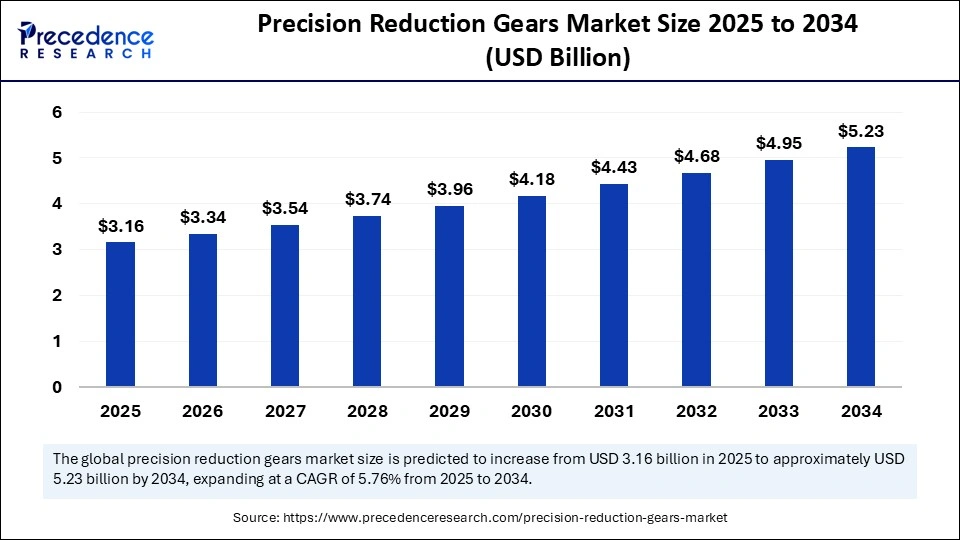
This rapid climb is underpinned by the rise of automation across various industries, a robotics boom, and accelerating adoption of digital manufacturing. Meanwhile, the integration of AI and sophisticated material science is transforming both gear innovation and efficiency, equipping companies to meet demands for accuracy, miniaturization, and sustainability.
Precision Reduction Gears Market Key Insights
-
The market reached USD 2.99 billion in 2024 and is forecasted to top USD 5.23 billion by 2034.
-
Asia Pacific claims the largest share, accounting for about 41% of global market value, while North America emerges as the fastest-growing region.
-
Leading companies are closely tied to robotics, digital manufacturing, and motion control advancements.
-
Top application: Robotics and collaborative robots dominate, with medical devices and industrial automation following as fast-growth sectors.
-
The most dominant technology: Strain wave gears, highly favored for their torque-to-weight ratio and compactness, are the industry backbone.
-
Hospitals, semiconductor producers, and the aerospace sector are among the top end-users adopting high-precision gears for critical, real-time operations.
Precision Reduction Gears Market Revenue Overview
| Year | Market Size (USD Billion) | CAGR (2025-2034) |
|---|---|---|
| 2024 | 2.99 | |
| 2025 | 3.16 | 5.76% |
| 2034 (F) | 5.23 |
-
Asia Pacific: USD 1.23 billion in 2024 to USD 2.17 billion by 2034 (CAGR: 5.84%).
How Is AI Shaping Precision Reduction Gears?
Artificial Intelligence is fast becoming the hidden genius behind next-gen precision reduction gears. AI algorithms now optimize gear geometry and fine-tune stress-load simulations, supercharging efficiency and extending product lifespans. With machine learning, manufacturers can tailor gear solutions for ultra-specific industrial, medical, and aerospace tasks—accelerating customization and minimizing downtime through smart predictive analytics. This not only improves reliability in critical use cases but also lowers operational costs through enhanced fault detection and preventive maintenance.
Moreover, AI-infused automation is set to reduce production errors and power perpetual scalability. As smart sensors and digital twins become mainstream in factories, the boundary between mechanical and digital engineering blurs, transforming precision gears from static components to intelligent, adaptable assets.
What’s Powering Market Growth?
Global automation is propelling market momentum, with robotics serving as a primary growth engine. The demand for accurate torque transmission in logistics, healthcare, and advanced manufacturing is relentless. Simultaneously, the electric vehicle revolution and aerospace modernization fuel new avenues for high-durability, lightweight precision gears.
Technological advances in material science, miniaturization, and digital monitoring have made precision reduction indispensable for semiconductor fabrication and medical diagnostics. The ongoing push for smarter, leaner factories worldwide is further embedding these components in the industrial landscape.
What Are the Emerging Opportunities and Trends?
Is Collaborative Robotics Creating New Market Niches?
Absolutely—service and collaborative robots now require compact, silent, and ultra-precise motion systems. Collaborative robotics for manufacturing, healthcare, and logistics have carved out powerful new demand niches. High-growth robotics segments are projected to outpace industrial automation in precision gear adoption in the coming years.
How Is the Electric Vehicle (EV) Boom Affecting the Market?
The electrification of vehicles globally drives innovation in high-precision gear systems for powertrains and chassis. Lightweight, energy-efficient designs aligned with EV requirements mark a major opportunity for gear makers. As more countries incentivize EV adoption, demand for specialized reduction gears is accelerating.
Are Sustainable Designs a Competitive Differentiator?
Sustainability mandates and net-zero goals spur demand for gear systems made from eco-friendly, recyclable components and advanced lubricants. Companies investing in green engineering gain competitive advantage in both mature and emerging markets.
Precision Reduction Gears Market Regional and Segment Analysis
Why Is Asia Pacific the Global Powerhouse?
Asia Pacific, holding 41% of the market in 2024, retains dominance because of its robust manufacturing base, advanced supply chains, and government initiatives supporting automation. China, Japan, and South Korea lead, with strong EV and robotics sectors. Local production advantages, combined with breakthrough innovations from Japanese and Korean firms in AI-driven control, cement the region’s leadership. India’s fast-growing automation sector also adds momentum.
How Is North America the Fastest Growing?
North America’s rapid growth comes from advanced robotics in healthcare, defense, and smart manufacturing, with a focus on AI and IoT integration. In Europe, sustainability and automotive innovation fuel market expansion. Both regions benefit from high R&D investment and government incentives for advanced manufacturing. Custom-developed, high-reliability systems drive lucrative new business in these markets.
Precision Reduction Gears Market Segments Gaining Ground
By Gear Type: Strain wave gears remain dominant, while cycloid gears record the fastest uptick due to their robustness and scalability.
By Precision Level: High-precision gears are vital for robotics, aerospace, and semiconductors. Standard-precision gears, once niche, are now the fastest-growing segment in cost-conscious markets.
By Configuration: Inline reduction gears are the industry’s anchor, particularly in robotics and CNC machinery. Right-angle gears are gaining traction with compact medical and packaging devices.
Precision Reduction Gears Market Companies
- Harmonic Drive Systems Inc.
- Nabtesco Corporation
- Sumitomo Heavy Industries
- WITTENSTEIN SE
- Cone Drive
- Neugart GmbH
- Spinea s.r.o.
- Onvio LLC
- Beijing CTKM Harmonic Drive Co., Ltd.
- Leaderdrive (China)
- GAM Enterprises, Inc.
- KOFON Motion Group
- DieQua Corporation
- Zhejiang Laifual Drive Co., Ltd.
- APEX Dynamics, Inc.
What Are the Main Challenges and Cost Pressures?
Despite robust demand, high initial investment costs, engineering complexity, and dependence on specialized raw materials constrain adoption for small and mid-sized enterprises. Technical hurdles, such as heat management and lubrication, add to operational cost pressures. Global supply chain disruptions and a lack of standardized gear specifications pose further limitations to market expansion.
Case Study: Enabling Zero-Defect Manufacturing in Robotics
A leading global robotics manufacturer replaced legacy drive systems with AI-optimized strain wave gears, achieving 25% higher productivity and zero unplanned downtime in pick-and-place operations. By integrating real-time vibration and strain sensors, predictive analytics flagged issues before mechanical failure, enabling the company to slash maintenance costs and maximize uptime—an industry-first in precision automation.
Get this report to explore global market size, share, CAGR, and trends, featuring detailed segmental analysis and an insightful competitive landscape overview @ https://www.precedenceresearch.com/sample/6838
You can place an order or ask any questions. Please feel free to contact us at sales@precedenceresearch.com |+1 804 441 9344

- ESG Software Market 2025: Comprehensive Key Players Ecosystem and Revenue Outlook - May 20, 2026
- ESG Software Market Worth Around USD 31.96 Billion by 2035 - May 20, 2026
- Hematopoietic Stem Cell Transplantation Market Size to Attain USD 24.32 Billion by 2035 as Precision Medicine and AI Reshape Blood Cancer Treatment - May 20, 2026
