
ESG Software Market Worth Around USD 31.96 Billion by 2035
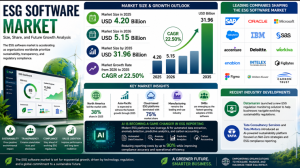
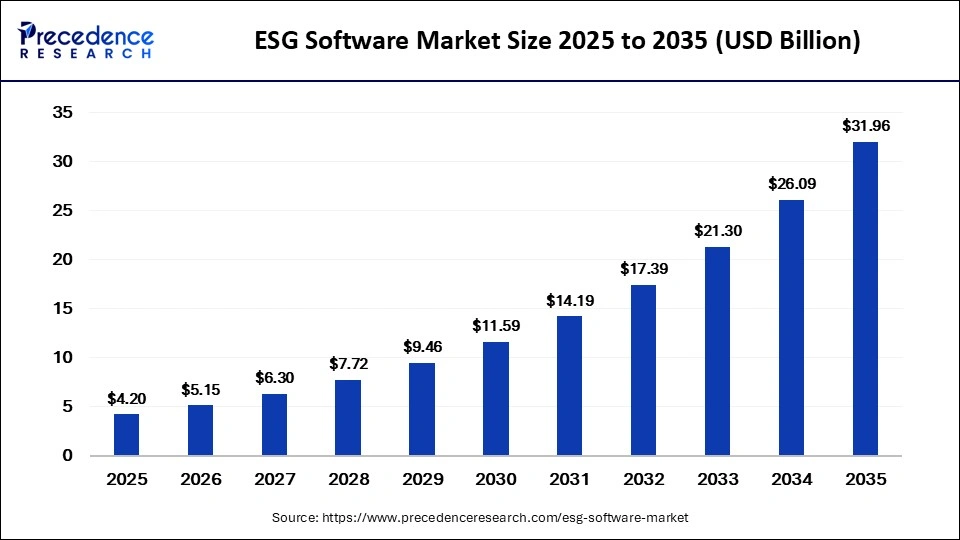
The global ESG software market is entering a transformative decade as enterprises worldwide increasingly prioritize transparent sustainability reporting, climate-risk management, and governance compliance. According to industry analysis, the global ESG software market size was valued at USD 4.20 billion in 2025 and is forecast to rise from USD 5.15 billion in 2026 to nearly USD 31.96 billion by 2035, expanding at a remarkable CAGR of 22.50% between 2026 and 2035.
The market is witnessing rapid momentum as organizations move away from frag
mented spreadsheets and manual disclosure systems toward automated, AI-powered ESG reporting platforms. The surge in mandatory disclosure frameworks, including the EU’s Corporate Sustainability Reporting Directive (CSRD), SEC climate disclosure requirements, and global sustainability standards, is significantly reshaping how businesses manage environmental, social, and governance data.
ESG software platforms are increasingly becoming mission-critical tools for enterprises seeking audit-ready reporting, carbon accounting precision, supply-chain transparency, and real-time sustainability performance monitoring.
ESG Software Market Key Points
- The global ESG software market is expected to reach USD 31.96 billion by 2035 from USD 4.20 billion in 2025, reflecting strong enterprise adoption worldwide.
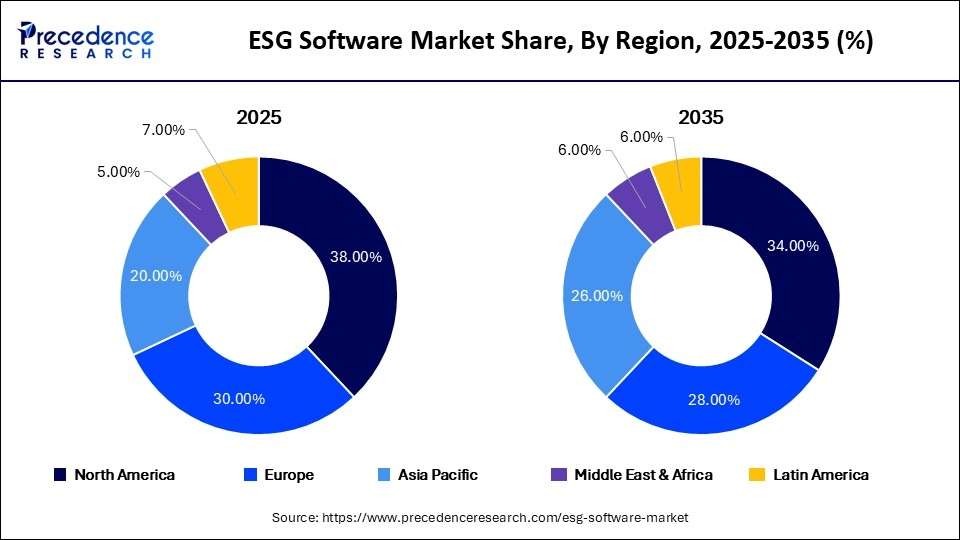
- North America accounted for the largest revenue share of 38% in 2025 due to strict compliance mandates and strong investor demand for auditable ESG data.
- Asia-Pacific is projected to witness the fastest growth rate of 25% CAGR through 2035 because of rapid digital transformation and sustainability reporting reforms.
- The software segment dominated the market with 70% share in 2025 as enterprises increasingly adopted automated ESG tracking and reporting systems.
- Cloud-based deployment led the market with 75% share in 2025 owing to scalability, flexibility, and lower infrastructure costs.
- Sustainability management emerged as the leading functionality segment with 35% market share in 2025.
- Manufacturing remained the largest end-use industry with 20% share, supported by growing pressure for sustainable production and supply-chain transparency.
- Large enterprises represented 70% of total market revenue in 2025 because of higher ESG compliance budgets and global operational complexity.
Why is ESG Software Becoming Essential for Modern Enterprises?
The global business landscape is rapidly evolving toward transparency, accountability, and sustainability-focused operations. Investors, regulators, consumers, and stakeholders are increasingly demanding reliable ESG disclosures that go beyond traditional financial reporting.
Modern ESG software solutions provide centralized platforms capable of aggregating environmental, governance, and social performance metrics in real time. These systems help enterprises automate reporting, track emissions, evaluate supplier sustainability, manage governance risks, and maintain compliance with rapidly changing global regulations.
Organizations are also leveraging ESG software to enhance investor confidence and strengthen long-term enterprise value. High-quality ESG reporting is increasingly influencing access to capital, shareholder trust, brand reputation, and competitive positioning across industries.
How is Artificial Intelligence Reshaping the ESG Software Industry?
Artificial intelligence is becoming one of the most disruptive technologies in the ESG software ecosystem. AI-powered platforms are enabling companies to automate large-scale data extraction from internal systems, supplier networks, regulatory databases, and sustainability disclosures.
Machine learning algorithms can detect reporting anomalies, predict climate-related risks, and improve carbon accounting accuracy with significantly reduced manual intervention. Industry estimates suggest that AI-driven ESG reporting solutions can reduce reporting costs by more than 90%, while dramatically improving reporting speed and audit readiness.
AI is also playing an increasingly important role in predictive sustainability analytics. Companies are now using AI-based ESG platforms to model climate scenarios, forecast supply-chain risks, optimize energy consumption, and proactively manage compliance challenges before they escalate into operational or regulatory issues.
As ESG reporting requirements become more complex globally, AI integration is expected to become a defining competitive advantage for software vendors and enterprise adopters alike.
ESG Software Market Revenue Outlook
| Market Indicator | Value |
|---|---|
| Market Size in 2025 | USD 4.20 Billion |
| Market Size in 2026 | USD 5.15 Billion |
| Forecast Market Size by 2035 | USD 31.96 Billion |
| CAGR (2026-2035) | 22.50% |
| Dominating Region | North America |
| Fastest Growing Region | Asia-Pacific |
What are the Major Growth Drivers Fueling the Market?
Regulatory Pressure and Mandatory ESG Reporting
Governments and regulatory bodies across the world are implementing stringent disclosure mandates aimed at improving sustainability accountability. Regulations such as CSRD in Europe and SEC climate disclosure proposals in the United States are compelling organizations to adopt automated ESG reporting platforms.
Businesses are increasingly required to generate transparent, accurate, and auditable sustainability data, creating strong demand for specialized ESG software solutions.
Investor Demand for Transparent ESG Data
Institutional investors and asset managers are increasingly incorporating ESG metrics into investment decision-making frameworks. Reliable ESG reporting is now viewed as a key indicator of long-term business resilience and operational sustainability.
This trend is encouraging enterprises to invest heavily in software platforms capable of delivering credible, audit-ready ESG disclosures.
Digital Transformation and Cloud Adoption
The rapid shift toward cloud-based enterprise systems is accelerating ESG software deployment across organizations of all sizes. Cloud-based platforms offer scalability, cost efficiency, centralized reporting, and real-time analytics capabilities, making them particularly attractive for SMEs and multinational corporations alike.
Could AI and Advanced Analytics Unlock the Next Growth Phase?
The ESG software market is entering a new innovation cycle driven by predictive analytics, automation, and intelligent risk management tools.
AI-enabled ESG platforms are increasingly capable of:
- Automating sustainability reporting workflows
- Monitoring Scope 3 emissions
- Conducting climate-risk simulations
- Enhancing supplier traceability
- Supporting proactive compliance management
- Improving operational sustainability forecasting
As climate-related financial risks become more prominent, businesses are expected to prioritize intelligent ESG analytics platforms capable of supporting long-term strategic decision-making.
ESG Software Market Segment Analysis
Component Analysis
In 2025, the Software segment held the largest market share at 70%, valued at USD 2.94 billion. This dominance is attributed to the growing need for automated ESG tracking and reporting solutions, along with the rising adoption of AI/ML and IoT technologies to measure ESG performance. The Software segment is projected to grow at a CAGR of 23%, reaching USD 23.97 billion by 2035 and capturing a 75% market share.
The Services segment accounted for 30% of the market in 2025, worth USD 1.26 billion, and is expected to grow at a CAGR of 19.5%, reaching USD 7.99 billion by 2035, representing 25% market share. The segment is growing as companies increasingly leverage end-to-end ESG solutions, with expansion in consultancy, implementation, and customization services driving demand.
Deployment Mode Analysis
The Cloud-based deployment mode dominated the market with a 75% share in 2025, representing USD 3.15 billion, due to its scalability, flexibility, and cost-effectiveness. Cloud-based solutions allow organizations to adopt ESG reporting without heavy IT infrastructure investment, which is particularly appealing to SMEs. The Cloud-based segment is expected to grow at a CAGR of 26%, reaching USD 26.20 billion by 2035, with a market share of 82%.
The On-premise segment held 25% of the market in 2025, worth USD 1.05 billion, primarily preferred by large enterprises for enhanced data security and regulatory compliance. The segment is projected to grow at a CAGR of 13%, reaching USD 5.75 billion by 2035, with an 18% market share, supported by demand for secure and customizable ESG software.
Functionality Analysis
The Sustainability Management segment led the market in 2025 with a 35% share, valued at USD 1.47 billion. Its growth is fueled by the adoption of sustainable practices, renewable energy, and ESG tracking goals. Sustainability Management is expected to grow at a CAGR of 24%, reaching USD 11.83 billion and 37% market share by 2035.
The Environmental Management segment accounted for 30% in 2025, worth USD 1.26 billion, driven by investments in ESG tracking systems and regulatory compliance, particularly in manufacturing and logistics. It is projected to grow at a CAGR of 22.5%, reaching USD 10.23 billion and 32% market share by 2035.
The Social Responsibility Tracking segment held 18% in 2025, valued at USD 0.76 billion, driven by corporate sustainability initiatives. It is expected to grow at a CAGR of 19.5%, reaching USD 5.11 billion in 2035, representing 16% of the market.
The Governance, Risk, and Compliance (GRC) segment accounted for 10% of the market in 2025, worth USD 0.42 billion, due to regulatory compliance and governance risk management needs. It is projected to grow at 18% CAGR, reaching USD 2.88 billion and 9% market share by 2035.
The Reporting & Analytics segment held 7% of the market in 2025, valued at USD 0.29 billion, and is expected to grow at 17.5% CAGR, reaching USD 1.92 billion and 6% market share by 2035.
End-Use Industry Analysis
The Manufacturing segment had the largest market share of 20% in 2025, valued at USD 0.84 billion, driven by sustainable production practices and supply chain management. It is expected to grow at a CAGR of 21.5%, reaching USD 7.03 billion and 22% market share by 2035.
The BFSI segment held 18% in 2025, worth USD 0.76 billion, growing at 18.5% CAGR to USD 5.43 billion by 2035, driven by regulatory pressures and sustainability-focused risk management.
The IT & Telecom segment accounted for 15% of the market in 2025, valued at USD 0.63 billion, growing at a CAGR of 20%, reaching USD 5.11 billion by 2035, supported by ESG integration into energy-efficient and sustainable IT operations.
The Healthcare segment held 14% in 2025, worth USD 0.59 billion, with CAGR of 21%, reaching USD 4.79 billion by 2035, driven by regulatory compliance and transparency initiatives.
The Retail & E-commerce segment accounted for 18% in 2025, valued at USD 0.76 billion, growing at 19.5% CAGR, reaching USD 6.07 billion by 2035.
The Energy & Utilities segment had 10% in 2025, valued at USD 0.42 billion, expected to grow at 17.5% CAGR, reaching USD 2.88 billion by 2035.
The Government segment held 5% in 2025, worth USD 0.21 billion, projected to grow at 15.5% CAGR, reaching USD 1.92 billion by 2035.
Organization Size Analysis
The Large Enterprises segment dominated the market in 2025 with 70% share, valued at USD 2.94 billion, driven by high budgets for ESG integration, global operations, and regulatory compliance. It is projected to grow at 22.5% CAGR, reaching USD 19.18 billion and 60% market share by 2035.
The SMEs segment held 30% of the market in 2025, worth USD 1.26 billion, fueled by the affordability and scalability of cloud-based ESG solutions. It is expected to grow at the fastest CAGR of 27%, reaching USD 12.78 billion and 40% market share by 2035.
ESG Software Market Regional Analysis
North America
In 2025, North America held the largest market share of 38%, with a total ESG Software market of USD 1.596 billion, growing to USD 10.87 billion in 2035 at a CAGR of 22.8%.
- United States: The market is projected to grow from USD 1.357 billion in 2025 to USD 9.239 billion in 2035, with a CAGR of 21.14%. The growth is driven by investor demand for transparency, widespread adoption of AI-powered and cloud-based reporting tools, and rapid uptake in BFS and energy sectors. Key players like Nasdaq, Diligent, and Workiva provide cloud-based ESG reporting platforms with AI integration.
- Canada: The Canadian market is expected to rise from USD 0.239 billion in 2025 to USD 1.630 billion in 2035, with a CAGR of 21.17%, supported by regulatory compliance and growing corporate ESG adoption.
Europe
Europe accounted for 30% of the market in 2025, with a value of USD 1.26 billion, reaching USD 8.95 billion in 2035 at a CAGR of 21.9%.
- Germany: The market will grow from USD 0.378 billion in 2025 to USD 2.685 billion in 2035, CAGR 21.66%. Germany leads Europe due to strong manufacturing mandates, carbon tracking requirements, and sustainability initiatives.
- United Kingdom: The ESG software market is expected to rise from USD 0.315 billion in 2025 to USD 2.237 billion in 2035, CAGR 21.66%, driven by corporate ESG transparency and investor-driven reporting requirements.
- France: The market will expand from USD 0.252 billion in 2025 to USD 1.790 billion in 2035, CAGR 21.66%, supported by proactive sustainability policies and CSRD implementation.
- Other European countries: Remaining countries collectively contribute to the region’s growth, adopting ESG reporting to meet regulatory and corporate sustainability goals.
Asia Pacific
Asia-Pacific held 20% of the market in 2025, valued at USD 0.84 billion, projected to reach USD 8.31 billion in 2035, at a CAGR of 25.7%. The region is expected to witness the fastest growth.
- China: The ESG software market will grow from USD 0.336 billion in 2025 to USD 3.324 billion in 2035, CAGR 25.3%, supported by dual carbon goals, carbon neutrality targets by 2060, AI/ML adoption, and green finance initiatives.
- Japan: The market is projected to rise from USD 0.210 billion in 2025 to USD 2.078 billion in 2035, CAGR 25.5%, driven by corporate sustainability mandates and technology adoption.
- India: ESG software adoption will increase from USD 0.168 billion in 2025 to USD 1.662 billion in 2035, CAGR 25.6%, with growth fueled by regulatory requirements and technology integration.
- Australia: The market will expand from USD 0.126 billion in 2025 to USD 1.247 billion in 2035, CAGR 25.2%, supported by ESG reporting adoption in corporate and government sectors.
Middle East & Africa
This region held 5% of the market in 2025, valued at USD 0.21 billion, projected to reach USD 1.92 billion in 2035, at a CAGR of 25.3%.
- UAE: The market will grow from USD 0.0735 billion in 2025 to USD 0.672 billion in 2035, CAGR 25.3%, driven by government-led sustainability regulations and cloud-based ESG adoption.
- South Africa: ESG software adoption will increase from USD 0.0735 billion in 2025 to USD 0.672 billion in 2035, CAGR 25.3%, supported by regulatory compliance and corporate ESG initiatives.
- Saudi Arabia: The market is expected to grow from USD 0.063 billion in 2025 to USD 0.576 billion in 2035, CAGR 25.3%, driven by emerging ESG regulations and corporate sustainability programs.
Latin America
Latin America accounted for 7% of the market in 2025, valued at USD 0.294 billion, reaching USD 1.92 billion in 2035, with a CAGR of 21.1%.
- Brazil: The ESG software market will rise from USD 0.176 billion in 2025 to USD 1.152 billion in 2035, CAGR 21.1%, supported by corporate ESG adoption and regulatory frameworks.
- Mexico: The market is projected to grow from USD 0.118 billion in 2025 to USD 0.768 billion in 2035, CAGR 21.1%, fueled by sustainability mandates and corporate compliance initiatives.
Major Companies Operating in the ESG Software Market
Tier 1 – Enterprise ESG Platforms
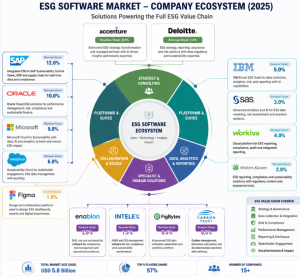
- SAP – Revenue: USD 0.55 billion. Offers ESG reporting, sustainability performance management, carbon footprint tracking, and compliance tools integrated with SAP S/4HANA. Primarily serves large enterprises with real-time sustainability analytics.
- Microsoft – Revenue: USD 0.60 billion. Provides Microsoft Cloud for Sustainability, ESG analytics, carbon tracking, and AI-powered insights to integrate sustainability into operations.
- Oracle – Revenue: USD 0.45 billion. Delivers ESG cloud applications, climate risk analytics, CSR reporting, and ESG data management, focusing on cloud-based integration of ESG and financial data.
- Salesforce – Revenue: USD 0.35 billion. Offers Sustainability Cloud for ESG reporting, carbon accounting, and stakeholder engagement, with CRM-linked ESG tracking.
- IBM – Revenue: USD 0.40 billion. Provides AI-powered ESG analytics, risk and compliance management, and supply chain sustainability solutions targeting large enterprises.
Tier 2 – Specialized ESG & EHS Management
These companies focus on analytics-driven or compliance-focused ESG software.
- SAS – Revenue: USD 0.25 billion. Offers ESG analytics software, sustainability dashboards, and predictive ESG risk modeling.
- Workiva – Revenue: USD 0.20 billion. Provides ESG reporting and compliance platforms, integrated reporting solutions, and data visualization tools.
- Enablon – Revenue: USD 0.18 billion. Specializes in EHS management, risk management, and ESG performance monitoring, delivering end-to-end solutions.
- Intelex Technologies – Revenue: USD 0.12 billion. Focuses on ESG and EHS management, compliance tracking, and sustainability reporting for small to mid-sized companies.
- FigBytes – Revenue: USD 0.08 billion. Provides ESG strategy platform, sustainability KPI tracking, and carbon accounting tools, with a focus on visualization and engagement.
- FigJam (Figma) – Revenue: USD 0.05 billion. Offers collaborative ESG planning and design tools for visualizing workflows and managing projects.
Tier 3 – Consulting & Advisory Focus
These companies primarily provide strategy, reporting, and certification support.
- Accenture – Revenue: USD 0.30 billion. Offers ESG advisory, strategy consulting, software implementation, and reporting solutions.
- Deloitte – Revenue: USD 0.28 billion. Provides ESG reporting services, compliance solutions, sustainability audits, and advisory.
- Wolters Kluwer – Revenue: USD 0.10 billion. Specializes in regulatory compliance software, ESG risk assessment, and reporting for compliance-heavy industries.
- Carbon Trust – Revenue: USD 0.07 billion. Offers carbon footprint assessment tools, sustainability consulting, and ESG certification support.
Latest Breakthroughs
The ESG software ecosystem is witnessing rapid innovation as vendors focus on AI-powered automation, regulatory intelligence, and climate-risk analytics.
- In March 2026, Datamaran launched a new ESG regulation monitoring platform designed to help enterprises track evolving sustainability regulations across global markets. The solution aims to simplify compliance management amid increasingly complex reporting requirements.
- In November 2025, Tata Consultancy Services and Tata Motors introduced an AI-powered sustainability platform focused on Net-Zero strategy management, real-time emission tracking, and ESG compliance reporting aligned with SEBI’s BRSR framework.
These developments highlight how ESG software providers are moving beyond basic reporting tools toward intelligent sustainability management ecosystems.
Segments Covered in the Report
By Component
- Software
- Services
By Deployment Mode
- Cloud-based
- On-premise
By Functionality
- Sustainability Management
- Environmental Management
- Social Responsibility Tracking
- Governance, Risk, and Compliance (GRC)
- Reporting and Analytics
By End-use Industry
- BFSI
- IT and Telecom
- Healthcare
- Manufacturing
- Retail and E-commerce
- Energy and Utilities
- Government
By Organization Size
- Large Enterprises
- Small and Medium Enterprises
By Region
- North America
- Latin America
- Europe
- Asia-pacific
- Middle and East Africa
Read Also: Podcasting Market Size Projected to Surpass USD 115.57 Billion by 2035
Get this report to explore global market size, share, CAGR, and trends, featuring detailed segmental analysis and an insightful competitive landscape overview @ https://www.precedenceresearch.com/sample/8420
You can place an order or ask any questions. Please feel free to contact us at sales@precedenceresearch.com |+1 804 441 9344

- ESG Software Market 2025: Comprehensive Key Players Ecosystem and Revenue Outlook - May 20, 2026
- ESG Software Market Worth Around USD 31.96 Billion by 2035 - May 20, 2026
- Hematopoietic Stem Cell Transplantation Market Size to Attain USD 24.32 Billion by 2035 as Precision Medicine and AI Reshape Blood Cancer Treatment - May 20, 2026
