
Manufacturing Analytics Market Poised to Reach USD 41.67 Billion by 2034, Fueled by Industry 4.0 and Predictive Technologies
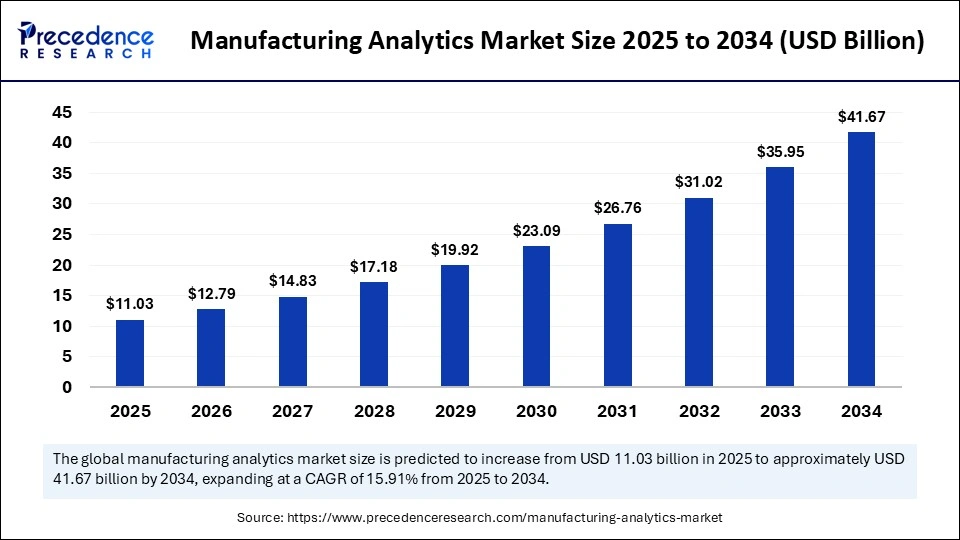
The global manufacturing analytics market is witnessing dynamic growth as manufacturers progressively adopt data-driven decision-making to optimize operations across production lines and supply chains. Valued at USD 11.03 billion in 2025, this market is forecasted to expand to USD 41.67 billion by 2034, reflecting a compound annual growth rate (CAGR) of 11.9% over the forecast period. Industry 4.0 trends, increasing demand for operational efficiency, predictive maintenance, and enhanced supply chain transparency are central growth catalysts for this booming sector.
Manufacturing Analytics Market Key Highlights
-
The market’s valuation reached approximately USD 11.03 billion in 2025 and is projected to approach USD 41.67 billion by 2034.
-
North America dominates the market with an estimated value of USD 4.63 billion in 2025, driven by mature industrial ecosystems and widespread adoption of AI and IoT technologies.
-
Key players fueling innovation and competition include IBM Corporation, Oracle Corporation, SAP SE, SAS Institute Inc., Tableau Software (Salesforce), and Microsoft Corporation.
-
The Asia-Pacific region is fast growing, exhibiting the highest CAGR, led by rising smart factory investments and government support for digital manufacturing.
-
Manufacturing analytics solutions leverage AI-enabled predictive maintenance and real-time quality management to reduce downtime and enhance product consistency.
Market Revenue Breakdown and Segmentation Analysis
The manufacturing analytics market revenue is segmented across various dimensions including component type, deployment mode, analytics type, application, and vertical industries:
| Segment | Key Insights |
|---|---|
| Component | Software dominates with advanced analytics and visualization tools; Services focus on integration and consulting. |
| Deployment Mode | Cloud-based analytics gain traction due to scalability and cost-effectiveness, while on-premises solutions remain critical for sensitive manufacturing environments. |
| Analytics Type | Predictive and prescriptive analytics see rapid adoption for maintenance and quality control, supplementing descriptive analytics. |
| Application | Demand forecasting, inventory management, and real-time production monitoring lead adoption use cases. |
| End-User Industry | Automotive, aerospace, pharmaceuticals, and electronics manufacturing are prominent verticals leveraging analytics for compliance and efficiency. |
The Role of Artificial Intelligence in Manufacturing Analytics
Artificial Intelligence (AI) acts as a cornerstone technology in the manufacturing analytics market, offering transformative capabilities beyond traditional data analysis. AI-driven predictive maintenance tools utilize machine learning algorithms to detect early signs of equipment wear and failure, significantly reducing unplanned downtime and repair costs. These intelligent systems sift through vast streams of sensor data, enabling manufacturers to make proactive maintenance decisions rather than reactive fixes.
Moreover, AI supports adaptive quality control by automating defect detection and process adjustments in real-time, thus maintaining consistent product quality while reducing waste. Integrating AI with cloud-based analytic platforms allows for enhanced scalability and continuous improvement, which is crucial for modern smart factories operating under Industry 4.0 paradigms.
What Are the Key Drivers of Manufacturing Analytics Market Growth?
Several powerful trends and factors are accelerating the adoption of manufacturing analytics:
-
The proliferation of connected sensors and Industrial Internet of Things (IIoT) devices provides an unprecedented volume of operational data for analytics solutions.
-
Increasing regulatory compliance demands and quality standards in sectors such as pharmaceuticals and aerospace prompt manufacturers to adopt real-time traceability and quality assurance analytics.
-
The push toward mass customization and flexible manufacturing necessitates data-driven systems capable of addressing production complexity without escalating costs.
-
Cloud adoption facilitates scalable and cost-effective analytics deployment, supporting global manufacturing operations and remote monitoring capabilities.
-
Growing sustainability concerns inspire the use of analytics to optimize energy consumption and minimize waste, aligning profit margins with environmental regulations.
Market Scope
| Report Coverage | Details |
| Market Size in 2025 | USD 11.03 Billion |
| Market Size in 2026 | USD 12.79 Billion |
| Market Size by 2034 | USD 41.67 Billion |
| Market Growth Rate from 2025 to 2034 | CAGR of 15.91% |
| Dominating Region | North America |
| Fastest Growing Region | Asia Pacific |
| Base Year | 2025 |
| Forecast Period | 2025 to 2034 |
| Segments Covered | Component / Offering, Deployment Model, Application / Use Case, Industry Vertical, and Region |
| Regions Covered | North America, Europe, Asia-Pacific, Latin America, and Middle East & Africa |
What Opportunities and Trends Define the Future of Manufacturing Analytics?
How will Industry 4.0 shape the manufacturing analytics market?
Industry 4.0 technologies like IoT, AI, and machine learning are foundational drivers. They enable seamless data integration, predictive insights, and real-time decision-making, transforming traditional plants into fully connected smart factories.
What is the impact of cloud and edge computing on analytics adoption?
Cloud computing offers flexible, cost-efficient data storage and analysis, while edge computing enables real-time analytics closer to manufacturing processes, reducing latency and enhancing responsiveness.
How are manufacturers addressing cybersecurity challenges in analytics?
As manufacturing analytics platforms grow, securing sensitive operational data becomes critical. Companies are investing in advanced cybersecurity protocols, including encryption, identity management, and anomaly detection.
What role does workforce training play in analytics success?
Data literacy initiatives and upskilling programs empower employees to interpret analytic insights effectively, ensuring better implementation of technology-driven improvements on the shop floor.
Regional and Segmentation Analysis Highlights
North America remains the largest market due to its robust industrial infrastructure, stringent regulatory frameworks, and rapid adoption of digital manufacturing technologies. Europe emphasizes innovation with a focus on compliance and environmentally sustainable manufacturing practices, while Asia-Pacific leads in market growth driven by expansive smart factory deployments in China, India, and Southeast Asia.
Segment-wise, predictive analytics dominates due to its efficacy in maintenance and quality control. Cloud deployment modes are growing rapidly, with hybrid solutions tailored for sensitive industries. End-use industries like automotive and aerospace heavily depend on analytics for complex product design and stringent quality standards.
Latest Breakthroughs from Industry Leaders
Top companies are continuously innovating to enhance manufacturing analytics capabilities:
-
IBM Corporation has enhanced its AI-driven Watson IoT platform with advanced predictive analytics features.
-
Oracle Corporation integrates real-time analytics with ERP systems for seamless operational insights.
-
SAP SE focuses on Industry 4.0 analytics with scalable cloud-native platforms.
-
SAS Institute releases new prescriptive analytics tools tailored for manufacturing process optimization.
-
Tableau Software (Salesforce) has integrated AI-driven visualization tools to simplify complex data interpretation.
These innovations are creating greater interoperability of analytics platforms with existing manufacturing execution systems (MES) and ERP, facilitating smoother transitions toward digital factories.
What Are the Key Challenges and Cost Pressures Facing the Market?
Manufacturers face hurdles such as high upfront costs for advanced analytics solutions, complex integration with legacy manufacturing systems, and data privacy concerns. Additionally, the scarcity of skilled talent to handle sophisticated analytics technologies poses a challenge. Cost pressures also emerge from scaling analytics infrastructure while justifying ROI in varying economic cycles. Overcoming these requires strategic investments in modular, scalable, and user-friendly analytics platforms.
Manufacturing Analytics in Action: A Case Study
A leading global automotive manufacturer implemented AI-powered predictive maintenance across its production facilities, resulting in a 15% reduction in unplanned downtime within the first year. By integrating sensor data analytics with cloud-based monitoring dashboards, the company achieved improved equipment longevity, enhanced safety compliance, and reduced maintenance costs, driving significant operational savings and production efficiency.
Get this report to explore global market size, share, CAGR, and trends, featuring detailed segmental analysis and an insightful competitive landscape overview @ https://www.precedenceresearch.com/sample/7111
You can place an order or ask any questions. Please feel free to contact us at sales@precedenceresearch.com |+1 804 441 9344

- ESG Software Market 2025: Comprehensive Key Players Ecosystem and Revenue Outlook - May 20, 2026
- ESG Software Market Worth Around USD 31.96 Billion by 2035 - May 20, 2026
- Hematopoietic Stem Cell Transplantation Market Size to Attain USD 24.32 Billion by 2035 as Precision Medicine and AI Reshape Blood Cancer Treatment - May 20, 2026
