
Toluene Diisocyanate Market Set for Steady Growth to 3.47 Million Tons by 2034 with AI-Driven Sustainability and Industrial Innovation
The global toluene diisocyanate (TDI) market is projected to grow steadily, reaching approximately 3.47 million tons by 2034 from 2.89 million tons in 2025, at a CAGR of 2.06% during the forecast period. This growth is primarily fueled by rising demand for flexible polyurethane foams in the automotive, furniture, and construction sectors, supported by rapid industrialization and consumer lifestyle improvements.
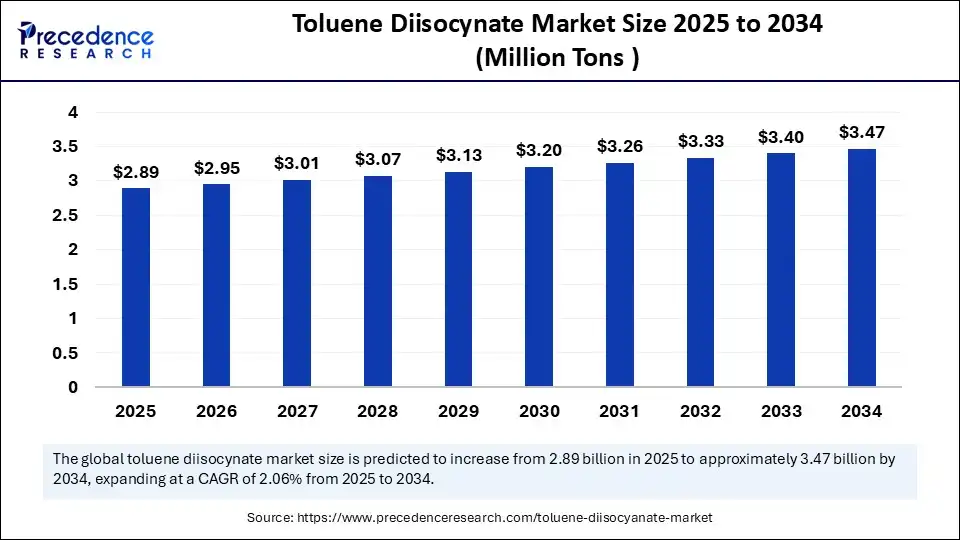
Toluene Diisocyanate Market Key Insights
-
The TDI market demand is forecasted to expand from 2.89 million tons in 2025 to 3.47 million tons by 2034.
-
Asia Pacific dominates the market with a 53% share in 2024, driven by China, India, and South Korea.
-
The Middle East & Africa is the fastest-growing region with robust infrastructure and urban development.
-
Flexible polyurethane foam leads applications with a 68% share in 2024, followed by growing coatings demand.
-
Pure grade (2,4-TDI) held over 80% market share in 2024; modified grades are gaining traction.
-
Furniture and bedding are the largest end-use industries (40% share), with automotive applications showing strong growth.
-
Major players include BASF SE, Covestro AG, Wanhua Chemical Group, Mitsui Chemicals, and Dow Inc.
-
AI technologies are transforming production efficiency, sustainability, and quality control in TDI manufacturing.
Market Growth and Drivers
The increasing demand for lightweight, energy-efficient, and durable materials is driving the TDI market. Flexible polyurethane foams made from TDI are essential in furniture cushions, mattresses, automotive seats, and packaging. The automotive industry’s shift toward lightweight seating to improve fuel efficiency and the construction sector’s interest in thermal insulation materials further propel TDI demand. Urbanization, increased consumer expenditure on home furnishings and automobiles, and government policies promoting green buildings augment the market’s positive outlook.
AI’s Role in Shaping the Toluene Diisocyanate Market
Artificial intelligence is playing a pivotal role in enhancing the efficiency and sustainability of TDI production. AI-enabled predictive analytics help optimize chemical reactions in real-time, improve raw material usage, and reduce energy consumption. Machine learning systems facilitate early detection of impurities, minimizing waste and ensuring consistent product quality.
Additionally, AI-based demand forecasting streamlines inventory and supply chain management, enabling manufacturers to anticipate market fluctuations effectively. Digital twin simulations also assist in environmental compliance by optimizing emissions and energy use, marking a significant advancement in sustainable chemical manufacturing.
Market Scope
| Report Coverage | Details |
| Market Demand in 2025 | USD 2.89 Million Tons |
| Market Demand in 2026 | USD 2.95 Million Tons |
| Market Demand by 2034 | USD 3.47 Million Tons |
| Market Growth Rate from 2025 to 2034 | CAGR of 2.06% |
| Dominating Region | Asia Pacific |
| Fastest Growing Region | Middle East & Africa |
| Base Year | 2025 |
| Forecast Period | 2025 to 2034 |
| Segments Covered | Application, Grade, End-Use Industry, Isomer Type, and Region |
| Regions Covered | North America, Europe, Asia-Pacific, Latin America, and Middle East & Africa |
What Opportunities and Trends Are Driving the TDI Market Forward?
How is regional development influencing TDI consumption?
Asia Pacific leads with a 53% market share in 2024, driven by massive manufacturing in China and India and expanding automotive and construction industries. The Middle East & Africa show the highest CAGR, supported by booming infrastructure and housing projects, especially in Saudi Arabia under its Vision 2030 strategy.
What are the emerging application sectors for TDI?
Besides dominant flexible polyurethane foam, coatings are witnessing significant growth fueled by international environmental standards, low-VOC formulations, and rapid infrastructure development. Adhesives and sealants made from TDI are gaining traction due to high bonding strength and chemical resistance, particularly in lightweight vehicle production and modular construction.
How are manufacturers responding to environmental and regulatory pressures?
ALeading companies are investing in green chemistry and AI-assisted process optimizations to produce low-emission and bio-based TDI variants. Collaboration between TDI producers and downstream users aims to develop sustainable polyurethane foams and coatings, leveraging renewable feedstocks and circular economy principles.
Regional and Segment Analysis
-
Asia-Pacific dominates with 1.53 million tons demand in 2025, expected to reach 1.86 million tons by 2034, led by China’s extensive production capabilities and rising downstream polyurethane industries.
-
North America’s market growth is supported by advances in green building and automotive sectors, focusing on energy-efficient materials and low-VOC products.
-
Europe emphasizes environmentally friendly manufacturing to comply with strict regulations and support exports.
-
The Middle East & Africa are rapidly emerging as key growth regions due to urbanization and infrastructure expansion.
-
Application-wise, flexible polyurethane foam holds the majority market share at 68%, with coatings and adhesives segments growing strongly.
-
By grade, the pure grade (2,4-TDI) remains predominant, with increasing adoption of modified grades tailored for specialty applications.
-
End-use industries include furniture & bedding (40% share), automotive interiors, construction insulation, packaging, footwear, and textiles.
-
Isomer types: 2,4-TDI leads the market, with mixed isomers and 2,6-TDI gaining interest due to specialized performance needs.
Latest Breakthroughs and Company Highlights
Leading companies actively embrace innovation for greener and more efficient TDI production. BASF SE has introduced low-carbon footprint TDI and AI-driven process optimization. Covestro AG develops renewable feedstock-based TDI and AI digital twins for plant operations. Wanhua Chemical Group expanded capacity with a new 360,000-tonne facility to strengthen its global market position.
Other notable players include Dow Inc., Huntsman Corporation, Mitsui Chemicals, Tosoh Corporation, OCI Company Ltd., Sadara Chemical Company, Vencorex Holding, Chemtura Corporation (LANXESS), Karoon Petrochemical, GNFC, Hanwha Solutions Corporation, DIC Corporation, Shandong Juli Chemical, Rubicon LLC, Yantai Juli Fine Chemical, Bayer MaterialScience, and Shandong Dongda Chemical.
Challenges and Cost Pressures
TDI production involves hazardous chemicals like phosgene, requiring stringent safety and environmental controls, driving high capital and operating costs. Market growth faces raw material price volatility, especially in crude oil derivatives used for synthesis. Regulatory pressures on isocyanate emissions compel manufacturers to invest heavily in cleaner, energy-efficient technologies. Overcapacity in certain regions may exert pricing pressures, intensifying competition among producers.
Case Study: BASF’s Sustainable TDI Innovation
BASF SE’s recent pilot production of renewable feedstock-based TDI at its Ludwigshafen plant exemplifies innovation marrying sustainability with performance. By integrating biomass-based raw materials and AI-assisted process control, BASF reduced CO2 emissions significantly while maintaining high product quality. The company’s launch of eco-balanced Lupranate TDI and advanced catalysts underlines a strategic commitment to resource efficiency and environmental stewardship, reinforcing their leadership in the global TDI market.
Get this report to explore global market size, share, CAGR, and trends, featuring detailed segmental analysis and an insightful competitive landscape overview @ https://www.precedenceresearch.com/sample/7116
You can place an order or ask any questions. Please feel free to contact us at sales@precedenceresearch.com |+1 804 441 9344

- ESG Software Market 2025: Comprehensive Key Players Ecosystem and Revenue Outlook - May 20, 2026
- ESG Software Market Worth Around USD 31.96 Billion by 2035 - May 20, 2026
- Hematopoietic Stem Cell Transplantation Market Size to Attain USD 24.32 Billion by 2035 as Precision Medicine and AI Reshape Blood Cancer Treatment - May 20, 2026
