
Dual Chamber Syringe Filling Machine Market Size to Reach USD 819.77 Million by 2034, Growing at a CAGR of 8.54%
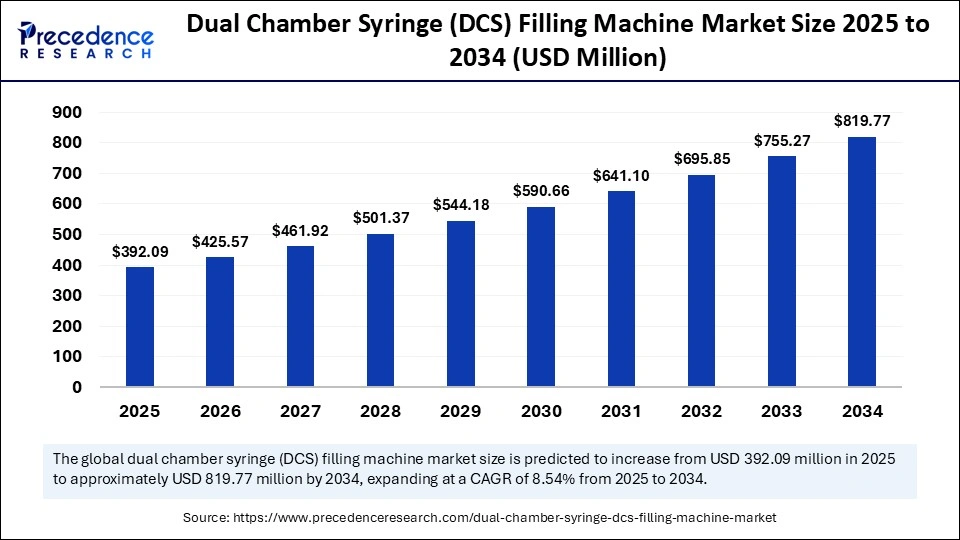
The global dual chamber syringe filling machine market is set to expand significantly, with a valuation of USD 392.09 million in 2025 expected to nearly double to USD 819.77 million by 2034. This growth is driven by a compound annual growth rate (CAGR) of 8.54% from 2025 to 2034, fueled by increasing demand for prefilled and lyophilized injectable drugs in the biopharmaceutical industry.
Dual Chamber Syringe Filling Machine Market Key Insights
-
The market size stood at USD 392.09 million in 2025 and is forecasted to reach USD 819.77 million by 2034.
-
North America, particularly the U.S., is the largest regional market, accounting for USD 205.46 million in 2025.
-
The U.S. dual chamber syringe filling machine market alone is projected to grow from USD 152.04 million in 2025 to USD 320.33 million in 2034.
-
Leading players in the market include Syntegon Technologies, Prosys Servo Filling Systems, Dara Pharmaceutical Packaging, TurboFil Packaging Machines, and Optima Machinery Corporation.
-
The market growth is strongly supported by advancements in automation, robotics, and increasing production of biological and lyophilized injectables.
What Is Driving the Dual Chamber Syringe Filling Machine Market?
The expanding use of prefilled syringes and the rise in biologics and lyophilized drugs are key market drivers. Prefilled syringes enhance patient safety, convenience, and reduce medication errors, which aligns with the biopharmaceutical industry’s focus on sophisticated drug delivery systems. Increasing chronic disease prevalence and demographic shifts toward an aging population further propel demand. Additionally, the pharmaceutical sector’s shift toward automation and stringent regulatory standards enhances market growth.
What Role Does AI Play in The Market?
Artificial intelligence (AI) is revolutionizing dual chamber syringe filling machines by optimizing production processes and ensuring higher precision and quality control. AI-powered vision systems and data analytics tools are increasingly integrated into filling machines to detect errors, reduce waste, and enhance operational efficiency. This technological advancement also supports regulatory compliance by maintaining stringent sterile filling requirements and enabling predictive maintenance to minimize downtime.
Dual Chamber Syringe Filling Machine Market Scope
| Report Coverage | Details |
| Market Size in 2025 | USD 392.09 Million |
| Market Size in 2026 | USD 425.57 Million |
| Market Size by 2034 | USD 819.77 Million |
| Market Growth Rate from 2025 to 2034 | CAGR of 8.54% |
| Dominating Region | North America |
| Fastest Growing Region | Asia Pacific |
| Base Year | 2024 |
| Forecast Period | 2025 to 2034 |
| Segments Covered | Machine Type, Sterility/Process Mode, Chamber/Product Type Filled, End-User/Buyer, Application/Drug Class, and Region |
| Regions Covered | North America, Europe, Asia-Pacific, Latin America, and Middle East & Africa |
Market Opportunities and Emerging Trends: What Key Questions Are Shaping The Market?
How are advancements in automation impacting the market?
Advances in robotics and automation are improving filling speeds, accuracy, and reliability while lowering operational costs. Customized machines tailored to specific production needs are gaining traction.
What are the emerging geographic opportunities?
While North America leads, Asia Pacific is the fastest-growing market due to rapid pharmaceutical industry developments, especially in China and India.
How do regulatory standards influence market adoption?
Strict regulatory guidelines, particularly in Europe and North America, encourage the adoption of advanced sterile filling technologies, ensuring safer drug delivery and higher market acceptance.
Challenges and Cost Pressures
Despite robust growth, challenges such as high equipment costs, complex regulatory compliance, and the need for specialized maintenance can create barriers to market entry and expansion. Manufacturers must navigate these hurdles while improving machine accuracy and reducing downtime to remain competitive.
Dual Chamber Syringe Filling Machine Market Regional Analysis
North America remains the largest market, reflecting a strong biopharmaceutical presence and advanced healthcare infrastructure. Europe follows with significant contributions from countries like Germany, UK, and Italy, where stringent quality standards promote advanced filling technologies.
The Asia Pacific region is notable for rapid market expansion due to burgeoning pharmaceutical manufacturing, particularly in China and India. Other regions such as South America and the Middle East & Africa are witnessing emerging market growth supported by healthcare infrastructure improvements and economic diversification.
Top Dual Chamber Syringe Filling Machine Market Companies
Provides advanced aseptic processing, filling, and packaging systems for pharmaceuticals and biotech products, emphasizing high automation, precision dosing, and compliance with stringent regulatory standards.
Supplies highly automated pharmaceutical filling, sealing, and packaging equipment for injectables, vials, syringes, and diagnostics, with strong expertise in sterile and high-speed systems.
Delivers comprehensive pharmaceutical packaging solutions including filling, sealing, sterilization, and assembly systems, supporting injectable, oral, and specialty drug production.
The former Bosch Packaging division (now Syntegon) develops high-performance sterile filling machines, isolators, and inspection technologies tailored for biologics and small-volume injectables.
Manufactures precision filling and sealing equipment for small-dose pharmaceutical and cosmetic applications, focusing on servo-driven accuracy and flexible production.
Provides aseptic filling, closing, and washing systems for vials, syringes, cartridges, and IV bags, widely used in biotech and sterile drug manufacturing.
Offers specialized liquid filling, closing, and assembly systems for pharma applications, known for modularity, innovation, and ability to handle complex container formats.
The U.S. arm of OPTIMA, providing pharmaceutical filling, assembly, and packaging technologies with strong service and integration capabilities for regulated markets.
Develops robotic, closed-system aseptic filling solutions for vials and syringes, widely adopted for biological drugs and small-batch production (now part of Cytiva).
Supplies pharmaceutical machinery, including filling, capping, labeling, and packaging systems designed for reliability and compliance in sterile production environments.
Dual Chamber Syringe Filling Machine MarketSegments Covered in the Report
By Machine Type
- Fully automatic inline filling & stoppering systems
- Semi-automatic/bench/laboratory systems
- Standalone filling modules
By Sterility/Process Mode
- Aseptic
- Non-aseptic/closed transfer
By Chamber/Product Type Filled
- Liquid/liquid dual chambers
- Liquid/lyophilized powder
- Liquid/diluent + drug compartments
By End-User/Buyer
- Pharmaceutical & biotech manufacturers
- Contract Development & Manufacturing Organizations
- Small biotech/clinical trial sponsors / R&D labs
By Application/Drug Class
- Biologics & monoclonal antibodies
- Vaccines & immunotherapies
- Small-molecule combination injectables
- Specialty & ophthalmic biologics
By Region
- North America
- Europe
- Asia Pacific
- Latin America
- Middle East and Africa
Get this report to explore global market size, share, CAGR, and trends, featuring detailed segmental analysis and an insightful competitive landscape overview @ https://www.precedenceresearch.com/sample/7133
You can place an order or ask any questions. Please feel free to contact us at sales@precedenceresearch.com |+1 804 441 9344

- ESG Software Market 2025: Comprehensive Key Players Ecosystem and Revenue Outlook - May 20, 2026
- ESG Software Market Worth Around USD 31.96 Billion by 2035 - May 20, 2026
- Hematopoietic Stem Cell Transplantation Market Size to Attain USD 24.32 Billion by 2035 as Precision Medicine and AI Reshape Blood Cancer Treatment - May 20, 2026
