
Life Science Automation and Robotics Market Size and Forecast 2025 to 2034
The global life science automation and robotics market is rapidly expanding, driven by high-throughput research demands, advancing biologic pipelines, and AI-enabled autonomous lab systems. Valued for precision and scalability, the market is forecast to grow at a robust CAGR of around 15% through 2034, transforming workflows in drug discovery, diagnostics, and biomanufacturing.
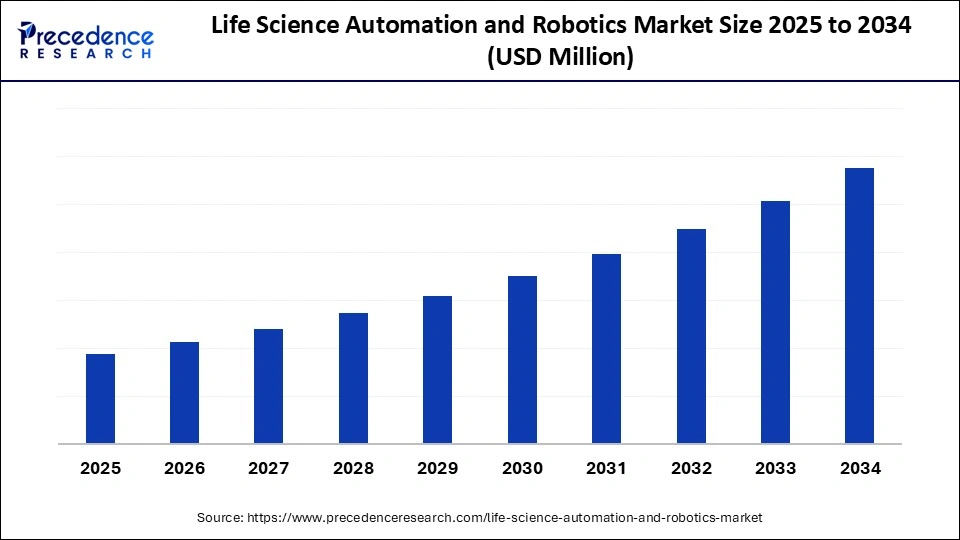
Quick Insights: The market was led by North America in 2024, with Asia Pacific poised for the fastest growth. Laboratory robotics dominated the technology segment, while pharmaceutical companies remain the top end-users. AI-driven autonomous systems and bioprocessing automation are gaining significant traction. Key industry players include Siemens, GE Healthcare, Merck, and Thermo Fisher.
What Is Fueling Life Science Automation and Robotics Adoption?
The life science sector is witnessing rising complexity in R&D pipelines, particularly biologics and cell therapies, which require scalable, precise, and reproducible workflows. Automation addresses labor shortages and the need for 24/7 operations, enhancing throughput and data accuracy. Integrated robotics and cloud-connected analytics are streamlining experimental and manufacturing processes, while AI optimizes assay design and predictive maintenance. Increasing capital investments by major industry players and venture funding for startups accelerating democratized automation also contribute to this upward trajectory.
How Is AI Transforming the Market?
AI plays a pivotal role by enabling autonomous optimization of laboratory assays, adaptive experimental scheduling, and real-time anomaly detection in biomanufacturing lines. Machine learning facilitates motion control and robotic path planning, thereby improving efficiency and minimizing contamination. AI-powered digital twins and cloud-based platforms are becoming integral to orchestrated lab workflows, enhancing regulatory compliance and accelerating drug development timelines.
What Growth Opportunities and Trends Are Emerging in Life Science Automation?
How are startups influencing market dynamics?
Emerging companies like Opentrons and Automata are developing modular, cost-effective automation solutions targeting smaller research labs, facilitating wider adoption.
What role does bioprocessing automation play?
The shift towards continuous, automated production in GMP facilities is reducing contamination risk and improving consistency.
How is regional growth shaping the market?
Asia Pacific’s pharmaceutical scale-up and government investments drive rapid adoption. China is fast becoming a biotech hub with increased self-sufficiency initiatives.
In what ways is automation impacting clinical diagnostics?
Automated sample handling and molecular analytics are improving turnaround times and accuracy in diagnostic labs.
Regional and Segmentation Analysis
North America leads with high pharmaceutical R&D expenditure and advanced digital infrastructure, notably the U.S., which drives demand for AI-enabled lab systems and GMP manufacturing automation. Europe follows with steady growth from biotech hubs, regulatory focus, and sustainability-driven automation.
Asia Pacific presents the highest growth prospects due to expanding pharma manufacturing and biotech investments, spearheaded by China, Japan, and South Korea.
Segments such as laboratory robotics remain dominant, while AI-driven autonomous systems display the highest growth rates across technology types. Workflow-wise, drug discovery and high-throughput screening capture significant market shares, while bioprocessing and manufacturing automation show promising growth .
Latest Breakthroughs and Leading Companies
September 2025 saw Merck and Siemens signing a renewed collaboration to integrate AI and data-based drug discovery tools. May 2025 marked GE Healthcare’s approval for its MRI system powered by industrial automation, enhancing diagnostic speed and patient comfort. Siemens Healthineers’ Atellica Automation system, launched in late 2024, reduced manual lab tasks significantly, improving efficiency amidst staffing shortages. Leading companies dominating the market include Siemens, GE Healthcare, Merck, Thermo Fisher, Danaher, and Sartorius among others .
What Challenges and Cost Pressures Affect the Market?
High initial capital expenditure on robotic systems and AI platforms can be restrictive, especially for smaller labs. Integration complexities across multi-vendor environments and stringent regulatory compliance further challenge adoption. Additionally, sustaining system performance with continuous upgrades and cybersecurity concerns adds to operational costs. Labor shortages and rising R&D costs, however, underscore the importance of automation as a cost-saving and efficiency-enhancing strategy over time .
Life Science Automation and Robotics MarketSegments Covered in the Report
By Technology Type
- Laboratory Robotics
- Process/Manufacturing Robotics
- AI-Driven Autonomous Systems
- Modular & Collaborative Robots (Cobots)
- Automated Liquid Handling Systems
- Vision-Guided Robotics
- Automated Storage & Retrieval Systems (ASRS)
By Workflow/Application
- Drug Discovery & High-Throughput Screening (HTS)
- Genomics, Proteomics & Cell Biology Automation
- Clinical Diagnostics Automation
- Bioprocessing & Biomanufacturing (Upstream & Downstream)
- Fill-Finish & Packaging Automation
- Quality Control & Inspection Automation
- Sample Preparation & Handling
By Component
- Robotic Systems
- Automated Instruments
- Software & Digital Control Platforms
- Consumables & Accessories
- Integration & Custom Automation Services
By End-User
- Pharmaceutical Companies
- Biotechnology Companies
- Contract Research Organizations (CROs)
- Contract Development & Manufacturing Organizations (CDMOs/CMOs)
- Clinical & Diagnostic Laboratories
- Academic & Research Institutes
- Medical Device Manufacturers
By Process Area
- R&D Laboratories
- Clinical & Diagnostic Labs
- Manufacturing & Packaging
- Quality Control & Regulatory Testing
- Supply Chain & Warehouse Automation
By Distribution Channel
- Direct OEM Sales
- Automation Integrators
- Value-Added Resellers
- Online Industrial Platforms
By Region
- North America
- Europe
- Asia-Pacific
- Latin America
- Middle East & Africa
Get this report to explore global market size, share, CAGR, and trends, featuring detailed segmental analysis and an insightful competitive landscape overview @ https://www.precedenceresearch.com/sample/7142
You can place an order or ask any questions. Please feel free to contact us at sales@precedenceresearch.com |+1 804 441 9344

- ESG Software Market 2025: Comprehensive Key Players Ecosystem and Revenue Outlook - May 20, 2026
- ESG Software Market Worth Around USD 31.96 Billion by 2035 - May 20, 2026
- Hematopoietic Stem Cell Transplantation Market Size to Attain USD 24.32 Billion by 2035 as Precision Medicine and AI Reshape Blood Cancer Treatment - May 20, 2026
