
Public Cloud Migration Market Set to Surge: Projected to Reach $414.18 Billion by 2035
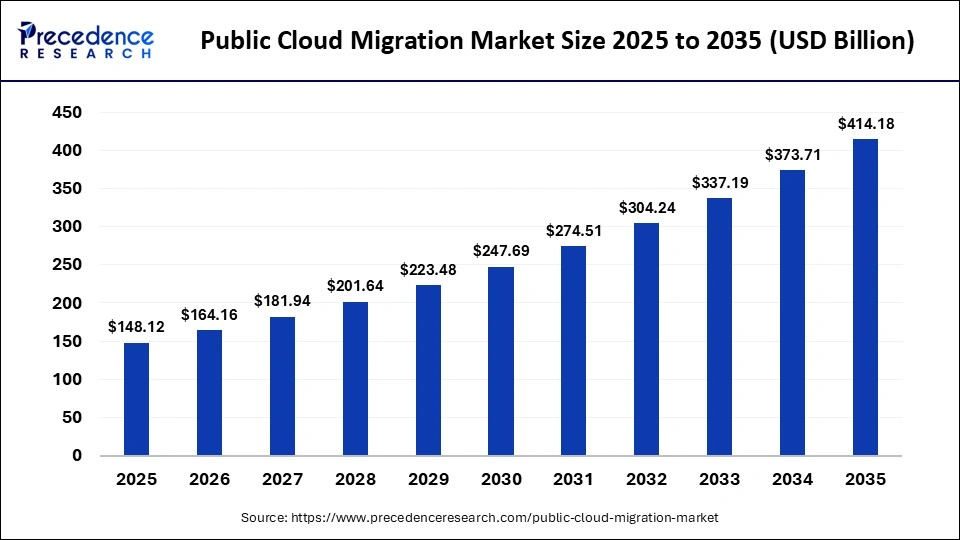
The global public cloud migration market is on a steep growth trajectory, with a valuation of $148.12 billion in 2025 and a forecasted rise to $414.18 billion by 2035, expanding at a robust CAGR of 10.83% over the next decade. This growth is propelled by digital transformation initiatives, heightened data security demands, and the widespread adoption of remote and hybrid work models that require agile, scalable, and resilient cloud infrastructure.
What’s Driving the Public Cloud Migration Boom?
Organizations worldwide are rapidly migrating their IT workloads to public cloud platforms to achieve greater agility, scalability, and cost efficiency. The market’s momentum is being fueled by the need for enhanced data security, compliance, and the ability to support evolving business models in a post-pandemic world. As digital transformation becomes a strategic imperative, public cloud migration is no longer a luxury but a necessity for enterprises aiming to stay competitive and future-ready.
Public Cloud Migration Market Key Highlights
-
The public cloud migration market was valued at $148.12 billion in 2025 and is projected to reach $414.18 billion by 2035.
-
North America leads the market with a 45.9% share in 2025, while Asia Pacific is expected to grow at the fastest CAGR of 22.5%.
-
The rehosting (Lift & Shift) segment dominated with a 35.4% market share in 2025.
-
The online/live migration mode held the highest market share at 62.2% in 2025.
-
The application migration segment led with over 36.7% of the market share in 2025.
-
The BFSI sector was the largest end-use industry, holding a 35.6% market share in 2025.
Revenue Table: Market Size and Growth
| Year | Market Size (USD Billion) |
|---|---|
| 2025 | 148.12 |
| 2026 | 164.16 |
| 2035 | 414.18 |
How Is AI Transforming Public Cloud Migration?
AI is revolutionizing public cloud migration by automating assessment, planning, and execution tasks, drastically reducing errors, costs, and migration timelines. Predictive analytics powered by AI optimizes resource allocation and identifies the most efficient migration strategies, while proactive threat detection and real-time monitoring ensure secure and resilient cloud environments.
AI-driven migration frameworks are also enabling organizations to continuously optimize cloud operations, forecast future capacity needs, and identify bottlenecks for improved performance and scalability. As AI becomes more integrated into cloud migration solutions, enterprises can expect faster, safer, and more cost-effective transitions to the cloud.
Public Cloud Migration Market Growth Factors
-
Increasing demand for business agility and scalability in a digital-first economy.
-
Aggressive digital transformation efforts to modernize legacy IT systems.
-
The global shift toward remote and hybrid work models.
-
The rise of multi-cloud and hybrid cloud strategies to avoid vendor lock-in and ensure regulatory compliance.
-
Growing investments in automation and AI-driven migration tools.
Public Cloud Migration Market Opportunity and Trend: What’s Next for Public Cloud Migration?
Why is Multi-Cloud Adoption Accelerating?
Enterprises are increasingly adopting multi-cloud strategies to balance costs, ensure data sovereignty, and comply with regional regulations. This trend is especially prominent in regulated industries such as BFSI and healthcare, where data privacy and security are paramount.
How Are Automation and AI Driving Innovation?
Automation and AI are streamlining complex migration processes, reducing manual errors, and enabling seamless transitions to cloud-native architectures. As cloud-native technologies like microservices and serverless computing gain traction, organizations can achieve greater scalability, agility, and cost optimization.
Public Cloud Migration Market Regional Analysis
North America
North America remains the dominant market, accounting for 45.9% of the global share in 2025. The region’s leadership is attributed to advanced IT infrastructure, the presence of major cloud providers, and supportive government policies. The U.S. public cloud migration market alone is projected to reach $143.69 billion by 2035, growing at a CAGR of 10.92%.
Asia Pacific
Asia Pacific is the fastest-growing region, with a projected CAGR of 22.5% from 2026 to 2035. This growth is driven by digital transformation initiatives, hyperscaler investments, and the rapid rise of AI and related technologies. Countries like India and Indonesia are leading the charge, with government-backed programs accelerating cloud adoption.
Europe
Europe is experiencing notable growth due to digital transformation, a strong focus on data sovereignty, and the demand for scalable IT solutions. Germany is at the forefront, leveraging Industry 4.0 and IoT to drive cloud migration and innovation.
Latin America and the Middle East & Africa
Latin America is seeing rapid digital transformation, with Brazil emerging as a key market. In the Middle East & Africa, government-led digital initiatives and investments in local infrastructure are fueling market expansion.
Public Cloud Migration Market Segment Insights
Migration Type Insights: Rehosting Leads Adoption
Why Rehosting (Lift & Shift) Dominated in 2025
Rehosting emerged as the leading migration type with a 35.4% market share in 2025 due to its speed, lower upfront cost, and minimal operational disruption. By moving applications to the cloud with little to no code changes, organizations can migrate quickly while gaining immediate benefits such as scalability, improved security, and enhanced disaster recovery. For many enterprises, rehosting serves as the first step in a broader cloud transformation strategy.
Rising Demand for Refactoring/Re-architecting
The refactoring segment is expected to grow at a CAGR of 19.4%, driven by the need to fully exploit cloud-native capabilities. By redesigning applications using microservices, containers, and serverless architectures, organizations achieve greater scalability, performance optimization, and long-term cost efficiency, enabling applications to dynamically scale based on demand.
Migration Mode Insights: Live Migration Takes the Lead
Strength of Online/Live Migration (2025)
Online or live migration dominated with a 62.2% share in 2025, as it enables seamless transitions with little to no downtime. Applications and virtual machines continue operating during migration, ensuring business continuity for mission-critical systems. This approach aligns well with hybrid cloud strategies, allowing smooth workload movement between on-premises and cloud environments.
Fast Growth of Automated Migration
Automated migration is projected to expand at a CAGR of 19.9%, supported by AI- and ML-driven tools that reduce manual effort, errors, and costs. Automation accelerates complex migrations, modernizes legacy systems, and improves scalability and performance by leveraging cloud-native services more efficiently.
Workload Type Insights: Application Migration at the Core
Leadership of Application Migration
Application migration led the market with a 36.7% share in 2025, reflecting strong enterprise demand to modernize legacy applications. Migrating applications to the cloud enables faster deployment, improved integration, and adoption of advanced technologies such as AI, machine learning, and analytics, enhancing agility and innovation.
Accelerating Database Migration
Database migration is expected to grow at a CAGR of 19.6%, driven by the need for cloud elasticity, AI/ML readiness, and cost optimization. Organizations are moving databases to the cloud to reduce capital expenses, support big data workloads, and enable scalable, high-performance applications for AI and IoT use cases.
Deployment Approach Insights: Single-Cloud Dominance
Why Single-Cloud Led in 2025
Single-cloud deployments accounted for a 54.5% share in 2025, supported by ease of deployment, scalability, and cost efficiency. Businesses benefit from simplified IT management, as cloud providers handle infrastructure maintenance while allowing organizations to scale resources quickly based on demand.
Rapid Adoption of Multi-Cloud Strategies
The multi-cloud segment is forecast to grow at a CAGR of 20.4%, driven by concerns around data sovereignty, regulatory compliance, and vendor lock-in. Multi-cloud and hybrid approaches offer enhanced flexibility, resilience, and disaster recovery, making them attractive for regulated industries such as finance and healthcare.
End-Use Industry Insights: BFSI at the Forefront
Why BFSI Dominated in 2025
The BFSI sector led the market with a 35.6% share in 2025, driven by regulatory compliance needs, digital transformation, and competitive pressure. Public cloud platforms provide secure, compliant infrastructures that support resilience testing, incident reporting, and advanced analytics, while reducing costs through pay-as-you-go models.
Fastest Growth in Healthcare
Healthcare is expected to register the fastest CAGR of 20.4%, fueled by rising data volumes from EHRs, IoT, and telehealth. Cloud migration supports advanced analytics, AI-driven insights, operational efficiency, and scalable data management, enabling healthcare organizations to improve outcomes while reducing administrative costs.
Latest Breakthroughs and Top Companies
Recent developments include Solifi’s strategic partnership with Liventus and Consult Disrupt to enhance cloud migration services for equipment finance clients. SCC launched its Cloud Migration & Security suite on AWS Marketplace, enabling customers to easily migrate and secure their AWS deployments.
Top Companies in the Market
-
Amazon Web Services (AWS)
-
Microsoft Azure
-
Google Cloud
-
Accenture
-
IBM
-
Oracle
-
Cisco
-
Capgemini
-
Infosys
-
TCS (Tata Consultancy Services)
-
Wipro
-
Cognizant
-
Rackspace Technology
-
HCLTech
-
DXC Technology
Challenges and Cost Pressures
Despite the market’s rapid growth, organizations face challenges such as regulatory hurdles, legacy system complexities, and the need for skilled cloud migration professionals. Cost pressures remain a concern, especially for small and medium-sized enterprises, but automation and AI-driven solutions are helping to mitigate these issues.
Case Study: BFSI Sector Transformation
A leading BFSI institution recently migrated its core banking applications to the public cloud using AWS’s migration tools. The transition reduced operational costs by 30%, improved scalability, and enhanced data security, enabling the institution to meet stringent regulatory requirements and deliver better customer experiences.
Get this report to explore global market size, share, CAGR, and trends, featuring detailed segmental analysis and an insightful competitive landscape overview @ https://www.precedenceresearch.com/sample/7227
You can place an order or ask any questions. Please feel free to contact us at sales@precedenceresearch.com |+1 804 441 9344

- ESG Software Market 2025: Comprehensive Key Players Ecosystem and Revenue Outlook - May 20, 2026
- ESG Software Market Worth Around USD 31.96 Billion by 2035 - May 20, 2026
- Hematopoietic Stem Cell Transplantation Market Size to Attain USD 24.32 Billion by 2035 as Precision Medicine and AI Reshape Blood Cancer Treatment - May 20, 2026
