
3D Motion Capture System Market Size to Reach USD 1,028.55 Million by 2035
The global 3D motion capture system market reached USD 286.11 million in 2025 and projects to expand from USD 325.16 million in 2026 to USD 1,028.55 million by 2035, achieving a robust CAGR of 13.65%. This surge stems from escalating demand for high-precision motion analysis in entertainment, sports, healthcare, and industrial sectors, fueled by AI integration and real-time processing advancements.
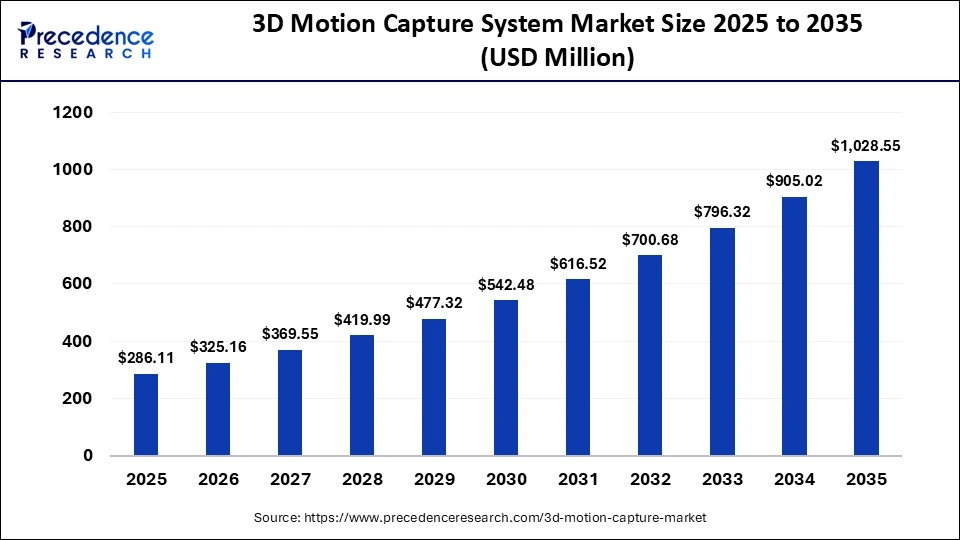
3D Motion Capture System Market Key Insights
- North America commands the largest share at 42.5% in 2025, driven by advanced studios and R&D investments.
- Asia Pacific emerges as the fastest-growing region with a 14.5% CAGR through 2035, propelled by booming gaming and animation hubs.
- Hardware leads components at 58.6% share, while marker-based systems dominate types at 71.3%.
- Media & entertainment tops end-uses with 34.5%, and on-premises deployment holds 68.7%.
Market Scope Overview
| Report Coverage | Details |
|---|---|
| Market Size in 2025 | USD 286.11 Million |
| Market Size in 2026 | USD 325.16 Million |
| Market Size by 2035 | USD 1,028.55 Million |
| CAGR 2026-2035 | 13.65% |
| Largest Region | North America (42.5%) |
| Fastest Region | Asia Pacific (14.5% CAGR) |
AI’s Transformative Role in 3D Motion Capture System Market
AI revolutionizes 3D motion capture by boosting accuracy in markerless tracking, detecting joints and expressions without physical markers for faster setups. Machine learning refines data by reducing noise, handling occlusions, and predicting movements, yielding natural outputs for sports and rehab.
Cloud-integrated AI enables scalable real-time analytics, empowering biomechanical insights and personalized diagnostics across industries.
What Fuels 3D Motion Capture Market Growth?
Rising demand for lifelike animations in gaming and films accelerates adoption, alongside VR/AR expansion in training and simulation. Sports biomechanics and healthcare diagnostics drive precision needs, with sensor tech and real-time rendering lowering barriers. Industrial automation and defense simulations further amplify momentum through AI-enhanced workflows.
What Opportunities and Trends Shape the Future?
How are markerless innovations expanding access? Markerless systems grow at 13.1% CAGR, offering setup-free tracking via AI pose estimation for indie creators and SMEs.
What trends dominate inertial tech? Inertial segments surge at 13.2% CAGR with portable IMUs for outdoor sports and VR, integrating drift-correction AI.
Where do cloud deployments unlock scalability? Cloud options rise at 13.4% CAGR, enabling remote collaboration and heavy AI processing without massive hardware.
3D Motion Capture System Market Regional Analysis
North America’s USD 121.60 Million in 2025: Leads at 42.5% with U.S. studios hitting USD 91.20 million, growing to USD 330.42 million at 13.74% CAGR. AR/VR and sports analytics thrive.
Asia Pacific’s Rapid Ascent: 14.5% CAGR from gaming booms in China and India.
Europe’s Innovation Edge: Advances in robotics and film, with UK biomechanics hubs.
Emerging Markets: MEA and Latin America gain via entertainment investments.
3D Motion Capture System Market Segment Insights
Component Insights
In 2025, the hardware segment dominated the 3D motion capture system market, accounting for 58.6% of total revenue, as hardware forms the foundational infrastructure of motion capture systems. Core components—including high-performance cameras, inertial sensors, electromagnetic receivers, and data acquisition units—are essential for capturing raw motion data. Without robust hardware, motion capture software cannot function efficiently or deliver accurate outputs.
Industries requiring precise movement analysis—such as film production, gaming, sports science, and biomechanics—depend on advanced hardware setups, including multi-camera arrays, synchronized sensor suits, and complex capture environments.
These configurations are inherently hardware-intensive and contribute significantly to system costs. Additionally, the growing adoption of virtual production pipelines and full-body performance capture technologies has prompted studios, research institutions, and training facilities to invest in high-resolution cameras and next-generation tracking systems, reinforcing hardware’s market dominance.
The software segment is projected to grow at a CAGR of 12.9% during the forecast period. Growth is driven by software’s expanding role in data processing, visualization, and real-time motion analytics. Modern motion capture platforms rely on advanced software engines to clean raw data, correct noise, fill occlusion gaps, apply machine learning filters, and transform motion data into animations or biomechanical insights.
Increasing demand for real-time applications in virtual production, live animation, sports training, and clinical diagnostics—along with the rise of cloud-based and AI-integrated software solutions—is accelerating adoption of flexible, scalable, and interoperable motion capture software.
Type Insights
The marker-based segment led the 3D motion capture system market with a 71.3% share in 2025, primarily due to its superior accuracy, reliability, and consistency. Marker-based systems minimize tracking errors caused by occlusion and deliver high-resolution skeletal and spatial datasets required for professional-grade applications.
Their ability to maintain precise motion tracking during complex and high-speed movements makes them the preferred standard for high-budget productions, scientific research, and advanced training programs.
The markerless segment is expected to grow at a CAGR of 13.1% over the forecast period, driven by its ease of use, faster setup, and increased flexibility. Markerless systems enable motion capture in natural environments without wearable sensors, making them ideal for applications in gaming, film, sports analytics, and healthcare.
Rapid advancements in AI-driven pose estimation, computer vision, and deep learning are significantly improving the accuracy and reliability of markerless solutions. Combined with more affordable hardware and sophisticated algorithms, these systems are increasingly attractive to small and mid-sized users seeking cost-effective and versatile motion capture solutions.
Technology Insights
The optical motion capture segment held a 32.6% market share in 2025, driven by its high accuracy, superior resolution, and long-standing adoption in professional environments. Optical systems use multi-camera arrays and triangulation techniques to deliver highly detailed and precise motion tracking.
Advances in high-speed cameras, enhanced frame rates, and ultra-high-resolution sensors have further strengthened the appeal of optical motion capture, particularly for film, gaming, and research applications that demand exceptional precision.
The inertial segment is projected to grow at a CAGR of 13.2% during the forecast period due to its portability, affordability, and adaptability. Inertial systems rely on IMUs (inertial measurement units) to capture motion without fixed camera setups, making them suitable for outdoor environments, sports fields, VR training, and mobile research.
Continuous improvements in sensor accuracy, drift correction, and AI-powered data refinement are enhancing system reliability. As demand increases for real-time capture, remote workflows, and wearable-based motion analysis, inertial technology is expected to experience rapid adoption across multiple industries.
End-Use Industry Insights
The media and entertainment segment dominated the 3D motion capture system market with a 34.5% share in 2025, fueled by rising demand for realistic animations, visual effects, and immersive digital experiences. Motion capture enables creators to produce lifelike character movements, facial expressions, and performances, significantly enhancing storytelling and audience engagement in films, video games, and virtual reality content.
As studios increasingly adopt virtual production, live-action animation, and immersive AR/VR experiences, motion capture has become a critical component of content creation workflows. It helps reduce manual animation efforts, improve production efficiency, and deliver high-quality visual outputs. Ongoing advancements in performance capture for digital doubles, stunt coordination, and humanoid character animation continue to drive demand, reinforcing the segment’s leadership.
The healthcare segment is expected to grow at a CAGR of 13.5% during the forecast period, driven by expanding applications in clinical assessment, rehabilitation, and biomechanical research. Motion capture enables precise analysis of gait, posture, joint mechanics, and movement asymmetries, supporting accurate diagnosis and personalized treatment planning. Healthcare providers increasingly use motion capture to monitor post-surgical recovery, manage neurological and musculoskeletal disorders, and enhance sports medicine and injury prevention programs.
Deployment Insights
The on-premises deployment segment accounted for 68.7% of market share in 2025, driven by the need for high-performance, low-latency, and secure data processing in professional motion capture environments. Large studios, research institutions, defense organizations, and healthcare facilities prefer on-premises systems to maintain full control over sensitive data while complying with strict privacy and regulatory requirements.
These deployments also provide the computational power required for real-time rendering, high-resolution capture, and advanced biomechanical analysis, making them ideal for high-budget productions and data-intensive research.
The cloud-based deployment segment is projected to grow at a CAGR of 13.4% over the forecast period due to increasing demand for scalable, flexible, and cost-efficient workflows. Cloud platforms allow users to store, process, and analyze motion data remotely, enabling real-time collaboration across distributed teams.
As AI-driven motion detection and automated data-cleaning algorithms gain traction, cloud infrastructure offers the computing capacity needed without significant upfront hardware investments. Lower initial costs and improved accessibility are making cloud solutions particularly attractive to SMEs, independent creators, and academic institutions, supported by the growing adoption of virtual production, remote training, and cloud-based animation pipelines.
3D Motion Capture System Market Companies
- Vicon: Provides optical motion capture solutions such as Vantage and Vero, which are highly precise and popular in film, game, biomechanics, and virtual production.
- OptiTrack: Offers game-optimized, high-precision optical mocap cameras and systems, VR/AR optimized, animation optimized, and robotics optimized.
- Xsens: Sells more advanced inertial motion capture suits and sensors that have the potential to deliver full body tracking to films, sports science, and industrial simulation.
- Qualisys: Produces optical motion capture cameras and integrated biomechanics analysis systems in the clinical, sport, and research fields.
- Motion Analysis Corporation: Provides motion capture systems that are integrated optical 3D, which involve a combination of high-speed cameras, active/ passive markers, and Cortex software that are used to achieve accurate tracking and biomechanical analysis.
Other Major Companies
- PhaseSpace
- Noitom
- Rokoko
- Noraxon
- Codamotion
- Northern Digital (NDI)
- Simi Reality Motion Systems
- Move.ai
- Defense / Motus Digital
- STT Systems
Segments Covered in the Report
By Component
- Hardware
- Software
- Services
By Type
- Marker-based
- Markerless
By Technology
- Optical
- Inertial
- Electromagnetic
- Ultrasonic/Other
By End-use Industry
- Media & Entertainment
- Sports & Performance Analytics
- Healthcare & Rehabilitation
- Defense & Aerospace
- Robotics & Automation
- Research & Academia
- Industrial/Manufacturing/AR-VR
By Deployment
- On-premises
- Cloud
By Region
- North America
- Europe
- Asia-Pacific
- Latin America
- Middle East and Africa
You can place an order or ask any questions. Please feel free to contact us at sales@precedenceresearch.com |+1 804 441 9344

- ESG Software Market 2025: Comprehensive Key Players Ecosystem and Revenue Outlook - May 20, 2026
- ESG Software Market Worth Around USD 31.96 Billion by 2035 - May 20, 2026
- Hematopoietic Stem Cell Transplantation Market Size to Attain USD 24.32 Billion by 2035 as Precision Medicine and AI Reshape Blood Cancer Treatment - May 20, 2026
