
Body Augmentation Filler Market Size to Hit USD 7.61 Billion by 2035, Fueled by 18.2% CAGR Amid Rising Demand for Non-Invasive Aesthetics
The global body augmentation filler market reached USD 1.42 billion in 2025 and is projected to surge to USD 7.38 billion by 2035, growing at a robust CAGR of 17.91% from 2026 to 2035. Key drivers include advancements in biocompatible materials, rising preference for non-surgical procedures with minimal downtime, and the influence of social media on beauty standards.
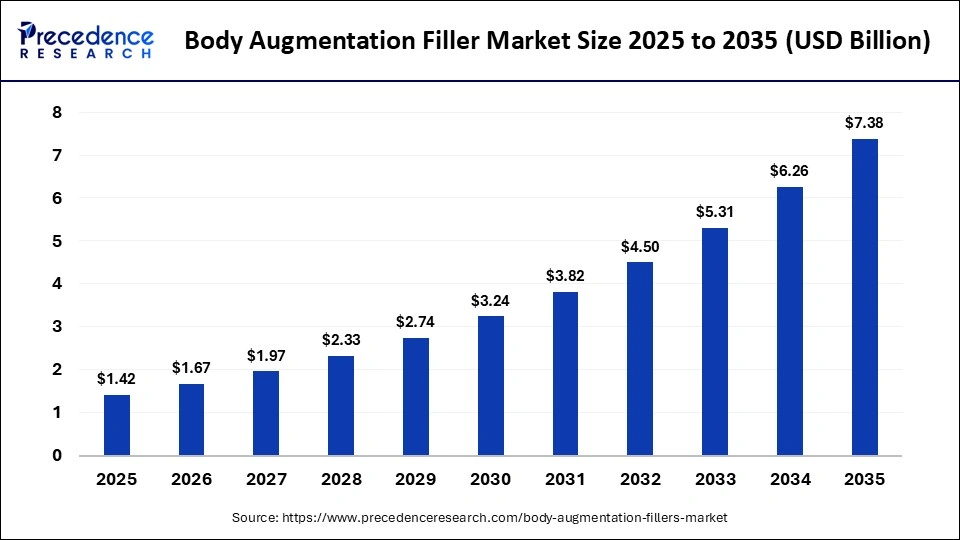
Body Augmentation Filler Market Key Points
- The North America region dominated with a 40.4% market share in 2025, driven by advanced healthcare infrastructure and high consumer acceptance.
- Temporary fillers led product types at 52.5% share, valued for their safety and reversibility.
- Hyaluronic acid (HA) topped material types with 29.7% share due to its biocompatibility and natural results.
- Buttock augmentation claimed 32.5% of applications, boosted by social media trends.
- Dermatology clinics held 58.5% of end-user share, offering specialized expertise.
AI’s Role in Body Augmentation Fillers
Artificial intelligence revolutionizes body augmentation fillers by enabling personalized treatment plans through 3D imaging and predictive outcome modeling, allowing patients to visualize results pre-procedure. AI enhances precision with augmented reality guidance and robotic assistance, analyzing scans for optimal filler placement to minimize complications and boost satisfaction.
Machine learning algorithms process facial and body data to recommend filler types, depths, and volumes tailored to individual anatomy, while post-treatment monitoring predicts adjustments for longer-lasting effects.
Market Growth Factors
Rising awareness of anti-aging solutions propels the market, alongside celebrity endorsements and social media influence that normalize non-surgical enhancements. Technological progress in bio-stimulatory fillers, which stimulate collagen for natural, durable results, attracts consumers seeking subtle contouring with less downtime. Expanding medical tourism and growing disposable incomes in emerging markets further accelerate adoption of these minimally invasive options.
Market Scope
| Report Coverage | Details |
| Market Size in 2025 | USD 1.42 Billion |
| Market Size in 2026 | USD 1.67 Billion |
| Market Size by 2035 | USD 7.38 Billion |
| Market Growth Rate from 2026 to 2035 | CAGR of 17.91% |
| Dominating Region | North America |
| Fastest Growing Region | Asia Pacific |
| Base Year | 2025 |
| Forecast Period | 2026 to 2035 |
| Segments Covered | Product Type, Material Type, Application, End-user, and Region |
| Regions Covered | North America, Europe, Asia-Pacific, Latin America, and Middle East & Africa |
What Opportunities and Trends Shape the Market?
Opportunity: How is demand expanding beyond facial procedures?
Body contouring for buttocks and breasts surges, driven by preferences for non-surgical volume enhancement over implants, with social media amplifying trends.
Trend: Why are bio-stimulatory fillers gaining traction?
These fillers promote natural collagen production for longer-lasting, skin-improving results, appealing to those desiring gradual, authentic enhancements without frequent touch-ups.
Opportunity: What role do partnerships play?
Collaborations between manufacturers and clinics expand reach, while AI-3D imaging customizes treatments, reducing risks and elevating outcomes.
What Drove Temporary Fillers to 52.5% Market Share?
Temporary fillers dominated in 2025 due to their biodegradability, reversibility via enzymes, and low complication risks, aligning with demand for safe, trial-friendly options. Semi-permanent fillers grow fastest at 18.3% CAGR, balancing longevity with manageability for one-to-two-year results.
Why Hyaluronic Acid Leads Materials at 29.7% Share?
Hyaluronic acid excels for its water-attracting properties, delivering natural volume and reversibility, endorsed widely by professionals. Poly-L-lactic acid follows at 18.5% CAGR, stimulating collagen for subtle, enduring body contouring that biodegrades safely.
Which Application Tops at 32.5%—Buttock Augmentation?
Buttock augmentation leads, offering instant shape enhancement with quicker recovery than surgery, fueled by celebrity aesthetics and minimal risks. Breast augmentation grows at 18.2% CAGR, providing customizable symmetry for broader appeal.
How Dermatology Clinics Captured 58.5% End-User Share?
Dermatology clinics dominate with expert care, AI tools, and 3D planning in comprehensive settings. Medical spas expand fastest at 18.8% CAGR, attracting wellness-focused consumers with convenient, affordable outpatient services.
Regional Dynamics
North America (40.4% Share): Valued at USD 573.68 million in 2025, it reaches USD 2,988.90 million by 2035 (CAGR 217.95%), powered by R&D from AbbVie and Galderma, plus cultural embrace of aesthetics. U.S. hits USD 2,256.62 million by 2035 at 18.02% CAGR.
Asia Pacific (Fastest at 20% CAGR): Rising incomes in India and China, plus social media, drive minimally invasive demand amid medical tourism growth.
Europe: Strict EU MDR regulations ensure safety, with Germany pioneering AI-integrated injectors.
Latin America: Brazil thrives on beauty culture and tourism, offering accessible pricing.
Middle East & Africa: UAE luxury centers cater to high spenders with advanced tech.
Top Companies and Breakthroughs
Leading players include AbbVie (Juvederm HA line), Galderma (Restylane, Sculptra), Merz (Radiesse, Belotero), Sinclair Pharma (Perfectha, Ellanse), and Teoxane (RHA fillers). Others: Suneva Medical, Ipsen, Laboratoires Vivacy, Prollenium Medical, Croma Pharma, BioPlus Co., Polytech Health & Aesthetics, HansBiomed, Stel+K, Aptos.
Recent breakthroughs: Waldencast acquired Novaestiq’s Saypha HA gels (July 2025); Evolus gained FDA nod for Evolysse Form/Smooth (February 2025); Galderma launched Restylane SHAYPE for chin (January 2024).
Challenges and Cost Pressures
High costs of premium fillers limit access for middle-income groups, especially with repeat sessions needed, widening gaps in emerging markets. Side effects, regulatory hurdles, and competition from alternatives like surgery add pressures, though innovations mitigate risks.
Case Study: Gluteal Augmentation Success
A multicenter study of 4,725 procedures across 2,801 patients showed high safety in buttock fillers, with low complications and strong efficacy in volume restoration, underscoring minimally invasive viability
Get this report to explore global market size, share, CAGR, and trends, featuring detailed segmental analysis and an insightful competitive landscape overview @ https://www.precedenceresearch.com/sample/7245
You can place an order or ask any questions. Please feel free to contact us at sales@precedenceresearch.com |+1 804 441 9344

- ESG Software Market 2025: Comprehensive Key Players Ecosystem and Revenue Outlook - May 20, 2026
- ESG Software Market Worth Around USD 31.96 Billion by 2035 - May 20, 2026
- Hematopoietic Stem Cell Transplantation Market Size to Attain USD 24.32 Billion by 2035 as Precision Medicine and AI Reshape Blood Cancer Treatment - May 20, 2026
