
Next-Generation Firewall Market Size to Reach USD 19.47 Billion by 2035 as Cyber Threats Demand Advanced Defenses
The global next-generation firewall (NGFW) market size is valued at USD 6.73 billion in 2025 and is projected to expand from USD 7.48 billion in 2026 to USD 19.47 billion by 2035, achieving a compound annual growth rate (CAGR) of 11.21%.
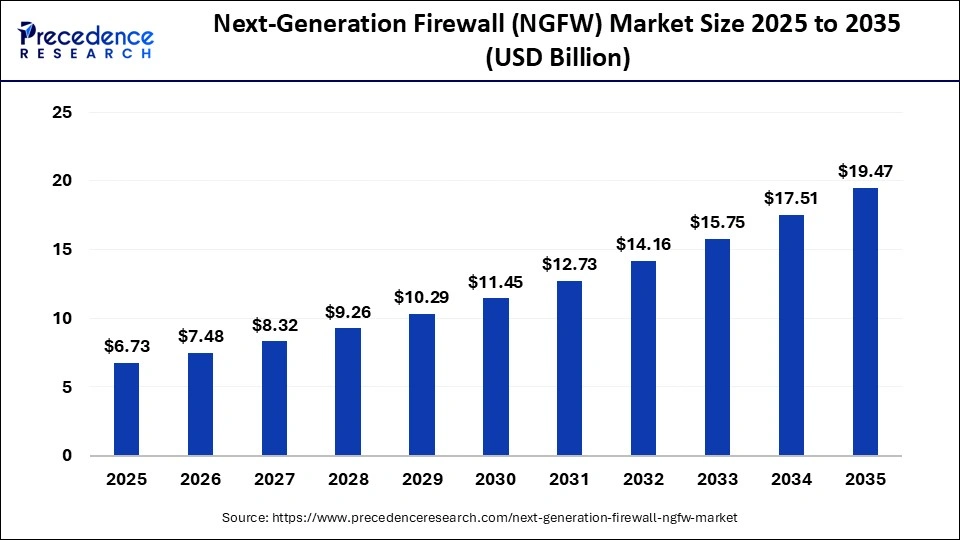
Rapid adoption of cloud computing, IoT devices, and remote work models heightens cyber risks like ransomware and phishing, driving organizations toward NGFWs for deep packet inspection, application awareness, and integrated threat prevention. Stricter regulations such as GDPR and PCI DSS further accelerate demand for these advanced platforms across enterprises.
Next-Generation Firewall Market Key Insights
- North America dominates with a 45.4% share in 2025, fueled by early tech adoption and robust cybersecurity investments.
- Hardware NGFW leads product segments at 58.5% share.
- Asia Pacific emerges fastest at 10.5% CAGR through digitization and e-commerce growth.
- BFSI holds 42.3% in end-user industries, with healthcare accelerating at 9.6% CAGR amid patient data protection needs.
- On-premises deployment claims 56.4% share for superior control, as cloud-based options rise at 9.8% CAGR.
Next-Generation Firewall Market Scope
| Report Coverage | Details |
|---|---|
| Market Size in 2025 | USD 6.73 Billion |
| Market Size in 2026 | USD 7.48 Billion |
| Market Size by 2035 | USD 19.47 Billion |
| CAGR 2026-2035 | 11.21% |
| Largest Region | North America (45.4%) |
| Fastest Region | Asia Pacific (10.5% CAGR) |
How Is AI Revolutionizing Next-Generation Firewalls?
AI integration transforms NGFWs by enabling neural networks to detect anomalies like subtle behavioral shifts in user patterns, far beyond traditional rules-based systems. Machine learning analyzes fingerprints, typing styles, and session behaviors in real-time, automating threat identification and reducing human error in fast-evolving attack landscapes. This shift supports zero-trust architectures, where AI-powered inspection of encrypted SSL/TLS traffic blocks sophisticated AI-driven cyberattacks proactively.
Automation addresses cybersecurity skills gaps, allowing NGFWs to self-optimize configurations, predict vulnerabilities, and orchestrate responses without constant IT intervention. As threats grow complex with IoT proliferation and cloud migration, AI ensures scalability, cutting response times while enhancing power efficiency in data centers.
What Fuels Next-Generation Firewall Market Growth?
Rising cyber threat complexity, including ransomware and zero-day exploits, compels enterprises to upgrade from legacy firewalls. Cloud migration and hybrid environments demand NGFW’s application-level visibility and intrusion prevention for securing distributed networks. IoT device explosion and remote workforce needs amplify attack surfaces, pushing zero-trust implementations.
What Opportunities and Trends Shape the NGFW Landscape?
How do sustainability goals influence NGFW strategies?
Vendors integrate ESG frameworks, optimizing configurations to cut e-waste and energy use in data centers. Circular economy practices extend hardware life cycles amid green IT mandates.
What role does zero-trust play in market expansion?
Adoption surges as NGFWs enforce identity-based policies across clouds and edges, countering perimeter breaches. Hybrid work models accelerate this shift.
Which innovations drive investor interest?
Palo Alto Networks, Fortinet, and Cisco lead R&D in AI-enhanced platforms, with Fortinet’s May 2025 FortiGate 700G launch boosting campus security.
Next-Generation Firewall Market Segmentation
Why Does Hardware Dominate Product Segments?
Hardware NGFW captured 58.5% share in 2025, delivering high-performance deep packet inspection and zero-trust compatibility for data centers. These appliances use specialized ICs and NPUs for optimized threat handling, with redundancies ensuring uptime. Cloud-native FWaaS grows fastest at 9.3% CAGR, offering scalable DevOps integration for dynamic workloads.
Which Components Lead Deployment Choices?
Hardware appliances hold 58.4% share for dedicated security processing, vital in mission-critical setups. Professional and managed services expand at 9.5% CAGR, tackling skills shortages through continuous monitoring and updates. On-premises prevails at 56.4% for granular control, while cloud-based surges at 9.8% for regulatory agility.
How Do End-User Industries Drive Demand?
BFSI leads at 42.3% share, leveraging NGFWs for GDPR/PCI compliance and sensitive data audits. Healthcare grows fastest at 9.6% CAGR, protecting patient records via IPS against advanced persistent threats. Government, IT/telecom, and retail follow, fueled by digitization.
Next-Generation Firewall Market Regional Dynamics
North America commands 45.4% share, with USD 3.06 billion in 2025 growing to USD 8.86 billion by 2035 at 11.22% CAGR, thanks to vendor hubs and regulations like CCPA.
U.S. market hits USD 2.29 billion in 2025, propelled by remote work and AI threats. Asia Pacific accelerates at 10.5% CAGR via 5G, e-commerce, and data localization in China and India.
Europe advances on GDPR and IoT in smart cities, while Middle East & Africa counters ransomware in energy sectors. UAE imports advanced NGFWs to build tech hubs.
Next-Generation Firewall Market Value Chain
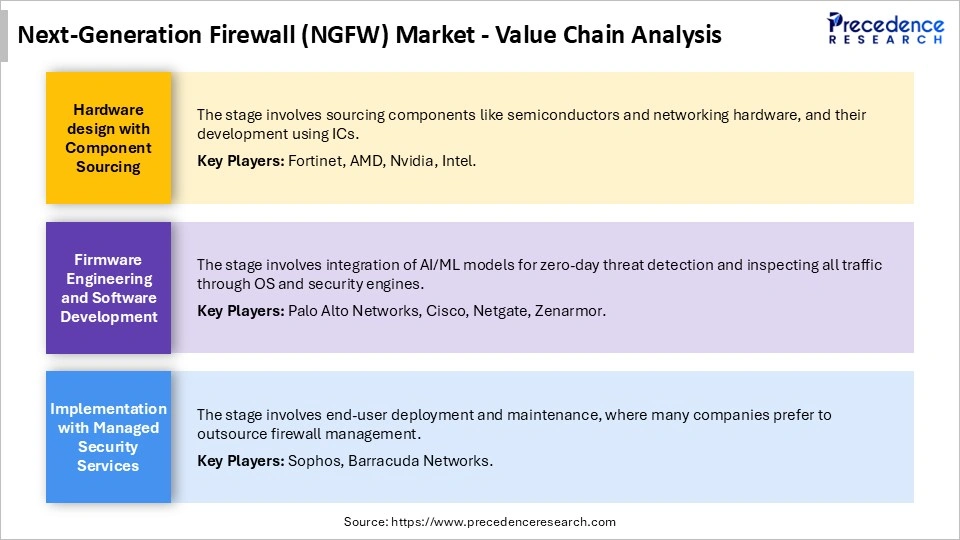
Next-Generation Firewall Market Top Companies and Breakthroughs
- Palo Alto Networks
- Fortinet
- Check Point Software
- Cisco Systems
- Juniper Networks
- Sophos
- SonicWall
- Barracuda Networks
- Forcepoint
- WatchGuard Technologies
- Hillstone Networks
- F5
- Huawei Technologies
- Trend Micro
- Zscaler
In November 2025, Palo Alto partnered with Chromosphere for AI workload security. SonicWall’s May 2025 suite expanded end-to-end protection for MSPs.
What Challenges and Cost Pressures Persist?
High upfront costs for hardware, licenses, and skilled management deter SMEs, alongside scaling complexities in distributed networks. Integration with legacy systems demands expertise, risking misconfigurations and vendor lock-in. Evolving threats require constant updates, inflating maintenance expenses.
Real-World Impact: NGFW Case Studies
VR Group deployed Forcepoint NGFWs for high-speed rail Wi-Fi, enabling zero-touch access across operators and slashing dropouts. Pague stores integrated Fortinet FortiGate for Secure SD-WAN, securing customer Wi-Fi and centralizing management. ENT Credit Union used Check Point for east-west visibility, optimizing data centers against anomalies
Segments Covered in the Report
By Product/Type
- Hardware NGFW
- Virtual NGFW
- Cloud-native NGF/FWaaS
By Component
- Hardware Appliances
- Softwar /Platform
- Professional & Managed Services
By Deployment Mode
- On-premises
- Cloud-based
- Hybrid
By End-user Industry
- BFSI
- Government & Defense
- IT & Telecom
- Healthcare
- Retail & E-commerce
By Region
- North America
- Europe
- Asia-Pacific
- Latin America
- Middle East and Africa
Get this report to explore global market size, share, CAGR, and trends, featuring detailed segmental analysis and an insightful competitive landscape overview @ https://www.precedenceresearch.com/sample/7268
You can place an order or ask any questions. Please feel free to contact us at sales@precedenceresearch.com |+1 804 441 9344

- ESG Software Market 2025: Comprehensive Key Players Ecosystem and Revenue Outlook - May 20, 2026
- ESG Software Market Worth Around USD 31.96 Billion by 2035 - May 20, 2026
- Hematopoietic Stem Cell Transplantation Market Size to Attain USD 24.32 Billion by 2035 as Precision Medicine and AI Reshape Blood Cancer Treatment - May 20, 2026
