
Heavy Metal Testing Market to Reach USD 7.20 Billion by 2035, Fueled by 6.75% CAGR Amid Rising Pollution Concerns
Stringent regulations and advanced detection technologies propel growth from USD 4.00 billion in 2026.
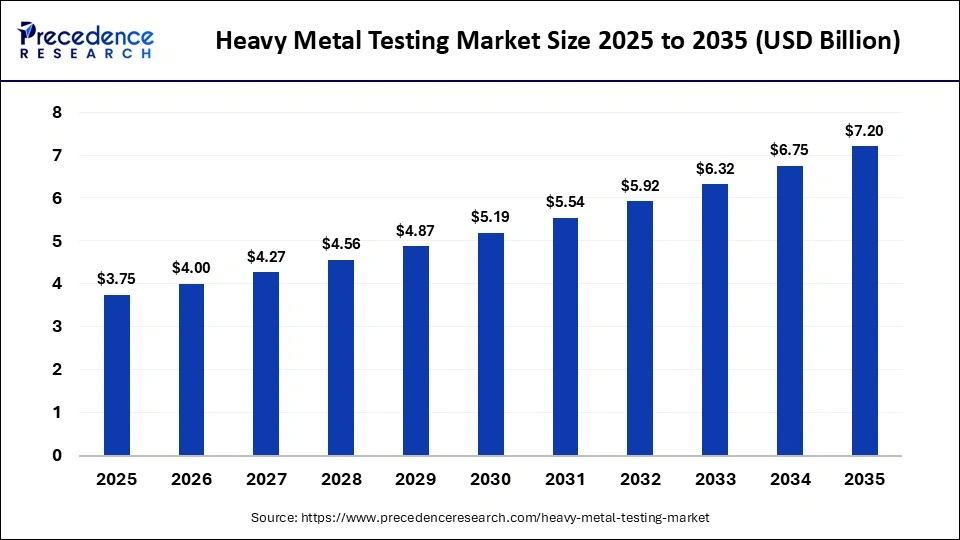
The global heavy metal testing market was valued at USD 3.75 billion in 2025 and is projected to expand at a robust CAGR of 6.75% from 2026 to 2035, driven by stringent environmental regulations, escalating industrial pollution, and heightened consumer awareness of toxicity risks in food, water, and pharmaceuticals. Breakthroughs in ICP-MS and biosensor technologies are enabling faster, more sensitive detection, bolstering demand across safety-critical sectors. This surge underscores a pivotal shift toward proactive public health protection in an era of intensifying contamination threats.
Heavy Metal Testing Market Key Insights
- The heavy metal testing market reached USD 3.75 billion in 2025 and is set to hit USD 7.20 billion by 2035.
- North America commands the largest share at 38.8% in 2025, while Asia Pacific surges at the fastest 6.5% CAGR through 2035.
- Arsenic testing dominates with 51.3% share, and ICP-MS leads technologies at 39.6%.
- Food safety applications hold 41.8%, with food & beverages samples at 45.4% and laboratories as top end-users at 40.4%.
Market Valuation Overview
| Report Coverage | Details |
|---|---|
| Market Size in 2025 | USD 3.75 Billion |
| Market Size in 2026 | USD 4.00 Billion |
| Market Size by 2035 | USD 7.20 Billion |
| CAGR 2026-2035 | 6.75% |
| Largest Region | North America (38.8%) |
| Fastest Region | Asia Pacific (6.5%) |
AI’s Role in Heavy Metal Testing
Artificial intelligence is revolutionizing heavy metal testing by automating workflows, enhancing analytical accuracy, and enabling predictive monitoring in high-volume labs. AI models prioritize samples, calibrate instruments, and preprocess data, slashing turnaround times while machine learning refines sensor sensitivity for trace-level detection in complex matrices like food and water.
Predictive AI analyzes historical data, trends, and variables to flag high-risk contamination zones, optimizing multi-sample runs to cut costs and errors. This shift from reactive to anticipatory testing supports regulatory compliance and scales efficiency for global labs.
Heavy Metal Testing Market Key Growth Drivers
Stringent global regulations from EPA, FDA, and WHO enforce heavy metal limits in water, food, and pharma, spurring routine testing demands. Industrial expansion in mining, electronics, and agriculture amplifies pollution risks, while consumer health awareness drives supply chain transparency. Advancements in portable ICP-MS and AAS technologies further accelerate adoption for on-site and lab-based analysis.
What Opportunities and Trends Shape the Market?
Rapid industrialization in Asia Pacific fuels 6.5% CAGR growth, with portable analyzers and AI integration enabling field testing and supply chain traceability. Sustainability mandates push blockchain for certified results, while emerging economies demand affordable biosensors for water and soil monitoring.
Heavy Metal Testing Market Segmentation
Type Insights
The arsenic segment dominated the heavy metal testing market with a 51.3% share in 2025. Its high toxicity, widespread environmental presence, and classification as a Group 1 carcinogen drive strict global testing requirements. Regulatory bodies such as the EPA and FDA enforce tight limits across drinking water, food, soil, and consumer products, making arsenic testing mandatory across sectors.
The mercury segment is expected to grow at a 5.5% CAGR due to rising concern over contamination in healthcare, electronics, water, and soil. Its multiple chemical forms require advanced, precise detection. Innovations in spectroscopy and robotics are making mercury testing faster and more accurate, accelerating demand across industries.
Technology/Method Insights
ICP-MS dominated with a 39.6% share in 2025 thanks to its unmatched sensitivity, ultra-low detection limits, and ability to test multiple metals simultaneously. Its speed and regulatory-grade accuracy make it essential for food, water, and pharmaceutical testing where ppb-level detection is required.
Atomic absorption spectroscopy (AAS) is projected to grow at a 5.8% CAGR due to its affordability, simplicity, and expanding use in portable systems. Portable AAS devices are increasingly used in environmental monitoring, industrial sites, and food testing, boosting segment growth.
Application Insights
Food safety testing held a 41.8% market share in 2025 due to stricter regulations, rising consumer awareness, and the high risk of contamination throughout the food chain. Heavy metals such as arsenic, lead, and mercury pose serious health risks, prompting extensive testing at each stage of production and distribution.
Environmental testing is set to grow at 5.6% CAGR as pollution from industrial and agricultural sources increases. Governments worldwide are tightening limits on toxic metals in water, air, and soil, driving adoption of advanced tools like ICP-MS and portable sensors for rapid, multi-element detection.
Sample Type Insights
The food & beverages segment dominated with a 45.4% share in 2025. Growing contamination risks in grains, dairy, seafood, and packaged foods have led to strict global regulations. Brands increasingly rely on high-precision technologies such as ICP-MS to ensure product safety and regulatory compliance.
The water testing segment is expected to grow at 5.7% CAGR due to rising industrial contamination, heavy metal exposure in drinking water, and greater focus on wastewater and irrigation safety. Demand for rapid, accurate, and portable testing solutions is accelerating across municipal and industrial sectors.
End-User Insights
Laboratories accounted for 40.4% share in 2025 due to the need for certified, high-precision, regulatory-compliant testing. Advanced instruments like ICP-MS and AAS require specialized infrastructure and trained personnel, making accredited labs the primary providers of heavy metal testing.
The government segment is forecast to grow at 5.8% CAGR as agencies expand environmental monitoring, food safety inspections, and workplace exposure assessments. National bodies such as EPA and WHO enforce strict metal limits, driving routine testing across public health and regulatory programs.
Heavy Metal Testing Market Regional Insights
North America led the market with a 38.8% share in 2025, supported by strict regulatory enforcement and advanced laboratory infrastructure. Mandatory testing under frameworks like the Safe Drinking Water Act and FDA guidelines ensures continuous demand across food, water, pharmaceuticals, and consumer products.
North America’s heavy metal testing market was valued at USD 1.46 billion in 2025 and is projected to reach USD 2.80 billion by 2035, growing at a 6.73% CAGR.
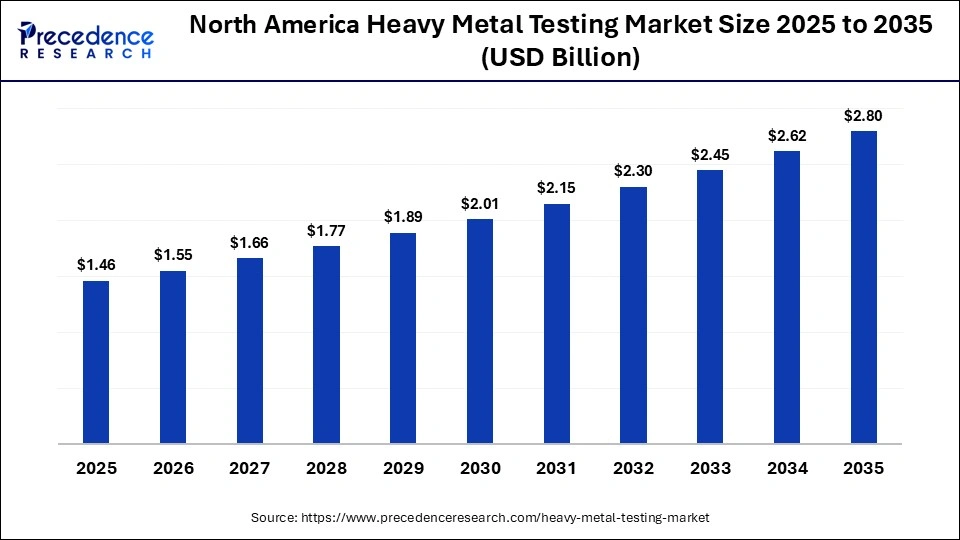
The U.S. market reached USD 1.08 billion in 2025 and will grow to USD 2.09 billion by 2035 at a 6.82% CAGR. Strong regulatory oversight, high consumer awareness, and advanced lab capabilities keep the U.S. at the forefront of global heavy metal testing standards.
Asia Pacific: Fastest-Growing Region
Asia Pacific is projected to grow at 6.5% CAGR due to rapid industrialization, increased pollution risks, and strengthening regulatory frameworks. Countries like China and India are ramping up mandatory testing for water, food, pharmaceuticals, and industrial effluents.
India is the fastest-growing market in APAC, driven by FSSAI-led food safety enforcement, higher demand for export compliance, and rising adoption of high-sensitivity testing technologies across public and private laboratories.
Europe Market Insights
Europe’s growth is supported by strict regulatory frameworks such as REACH and RoHS, strong consumer expectations for safety, and the presence of leading TIC companies like SGS, Eurofins, Intertek, and TÜV SÜD. Routine compliance testing across supply chains strengthens demand.
Germany maintains strong testing demand through strict product safety enforcement and advanced laboratory automation, supporting high standards across food, consumer goods, and industrial materials.
Latin America: Emerging Growth Region
Latin America’s growth is driven by expanding mining, agriculture, and manufacturing sectors, which increase contamination risks. Tightening regulations, improved laboratory infrastructure, and rising consumer awareness are accelerating routine heavy metal testing demand.
Brazil is a key contributor due to strong INMETRO-led reforms, export-driven compliance requirements, and growing environmental testing linked to mining and agricultural activities.
Middle East & Africa: Rising Testing Demand
MEA is gaining traction due to industrial expansion, mining operations, and environmental contamination risks. Governments are aligning heavy metal limits with global standards and mandating routine testing across food, water, and industrial effluents.
Saudi Arabia is expanding mandatory heavy metal testing across foods, bottled water, supplements, and industrial wastewater under strict SFDA and environmental regulations, driving sustained market growth.
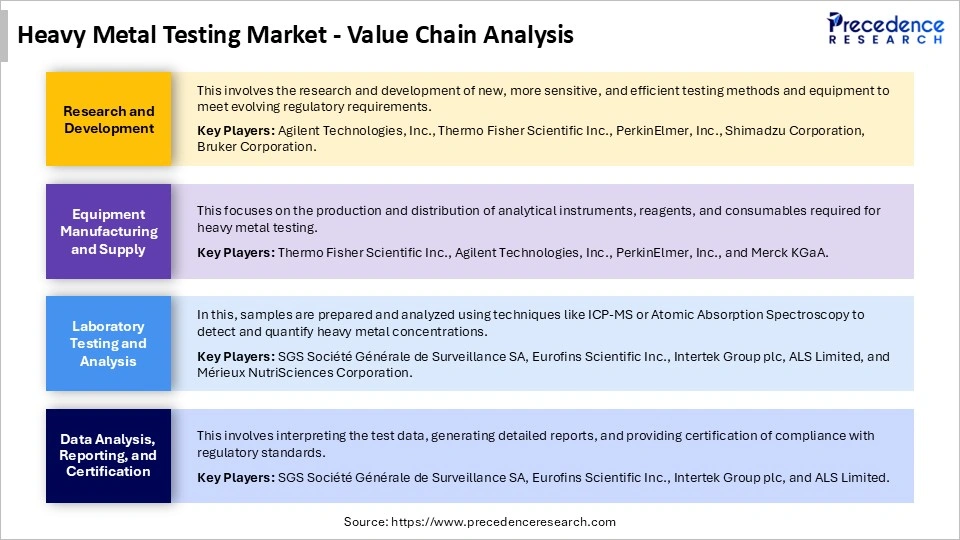
Value Chain Analysis
Heavy Metal Testing Market Top Companies and Breakthroughs
Leading firms include SGS S.A., Eurofins Scientific SE, Intertek Group plc, Bureau Veritas SA, ALS Limited, TÜV SÜD AG, Mérieux NutriSciences, LGC Group, AsureQuality Limited, Microbac Laboratories, EMSL Analytical, OMIC USA Inc., R J Hill Laboratories, Pace Analytical, and NSF International.
Recent innovations
Agilent Technologies’ October 2024 InfinityLab LC Series with AI-assisted automation boosts sample tracking and accuracy. Axiom Foods’ February 2025 Oryzatein 2.0 rice protein achieves undetectable heavy metals via rigorous testing.
Real-World Case Study
In West Bengal, India, textile wastewater heavy metal contamination raised health risks; remediation via AI-enhanced biosensors and ICP-MS cut pollution by 70%, showcasing scalable environmental testing impact
Segments Covered in the Report
By Type
- Arsenic
- Lead
- Cadmium
- Mercury
- Others
By Technology/Method
- ICP-MS
- AAS
- ICP-OES
- XRF
- Others
By Application
- Food Safety Testing
- Environmental Testing
- Clinical Diagnostics
- Industrial Quality Control
- Others
By Sample Type
- Food & Beverages
- Water
- Soil
- Blood & Biological
- Others
By End-User
- Laboratories
- Government
- Industrial
- Environmental Agencies
- Others
By Region
- North America
- Europe
- Asia-Pacific
- Latin America
- Middle East & Africa
Get this report to explore global market size, share, CAGR, and trends, featuring detailed segmental analysis and an insightful competitive landscape overview @ https://www.precedenceresearch.com/sample/7293
You can place an order or ask any questions. Please feel free to contact us at sales@precedenceresearch.com |+1 804 441 9344

- ESG Software Market 2025: Comprehensive Key Players Ecosystem and Revenue Outlook - May 20, 2026
- ESG Software Market Worth Around USD 31.96 Billion by 2035 - May 20, 2026
- Hematopoietic Stem Cell Transplantation Market Size to Attain USD 24.32 Billion by 2035 as Precision Medicine and AI Reshape Blood Cancer Treatment - May 20, 2026
