
Mental Health Screening Market Set to Soar to USD 5.76 Billion by 2035
Global Demand Driven by AI Innovation, Rising Awareness & Preventive Care – Forecast CAGR of 10.23% (2026-2035)
The Global Mental Health Screening Market is on a robust growth trajectory, with the total market valuation expected to jump from USD 2.58 billion in 2025 to a staggering USD 5.76 billion by 2035, expanding at a compound annual growth rate (CAGR) of 10.23% during the forecast period.
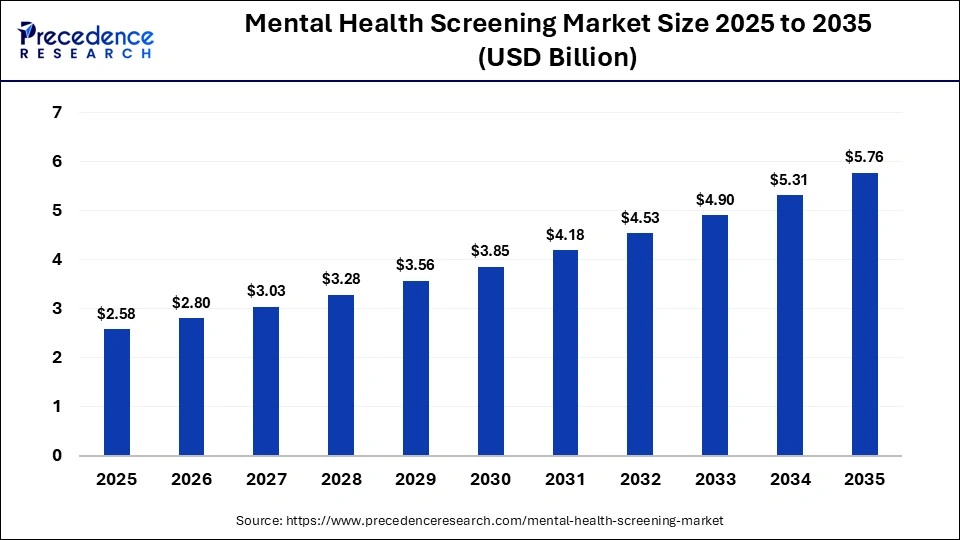
This surge is fuelled by accelerating global mental health awareness, adoption of digital and AI-based screening tools, supportive public policies, and a shifting focus toward early detection and preventive care — signaling a transformative phase in mental health diagnostics worldwide.
Mental Health Screening Market Key Insights
• Global market valued at USD 2.58 Bn in 2025 and projected to reach USD 5.76 Bn by 2035.
• Forecast CAGR of 10.23% between 2026 and 2035.
• North America dominated the market with ~40% share in 2025.
• Asia Pacific poised to be the fastest-growing region at a 10.5% CAGR.
• Software segment led by revenue (~88%), driven by digital and AI tools.
• Online platforms held ~58% share among solution types in 2025.
• Self-reported questionnaires accounted for ~65% of screening methods.
• Physiological/psychological disorder segment dominated by applications.
Mental Health Screening Market Revenue Breakdown (2025 vs 2035)
| Segment | 2025 Value | 2035 Forecast |
|---|---|---|
| Global Market Size | USD 2.58 Bn | USD 5.76 Bn |
| North America | USD ~1.03 Bn | USD ~2.33 Bn |
| U.S. Market | USD 774.00 Mn | USD 1,761.26 Mn |
AI’s Pivotal Role: Transforming Screening to Precision Prevention
Artificial Intelligence (AI) is reshaping the future of mental health screening. Next-generation tools analyze nuanced behavioral cues — such as speech patterns, typing rhythms, and self-reported data — enabling early risk detection beyond traditional questionnaires. AI-driven initial triage automates symptom clustering, offering refined draft assessments for clinicians to validate, significantly improving throughput and early diagnosis.
In underserved regions where mental health professionals are scarce, AI-powered chatbots and adaptive algorithms provide 24/7 support, multilingual screening, and real-time interaction via smartphones — democratizing access to preliminary mental health evaluations.
Why Is the Market Growing So Fast?
The rise in the Mental Health Screening Market is anchored by several macro and micro-level forces:
1. Escalating Mental Health Prevalence:
Mental disorders — including depression, anxiety, PTSD, ADHD, and cognitive impairments — are increasingly diagnosed across age groups, driving demand for standardized screening solutions.
2. Technology Adoption:
Integration of cloud-based platforms, telehealth solutions, wearable sensors, and mobile apps is enhancing user experience and expanding screening scope outside clinical settings.
3. Preventive Healthcare Shift:
Healthcare systems, employers, and academic institutions are institutionalizing mental health assessments as routine preventive measures.
4. Policy Support:
Governments and health agencies are expanding regulations and mandates that normalize regular mental health evaluations — for example, new student screening requirements implemented in parts of the U.S. public education system.
What Trends are Shaping the Future of Mental Health Screening?
What is driving the shift to digital platforms and mHealth apps?
Mobile-first applications and digital platforms expand reach, reduce stigma, and provide convenient, real-time self-assessments that users can access privately and repeatedly.
How are employers and schools adopting screening tools?
Integrated screenings are becoming staples of school health programs and corporate wellness initiatives — boosting early detection and support for high-risk individuals.
Are biomarker tools gaining traction?
Physiological and behavioural biomarker tools are projected to grow rapidly, providing objective data that complements traditional surveys.
Mental Health Screening Market Regional Highlights
North America accounted for nearly 40% of the global market share in 2025, driven by the normalization of mental health screenings as part of routine healthcare. Screenings are increasingly embedded into annual check-ups, school programs, workplace wellness initiatives, and primary care settings.
Rising stress levels among working adults and growing acceptance of quick, self-guided tools—such as PHQ-9 assessments and AI-powered chatbots—are helping reduce stigma. Strong government-backed policies and early detection programs continue to promote widespread adoption across communities.
The North America mental health screening market was valued at approximately USD 1.03 billion in 2025 and is projected to reach around USD 2.33 billion by 2035, expanding at a CAGR of 8.51% from 2026 to 2035.
The U.S. mental health screening market was valued at approximately USD 774.0 million in 2025 and is expected to reach nearly USD 1,761.26 million by 2035, growing at a CAGR of 8.57% between 2026 and 2035.
The U.S. dominates the North American market due to a high prevalence of mental health disorders, increased public awareness, and declining stigma around mental health support. Market growth is supported by strong government funding, favorable reimbursement frameworks, and integration of screenings into primary care systems.
Advancements in AI-based screening tools, digital platforms, and employer-led mental wellness programs are further accelerating early detection and access to care.
Asia Pacific Market
The Asia Pacific region is projected to be the fastest-growing market, registering a CAGR of 10.5% from 2026 to 2035. Growth is driven by increasing mental health awareness, expanding digital infrastructure, and culturally adaptive screening tools.
Multilingual and mobile-based platforms allow users to discreetly monitor emotional well-being, helping overcome cultural stigma and accessibility barriers across diverse populations.
China dominated the Asia Pacific mental health screening market due to government-led community initiatives, policy reforms, and large-scale investments in digital health infrastructure. High smartphone and internet penetration support widespread adoption of digital screening tools.
Rising awareness of mental health disorders and expanded access to early intervention services—across both urban and rural regions—continue to strengthen China’s leadership in the regional market.
Market Segmentation
Component Insights
The software segment dominated the mental health screening market in 2025, accounting for approximately 88% of total revenue. This leadership is driven by the widespread adoption of AI-powered screening tools, mHealth applications, self-screening platforms, remote monitoring systems, and virtual care solutions.
Software-based solutions offer user anonymity, multilingual capabilities, and seamless telehealth integration, making them highly suitable for deployment across schools, workplaces, and clinical settings. Their cost-effectiveness, broad accessibility, and real-time assessment capabilities—often enabled through chatbots—have further accelerated adoption.
The hardware segment is expected to grow at the fastest CAGR of 9.7% over the forecast period. This segment includes wearables and biometric sensors that monitor physiological indicators such as heart rate, sleep patterns, and vocal biomarkers.
Although higher device costs have limited large-scale adoption, advancements in smartwatch integrations and voice-based biomarker technologies are expected to support long-term growth by complementing software-driven screening tools.
Solution Type / Platform Insights
Online platforms held a dominant share of approximately 58% of the mental health screening market in 2025. These platforms provide web-based self-assessments, AI-driven questionnaires, and advanced data analytics, enabling large-scale population screening without the need for physical infrastructure.
Their ability to deliver real-time results, multilingual support, and EHR system integration makes them ideal for use in workplaces, educational institutions, and community health programs. Online platforms also offer a secure and private environment, encouraging individuals to engage proactively in mental health assessments.
The mHealth apps segment is projected to grow at the fastest CAGR of 9.5% from 2026 to 2035. These mobile-first solutions leverage chatbots, gamified assessments, and push notifications to support proactive and continuous mental health monitoring.
The dominance of smartphones and increasing user preference for on-the-go screening fuel this growth, although competition from comprehensive digital health platforms may limit market share expansion.
Screening Method / Assessment Insights
The self-reported questionnaires and surveys segment led the market with an estimated 65% share in 2025. These tools are widely used due to their simplicity, privacy, and ease of access, allowing individuals to assess their mental health independently.
Standardized tools such as PHQ-9 for depression and GAD-7 for anxiety enable quick, reliable assessments that can be completed within minutes on apps or websites, often without direct clinical involvement.
The biomarkers, observation, and other tools segment is expected to register the highest growth rate of 9.2% during the forecast period. These tools track physiological and behavioral indicators, including voice patterns, heart rate variability, body language, and social interactions.
AI-powered systems and chatbots enhance early detection by identifying non-verbal cues; however, widespread adoption depends on clinical validation and regulatory approval.
Application Insights
The physiological and psychological disorders segment dominated the market in 2025, generating approximately 46% of total revenue. Rising levels of chronic stress, economic uncertainty, constant digital engagement, and environmental pressures have significantly increased the prevalence of anxiety and depression.
Younger populations are particularly affected due to social media exposure, doom-scrolling, and body image concerns, while an aging population continues to drive long-term demand for mental health screening.
The cognitive disorders segment is anticipated to grow at the fastest rate, with a projected CAGR of 9.4% from 2026 to 2035. Growth is driven by an aging population, increasing awareness, and rising demand for early diagnosis and intervention.
Digital screening tools, telehealth expansion, employer wellness programs, and primary care integration are accelerating adoption, supported by growing investment in AI-enabled, accessible mental health screening solutions despite ongoing challenges related to stigma.
Case in Point: Policy-Driven Growth in the U.S.
In August 2025, an education policy initiative mandated annual mental health screenings for public school students in Illinois embedding mental health checks alongside traditional vision and hearing tests. This landmark move reflects a broader trend of normalizing early detection within standard healthcare routines.
Mental Health Screening Market Leading Companies
The competitive landscape includes innovators and established healthcare tech players, such as:
Adaptive Testing Technologies, Proem Behavioural Health, Aiberry, SonderMind Inc., Clarigent Health, Riverside Community Care, Kintsugi Mindful Wellness, Thymia Limited, Ellipsis Health Inc., Canary Speech, Headspace Health, Quartet Health, Modern Life, Sonde Health, Inc.
Segments Covered in the Report
By Component
- Software
- Hardware
By Solution Type/Platform
- Online Platforms
- Telehealth & Virtual Care
- mHealth Apps
By Screening Method/Assessment
- Self-Reported Questionnaires & Surveys
- Clinical Interviews
- Biomarker/Observation/Other Tools
By Application (Disorder Focus)
- Physiological/Psychological Disorders
- Cognitive Disorders
- Behavioral Disorders/Others
By Region
- North America
- Europe
- Asia-Pacific
- Latin America
- Middle East & Africa
Get this report to explore global market size, share, CAGR, and trends, featuring detailed segmental analysis and an insightful competitive landscape overview @ https://www.precedenceresearch.com/sample/7457
You can place an order or ask any questions. Please feel free to contact us at sales@precedenceresearch.com |+1 804 441 9344

- ESG Software Market 2025: Comprehensive Key Players Ecosystem and Revenue Outlook - May 20, 2026
- ESG Software Market Worth Around USD 31.96 Billion by 2035 - May 20, 2026
- Hematopoietic Stem Cell Transplantation Market Size to Attain USD 24.32 Billion by 2035 as Precision Medicine and AI Reshape Blood Cancer Treatment - May 20, 2026
