
Medical Device Security Market Size to Soar to USD 23.42 Billion by 2035
Surging Cyber Threats, IoMT Growth, and Regulatory Pressure Propel Market at a 9.03% CAGR (2026–2035)
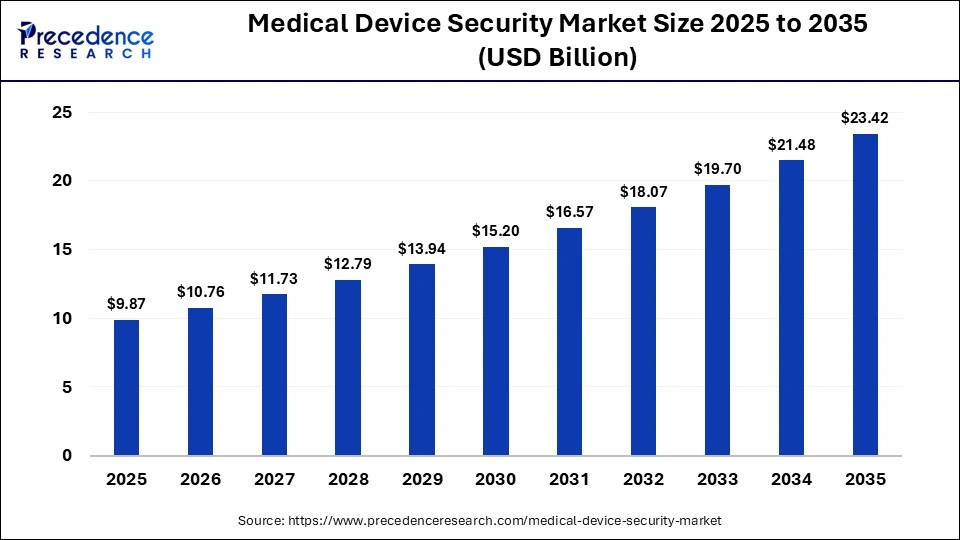
The global Medical Device Security Market is projected to expand from USD 10.76 billion in 2026 to an estimated USD 23.42 billion by 2035, growing at a robust Compound Annual Growth Rate (CAGR) of 9.03% over the forecast period. This acceleration is driven by the increasing prevalence of connected healthcare ecosystems, rising cyber threats targeting critical medical infrastructure, and stringent regulatory mandates to safeguard patient data and device integrity.
Medical Device Security Market Key Highlights
-
The market is valued at USD 9.87 billion in 2025 and is forecast to reach USD 23.42 billion by 2035 at a 9.03% CAGR.
-
North America holds the largest share, dominating with 38% of the global market in 2025.
-
Asia Pacific is poised to be the fastest-growing region over the forecast period.
-
Solutions segment led in 2025, while services is the fastest-growing component.
-
By security type, endpoint security held the largest share; cloud security is growing fastest.
-
Hospital medical devices dominated by device type, with wearable devices showing rapid growth.
-
Healthcare providers were the largest end-users, with healthcare payers climbing fastest.
What’s Driving the Market?
Medical devices—ranging from infusion pumps to wearable monitors—now operate over digital networks that make them vulnerable to cyberattacks and data breaches. With expanded IoMT (Internet of Medical Things) adoption, healthcare organizations are investing heavily in layered security frameworks that protect device functionality, patient safety, and sensitive health data.
The industry’s momentum is further boosted by regulatory compliance pressures from healthcare authorities worldwide, pushing providers to prioritize next-generation cybersecurity strategies.
AI & Machine Learning: The Security Game-Changers
Artificial Intelligence (AI) and Machine Learning (ML) are increasingly central to medical device security frameworks. These technologies offer real-time threat detection, anomaly identification, and predictive risk mitigation—enabling proactive defense against sophisticated cyber attacks before breaches occur. By continuously learning network patterns, AI systems can isolate suspicious behavior and automate response protocols, reducing the risk of costly downtime and compliance violations.
In cloud environments, AI-powered security solutions enhance access control, encryption, and platform monitoring especially important as IoMT devices share sensitive health data across networks. With the integration of big data analytics, organizations can now gain deeper insights into threat vectors and emerging risks that were previously undetectable.
What Trends Are Shaping the Future?
Why is the integration of Internet-connected devices reshaping the security landscape?
IoMT devices such as smart wearables, infusion pumps, and remote monitors collect and transmit patient data in real time. This connectivity expands the cyber-attack surface, making robust endpoint and cloud security solutions essential to defend against ransomware, malware, and unauthorized access.
How are global compliance standards impacting the market?
Regulatory bodies are tightening cybersecurity requirements for medical devices, mandating ongoing threat assessments and secure development lifecycles. These frameworks compel healthcare providers and manufacturers to invest in comprehensive security architectures, driving market growth and innovation.
Medical Device Security Market Scope
| Report Coverage | Details |
| Market Size in 2025 | USD 9.87 Billion |
| Market Size in 2026 | USD 10.76 Billion |
| Market Size by 2035 | USD 23.42 Billion |
| Market Growth Rate from 2026 to 2035 | CAGR of 9.03% |
| Dominating Region | North America |
| Fastest Growing Region | Asia Pacific |
| Base Year | 2025 |
| Forecast Period | 2026 to 2035 |
| Segments Covered | Component, Type, Device Type, End User, and Region |
| Regions Covered | North America, Europe, Asia-Pacific, Latin America, and Middle East & Africa |
Medical Device Security Market Regional Insights
North America
With advanced healthcare infrastructure and heightened regulatory oversight, North America continues to lead the global Medical Device Security Market. Investments in IoMT, strict FDA mandates, and high cybersecurity awareness are key pillars supporting growth.
Asia Pacific
Rapid digitization of healthcare services, expanding hospital networks, and rising government initiatives for data security make Asia Pacific the fastest-growing regional market—poised for significant future expansion.
Medical Device Security Market Segmental Insights
Component Type Insights
The solutions segment dominated the medical device security market in 2025, driven by strong demand for integrated software and hardware solutions designed to secure the rapidly expanding Internet of Medical Things (IoMT) ecosystem. This segment includes critical technologies such as antivirus and antimalware software, identity and access management (IAM), encryption, intrusion detection and prevention systems (IDS/IPS), and risk and compliance management solutions. These tools enable healthcare organizations to safeguard sensitive patient data across multiple platforms, supporting widespread market adoption.
Additionally, the growing use of AI-powered real-time threat detection to protect healthcare systems from malware, ransomware, and advanced cyberattacks further accelerated the growth of this segment.
In contrast, the services segment is expected to register the fastest growth during the forecast period, recording the highest CAGR. A shortage of skilled, in-house cybersecurity professionals within the healthcare sector has increased reliance on outsourced security services. Organizations increasingly prefer managed and professional cybersecurity services to reduce capital expenditure associated with building and maintaining internal security infrastructure, thereby fueling market expansion.
Type Insights
The endpoint security segment led the market in 2025, primarily due to the growing deployment of connected devices such as wearables, patient monitoring systems, and infusion pumps. These devices represent a large and relatively vulnerable attack surface, making them prime targets for cybercriminals. The rising adoption of connected healthcare wearables that store and transmit sensitive patient data has significantly increased the risk of malware and ransomware attacks, driving demand for endpoint security solutions. Government initiatives and regulatory compliance requirements aimed at mitigating cyber risks further supported segment growth.
Meanwhile, the cloud security segment is anticipated to be the fastest-growing segment during the forecast period. Growth is largely attributed to the increasing adoption of cloud-based healthcare platforms for managing connected IoT medical devices. Rising cyber threats, combined with stringent data protection regulations, have accelerated demand for secure, scalable, and flexible cloud security solutions. Cloud-based security enables secure device monitoring, remote patch management, and controlled access to patient data, supporting sustained market growth.
Device Type Insights
The hospital medical devices segment accounted for the largest share of the medical device security market in 2025. This dominance is driven by the extensive use of high-value and mission-critical devices such as MRI systems, CT scanners, infusion pumps, ventilators, and patient monitoring equipment within hospital environments. High device density, large volumes of sensitive patient data, and strict regulatory requirements have increased the need for robust cybersecurity solutions. Growing concerns over malware and cyberattacks targeting connected hospital devices further contributed to market expansion.
The wearable and external medical devices segment is projected to experience the fastest growth during the forecast period. Wearable devices play a vital role in enabling remote patient monitoring and home healthcare, offering greater convenience for patients with chronic conditions. Technological advancements such as AI integration, 5G connectivity, and the rapid adoption of IoT, telemedicine, and digital health platforms are key factors driving growth in this segment.
End User Insights
The healthcare providers segment led the market in 2025, owing to the extensive use of connected medical devices across hospitals and clinics. These environments handle large volumes of sensitive patient data, making them prime targets for cyber fraud, ransomware, and data breaches. Significant investments in endpoint, network, and application security solutions to protect IoT-enabled medical devices have supported market growth. Increasing regulatory pressure and high-profile cybersecurity incidents have further reinforced demand within this segment.
The healthcare payers segment is expected to grow at the fastest CAGR during the forecast period. Insurance providers and government healthcare programs are increasingly investing in cybersecurity solutions to protect vast patient databases, ensure regulatory compliance, mitigate risks associated with connected devices, and reduce financial losses from data breaches. Greater involvement in digital health ecosystems and rising financial exposure to data security risks continue to drive growth in this segment.
Medical Device Security Market Top Companies Driving Innovation
The competitive landscape features global leaders advancing solutions and services that fortify connected medical systems, including:
Cisco Systems (US), IBM (US), GE Healthcare (US), Symantec (US), CA Technologies (US), Philips (Netherlands), DXC Technology (US), CloudPassage (US), FireEye (US), and Sophos (UK).
Recent industry developments include cybersecurity toolkits and security intelligence platforms designed to enable manufacturers and providers to assess vulnerabilities, prioritize risk, and automate remediation strategies in minutes.
Case Spotlight: A Cybersecurity Success Story
In 2025, Medcrypt rolled out a medical device product security intelligence platform that helps manufacturers pinpoint security weaknesses, translate risk into actionable dollars, and automatically generate remediation plans—dramatically reducing response times and enhancing overall device security.
Segments Covered in the Report
By Component
- Solutions
- Services
By Type
- Application Security
- Endpoint Security
- Network Security
- Cloud Security
By Device Type
- Hospital Medical Devices
- Internally Embedded Medical Devices
- Wearable and External Medical Devices
By End User
- Healthcare Providers
- Medical Device Manufacturers
- Healthcare Payers
By Region
- North America
- Europe
- Asia-Pacific
- Latin America
- Middle East & Africa
Get this report to explore global market size, share, CAGR, and trends, featuring detailed segmental analysis and an insightful competitive landscape overview @ https://www.precedenceresearch.com/sample/7474
You can place an order or ask any questions. Please feel free to contact us at sales@precedenceresearch.com |+1 804 441 9344

- ESG Software Market 2025: Comprehensive Key Players Ecosystem and Revenue Outlook - May 20, 2026
- ESG Software Market Worth Around USD 31.96 Billion by 2035 - May 20, 2026
- Hematopoietic Stem Cell Transplantation Market Size to Attain USD 24.32 Billion by 2035 as Precision Medicine and AI Reshape Blood Cancer Treatment - May 20, 2026
