
Automated Endoscope Reprocessors Market Size to Surge to USD 1,201.16 Million by 2035; Poised for Transformation with AI-Enabled Solutions
Rising Focus on Infection Control and Smart Healthcare to Drive CAGR of 5.1% Over 2026–2035
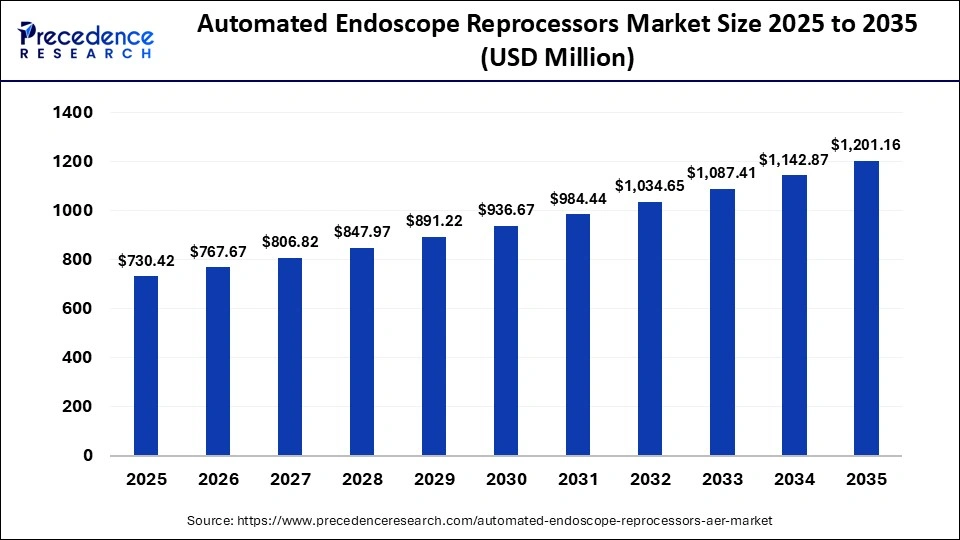
The Global Automated Endoscope Reprocessors Market is on a robust growth trajectory, projected to reach USD 1,201.16 million by 2035 from USD 730.42 million in 2025, growing at a CAGR of approximately 5.1% between 2026 and 2035. Heightened concerns around hospital-acquired infections (HAIs), stringent regulatory mandates, rising endoscopic procedure volumes, and the electrifying pace of AI and digital innovations are reshaping how healthcare facilities approach endoscope reprocessing, creating opportunities for safer, standardized, and traceable reprocessor solutions across the globe.
Automated Endoscope Reprocessors Market Key Insights
-
The AER market was valued at USD 730.42 million in 2025 and is forecast to exceed USD 1.2 billion by 2035.
-
North America leads the market, capturing about 38% share in 2025, driven by widespread adoption of automated medical technologies and rigorous infection-control norms.
-
The Asia Pacific region is the fastest-growing market, fueled by expanding healthcare infrastructure and increasing endoscopy procedures.
-
Standalone AER units held the largest segment share (~56%) in 2025, while integrated AER systems are expected to record the fastest growth through 2035.
-
Flexible endoscope reprocessors dominated (≈72%) due to the prevalence of GI, pulmonary, and urological procedures.
-
Hospitals & surgical centers were the top end-user segment (~63% share), as these facilities handle high procedure volumes requiring standardized reprocessing.
What’s Fueling Growth?
The AER market’s expansion is rooted in several macro and healthcare-specific drivers: rising volumes of minimally invasive diagnostic and therapeutic endoscopic procedures, stringent infection prevention mandates, and growing pressure on facilities to eliminate human error in manual cleaning processes. Healthcare systems across developed and emerging markets are intensifying their focus on standardized, automated reprocessing workflows to drive patient safety, regulatory compliance, and operational efficiency.
AI’s Role in Shaping the AER Landscape
Artificial intelligence is no longer a future concept — it’s actively being woven into the fabric of modern AER systems. Today’s AI-enabled reprocessors enhance accuracy, predictive maintenance, and real-time monitoring, empowering hospitals to reduce inadequate disinfection risks and improve traceability across reprocessing cycles.
AI systems also automate documentation, turning traditionally manual reporting into streamlined digital processes that support audit readiness and compliance verification. Collectively, these smart capabilities are enabling healthcare facilities to maximize throughput, reduce staff burden, and leverage data-driven insights for quality and safety improvements.
Automated Endoscope Reprocessors Market Growth Factors: What’s Driving Adoption?
-
Stringent regulatory demands: Rising global emphasis on infection control standards has accelerated AER adoption in hospitals and diagnostic centers.
-
Endoscopic procedure volume surge: With minimally invasive procedures becoming norm, demand for efficient, repeatable reprocessing systems is increasing.
-
Technology integration: IoT, traceability software, and digital analytics are making reprocessors more efficient and compliant.
-
Infrastructure investments: Healthcare spending in emerging economies like India and Southeast Asia is enabling wider deployment of automated reprocessing solutions.
Trend Spotlight: What Opportunities Are Unfolding in the AER Market?
How is integration of digital traceability transforming the market?
Digital traceability is turning AER systems into compliance-ready, audit-friendly tools. Real-time logging and cloud-based reports are now essential for hospital accreditation and regulatory inspections, significantly enhancing workflow oversight and documentation accuracy.
Why are ambulatory surgical centers (ASCs) rapidly adopting compact AERs?
With a shift toward outpatient care and same-day procedures, ASCs are investing in smaller, agile reprocessors that deliver fast, reliable disinfection with minimal footprint supporting rapid turnover and reduced operating costs.
Automated Endoscope Reprocessors Market Scope
| Report Coverage | Details |
| Market Size in 2025 | USD 730.42 Million |
| Market Size in 2026 | USD 767.67 Million |
| Market Size by 2035 | USD 1,201.16 Million |
| Market Growth Rate from 2026 to 2035 | CAGR of 5.10% |
| Dominating Region | North America |
| Fastest Growing Region | Asia Pacific |
| Base Year | 2025 |
| Forecast Period | 2026 to 2035 |
| Segments Covered | Product Type, Endoscope Type, Reprocessing Cycle, Technology/Feature, End-User, and Region |
| Regions Covered | North America, Europe, Asia-Pacific, Latin America, and Middle East & Africa |
Automated Endoscope Reprocessors Market Regional & Segment Analysis
North America
Dominant regional market (~38% share) thanks to advanced healthcare infrastructure, strong reimbursement frameworks, and proactive infection surveillance policies.
Asia Pacific
Fastest growth trajectory anticipated as investments in healthcare facilities rise, and demand for automated, compliance-ready technologies grows.
Automated Endoscope Reprocessors Market Segment Highlights
-
Product Type: Standalone units lead; integrated systems set for fastest future expansion.
-
Endoscope Type: Flexible variants are most widely used; rigid units are gaining momentum.
-
Reprocessing Cycle: High-level disinfection remains critical; low-level processes are trending upward.
-
Technology: Automated cycles dominate now; IoT and remote monitoring features are accelerating.
-
End-User: Hospitals lead; ambulatory centers and diagnostics clinics are strong growth contributors.
Automated Endoscope Reprocessors Market Value Chain Analysis
Latest Breakthroughs & Competitive Pulse
Key players
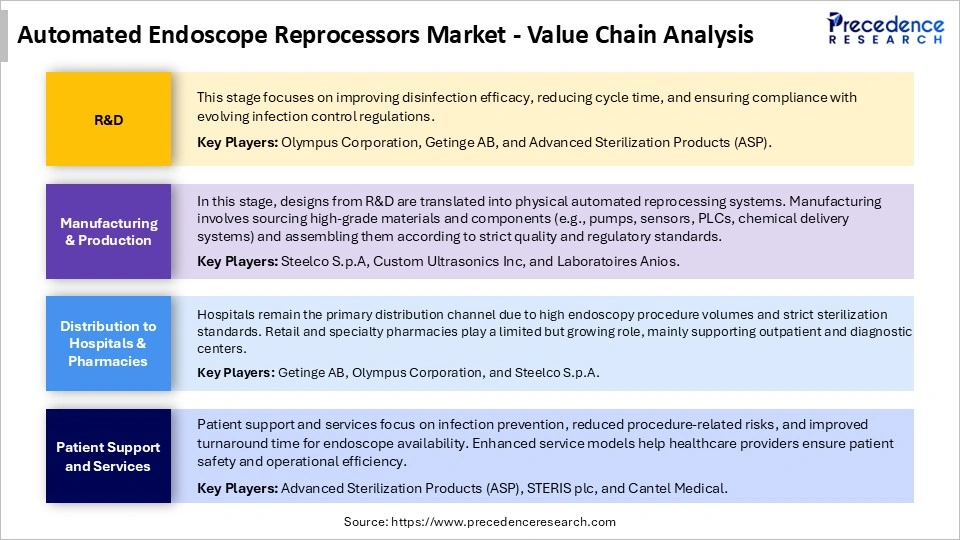
STERIS plc, Olympus Corporation, Advanced Sterilization Products (ASP), Getinge AB, Cantel Medical (part of STERIS), Steelco S.p.A., Wassenburg Medical B.V., Belimed AG, Ecolab Inc., Custom Ultrasonics, Shinva Medical, Soluscope S.A.S., ARC Healthcare Solutions, Metrex Research, Ottomed Endoscopy, and Biorad Medisys.
Automated Endoscope Reprocessors Market Recent highlights
-
Olympus Corporation unveiled ScopeLocker Air, a high-capacity drying and storage system that enhances infection prevention workflows.
-
Soluscope (Ecolab) achieved EU MDR certification for its Serie XS compact AER model — marking validated safety standards and market readiness in Europe.
Segments Covered in the Report
By Product Type
- Standalone AER Units
- Integrated AER Systems (with washers/traceability software)
- Accessory Consumables & Add-ons
By Endoscope Type
- Flexible Endoscope Reprocessors
- GI endoscopes
- Bronchoscopes
- Urological scopes
- Rigid Endoscope Reprocessors
- Laparoscopes
- Arthroscopes
By Reprocessing Cycle
- High-Level Disinfection (HLD)
- Low-Level Disinfection
By Technology/Feature
- Automated Disinfection & Wash Cycles
- Traceability & Documentation Software
- Integrated Leak Detection & Safety Systems
- Remote Monitoring & IoT-enabled Features
By End-User
- Hospitals & Surgical Centers
- Ambulatory Surgical Centers (ASCs)
- Diagnostic/Endoscopy Centers
- Others (Clinics, Specialty Practices)
By Region
- North America
- Europe
- Asia-Pacific
- Latin America
- Middle East & Africa
Get this report to explore global market size, share, CAGR, and trends, featuring detailed segmental analysis and an insightful competitive landscape overview @ https://www.precedenceresearch.com/sample/7573
You can place an order or ask any questions. Please feel free to contact us at sales@precedenceresearch.com |+1 804 441 9344

- ESG Software Market 2025: Comprehensive Key Players Ecosystem and Revenue Outlook - May 20, 2026
- ESG Software Market Worth Around USD 31.96 Billion by 2035 - May 20, 2026
- Hematopoietic Stem Cell Transplantation Market Size to Attain USD 24.32 Billion by 2035 as Precision Medicine and AI Reshape Blood Cancer Treatment - May 20, 2026
