
Wireless Brain Sensors Market Size to Soar to USD 1,620.58 Million by 2035
Growing Neurological Care, AI Integration, and Remote Monitoring to Drive 10.12% CAGR Through 2035
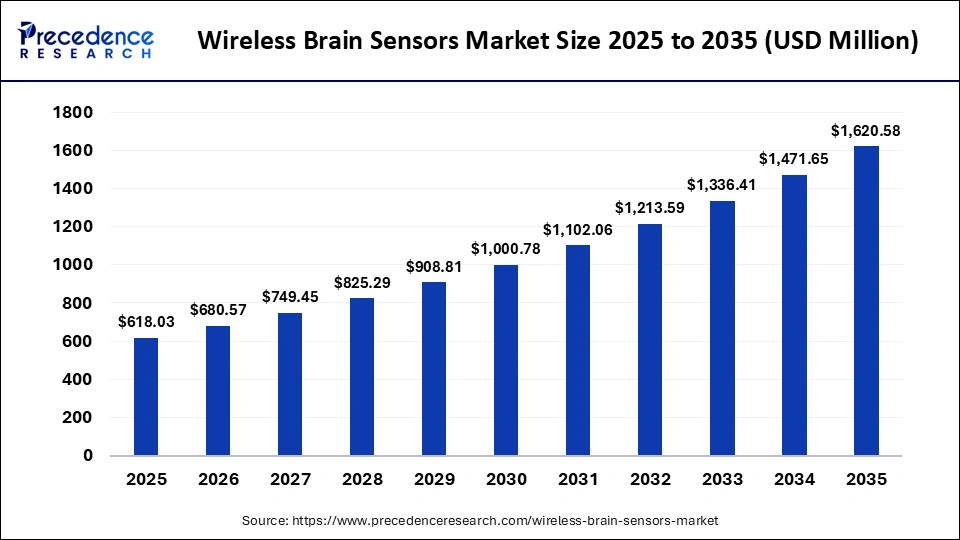
The Global Wireless Brain Sensors Market is on track to transform neuro-monitoring and brain health technologies, expanding from an estimated USD 618.03 million in 2025 to an impressive USD 1,620.58 million by 2035, at a robust 10.12% CAGR during the forecast period. Fueled by rising neurological disorders, the greater demand for non-invasive brain monitoring solutions, and the integration of artificial intelligence, wireless brain sensors are redefining clinical care, research, and consumer brain health tracking.
Wireless Brain Sensors Market Key Insights
-
The market was valued at ~USD 618 million in 2025 and is projected to reach ~USD 1.62 billion by 2035.
-
North America controls over 41% of the global market share.
-
Wireless EEG sensors dominate sensor-type revenue with ~62% share in 2025.
-
Wearable headbands/headsets are the largest product type segment (~44% share).
-
Bluetooth/BLE connectivity leads wireless connectivity at ~48% share.
-
Neurological disorder diagnosis & monitoring is the top application segment.
-
Hospitals & neurology centers remain the leading end-user in 2025.
-
Asia-Pacific is forecasted as the fastest-growing regional market.
Wireless Brain Sensors Market Revenue Snapshot
Wireless Brain Sensors — 2025 vs. 2035 (USD Million)
| Metric | 2025 | 2035 (Forecast) |
|---|---|---|
| Total Market Value | 618.03 | 1,620.58 |
| CAGR (2026–2035) | — | 10.12% |
Why Wireless Brain Sensors Matter
Wireless brain sensors encompassing EEG systems, fNIRS sensors, and emerging modalities — allow clinicians, researchers, and even consumers to monitor brain activity without cumbersome wired setups. From diagnosing epilepsy to prompting early identification of cognitive impairments, these devices reduce clinical burden while expanding access to real-time neurological data in hospital, research, and home environments.
How AI Is Supercharging Market Growth
AI and Real-Time Brain Analytics
AI-powered analytics are now being embedded directly into wireless sensor platforms. These systems can automatically clean and interpret EEG and fNIRS signals, rapidly detect patterns, and alert clinicians to anomalies that might otherwise require hours of manual review. Real-time AI models are also enabling predictive insights — for example, forecasting seizure activity or detecting early-stage neurological decline.
Enabling Remote Healthcare and Personalized Care
When paired with machine learning and cloud platforms, wireless brain sensors become powerful tools for remote patient monitoring and personalized brain health tracking. Algorithms can adapt to individual signal baselines, enhancing accuracy in home-based care and tele-neurology setups — a trend that gained urgency after the COVID-19 pandemic underscored the importance of decentralized healthcare.
What’s Driving Growth in This Market?
-
Increase in neurological disorders such as epilepsy, stroke, dementia, and sleep disorders.
-
Surging demand for non-invasive monitoring devices in both clinical and consumer segments.
-
Consumer neurotechnology boom, especially in wellness and cognitive tracking products.
-
Remote care adoption, including tele-neurology and home-based monitoring models.
-
Technological shifts like dry electrodes, wearable ergonomics, and cloud-based analytics.
What Are the Latest Trends and Opportunities?
Could wireless brain sensors become mainstream in consumer wellness?
Consumer adoption of neuro-wellness wearables is accelerating, especially as devices bridge the gap between clinical precision and everyday usability. Wireless headsets that track sleep, focus, and stress are gaining traction in the wellness market.
Is tele-neurology the next frontier?
The pandemic accelerated remote care models and highlighted the need for reliable remote brain monitoring. Wireless sensors integrated with mobile apps and cloud services are enabling neurologists to supervise patients outside traditional clinical settings, reducing costs and enhancing patient comfort.
Wireless Brain Sensors Market Scope
| Report Coverage | Details |
| Market Size in 2025 | USD 618.03 Million |
| Market Size in 2026 | USD 680.57 Million |
| Market Size by 2035 | USD 1,620.58 Million |
| Market Growth Rate from 2026 to 2035 | CAGR of 10.12% |
| Dominating Region | North America |
| Fastest Growing Region | Asia Pacific |
| Base Year | 2025 |
| Forecast Period | 2026 to 2035 |
| Segments Covered | Sensor Type, Product Type, Connectivity Type, Application, End-User, Use Setting, Technology/Platform, Channel, and Region |
| Regions Covered | North America, Europe, Asia-Pacific, Latin America, and Middle East & Africa |
Wireless Brain Sensors Market Regional Footprint: Who’s Leading and Who’s Rising
North America — Dominates with ~41% share thanks to advanced healthcare infrastructure, rapid adoption of digital health technologies, and significant neuroscience research activity.
Asia-Pacific — Fastest-growing region, driven by expanding healthcare access, rising neurological disease incidence, and investments in digital health infrastructure. China, Japan, and India are notable growth engines.
Europe, Latin America & Middle East — Steady growth supported by increasing awareness of brain health technologies and rising investments in neurotechnology R&D.
Wireless Brain Sensors Market Segment Outlook
Sensor Type Insights
Why Wireless EEG Sensors Dominated the Market
Wireless EEG sensors led the wireless brain sensors market with an estimated 62% share in 2025, driven by their clinical reliability and wide applicability in neurology. These sensors enable high-resolution, real-time monitoring of brain electrical activity, making them essential for diagnosing epilepsy, sleep disorders, brain injuries, and cognitive impairments.
Their versatility across clinical, research, and therapeutic applications has reinforced their dominance and sustained widespread adoption.
Rapid Growth of Wireless fNIRS Sensors
Wireless fNIRS sensors are expected to register the fastest growth rate, supported by their ability to measure cerebral blood flow and oxygenation, particularly in the prefrontal cortex.
These sensors are well suited for cognitive research, mental health assessments, and neurorehabilitation. Their tolerance to motion artifacts enables use in ambulatory and real-world environments, driving adoption in brain–computer interface research and human–computer interaction studies.
Product Type Insights
Leadership of Wearable Headbands and Headsets
Wearable headbands and headsets captured approximately 44% of market revenue in 2025, supported by ease of use, comfort, and ergonomic design. These devices are widely used in EEG and fNIRS applications to assess attention, stress, sleep patterns, and mental workload.
Their suitability for long-term wear makes them attractive across clinical, research, and consumer neurotechnology settings.
Fastest Growth in Sensor Patches and Modular Nodes
Wireless sensor patches and modular nodes are expected to grow at the fastest CAGR due to their flexibility and scalability. These solutions allow customized sensor placement across multiple brain regions, supporting advanced neurological and multimodal research.
Their compact design and portability enable continuous monitoring without restricting patient mobility.
Connectivity Type Insights
Why Bluetooth/BLE Connectivity Led in 2025
Bluetooth and BLE-based sensors dominated the market with around 48% share in 2025, driven by low power consumption, stable connectivity, and broad compatibility with smartphones and wearables.
BLE supports long battery life and seamless data transfer, making it ideal for continuous monitoring in both clinical and home environments. Its easy integration with mobile health platforms and AI-driven analytics further reinforces adoption.
Strong Growth Expected for Wi-Fi-Enabled Sensors
Wi-Fi-enabled sensors are projected to grow at the highest CAGR from 2026 to 2035 due to demand for high-bandwidth, real-time data transmission.
These sensors are well suited for hospitals and research facilities that require advanced analytics, high-resolution streaming, and centralized monitoring. Growth is supported by expanding tele-neurology programs and smart healthcare infrastructure.
Application Insights
Dominance of Neurological Disorder Diagnosis and Monitoring
Neurological disorder diagnosis and monitoring accounted for approximately 31% of market revenue in 2025, driven by the rising prevalence of epilepsy, stroke, dementia, and sleep disorders.
Wireless brain sensors enable long-term, real-world monitoring, improving diagnostic accuracy and supporting personalized treatment strategies.
Rapid Expansion of BCI and Assistive Technologies
The brain–computer interface and assistive technology segment is expected to grow rapidly, fueled by advancements in neurotechnology and human–machine interaction.
Wireless brain sensors play a critical role in converting neural signals into actionable outputs for rehabilitation, assistive devices, and cognitive enhancement applications.
End-User Insights
Hospitals and Neurology Centers as Key End Users
Hospitals and neurology centers held approximately 34% market share in 2025, driven by the need for accurate and clinically validated brain monitoring tools.
These settings benefit from trained professionals, regulatory compliance, and seamless integration with hospital IT systems, supporting extensive use in diagnosis and treatment planning.
Fastest Growth in Homecare and Remote Monitoring
Homecare and remote patient monitoring are expected to grow at the fastest rate, supported by the shift toward decentralized healthcare.
Wireless brain sensors enable continuous at-home monitoring, reducing hospital visits and improving patient adherence. Growth is further driven by telemedicine adoption, wearable technologies, and AI-enabled health applications.
Use Setting Insights
Clinical and Hospital-Based Monitoring Leading the Market
Clinical and hospital-based monitoring accounted for approximately 43% of market revenue in 2025, as high-quality, real-time brain data is essential for diagnosis and treatment.
Wireless systems improve workflow efficiency by enabling patient mobility while maintaining clinical-grade precision. Expanded wireless infrastructure and tele-neurology services are further strengthening this segment.
Accelerated Growth in Home-Based Monitoring
Home-based monitoring is expected to witness the fastest growth, driven by aging populations and rising demand for convenient care.
This approach reduces healthcare visits, lowers costs, and improves accessibility, particularly for patients in remote locations or managing chronic neurological conditions.
Technology and Platform Insights
Why AI-Enabled Wireless Brain Sensors Led the Market
Wireless brain sensors integrated with AI analytics software captured approximately 44% share in 2025, as they transform raw neural signals into actionable clinical insights.
AI enables real-time pattern recognition, anomaly detection, and predictive analysis, improving diagnostic speed and accuracy while supporting personalized treatment planning.
Rapid Growth of Integrated Neuro-Monitoring Ecosystems
Integrated neuro-monitoring ecosystems are expected to grow at the fastest pace, combining brain sensors with cloud platforms, peripheral nervous system monitoring, and digital health tools.
These systems support holistic evaluation of brain–body interactions and are increasingly adopted in rehabilitation, mental health, and performance monitoring applications.
Channel Insights
Why Direct Sales Led the Market in 2025
Direct sales to hospitals and research centers dominated with approximately 46% market share, as wireless brain sensor systems often require customization, training, and ongoing technical support.
This channel ensures regulatory compliance, long-term contracts, and strong customer relationships, particularly for high-value clinical and research deployments.
Fastest Growth in Online and Direct-to-Consumer Sales
Online and direct-to-consumer sales are expected to grow at the fastest CAGR from 2026 to 2035, driven by rising consumer interest in brain health, wellness, and cognitive performance.
E-commerce platforms and digital health apps are expanding accessibility, making consumer-grade wireless brain sensors an increasingly important growth channel.
Wireless Brain Sensors Market Top Companies
-
EMOTIV
-
Advanced Brain Monitoring, Inc.
-
NeuroSky
-
Neuroelectrics
-
Neuronetrix Solutions, LLC
Notable developments: At CES 2026, next-generation AI-enabled brain monitoring tech grabbed headlines, while innovative startups are raising multi-million-dollar funding rounds for EEG-embedded consumer devices.
Get this report to explore global market size, share, CAGR, and trends, featuring detailed segmental analysis and an insightful competitive landscape overview @ https://www.precedenceresearch.com/sample/7588
You can place an order or ask any questions. Please feel free to contact us at sales@precedenceresearch.com |+1 804 441 9344

- ESG Software Market 2025: Comprehensive Key Players Ecosystem and Revenue Outlook - May 20, 2026
- ESG Software Market Worth Around USD 31.96 Billion by 2035 - May 20, 2026
- Hematopoietic Stem Cell Transplantation Market Size to Attain USD 24.32 Billion by 2035 as Precision Medicine and AI Reshape Blood Cancer Treatment - May 20, 2026
