
Hospital Services Market Surges Toward USD 25.26 Trillion by 2035
What is the Hospital Services Market Size in 2026?
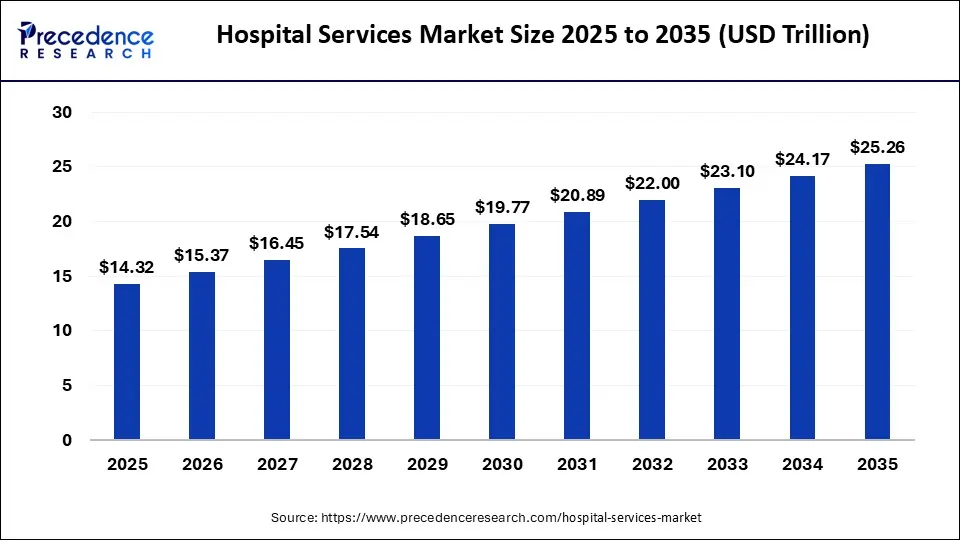
The global hospital services market is undergoing a massive transformation, driven by expanding healthcare access, technological innovation, and increasing chronic disease burden. According to Precedence Research, the market is projected to grow from USD 15.37 trillion in 2026 to approximately USD 25.26 trillion by 2035, registering a steady CAGR of 5.84% from 2026 to 2035.
Why Is the Hospital Services Market Entering a New Growth Phase?
The hospital services ecosystem has become the backbone of the global healthcare infrastructure. Rising patient volumes, increasing life expectancy, and broader insurance coverage—especially in emerging economies—are driving sustained demand. Additionally, the shift toward patient-centric care models and value-based healthcare is accelerating service diversification across hospitals.
Healthcare providers are also expanding specialty services such as oncology, cardiovascular care, and diagnostics, while simultaneously investing in digital transformation to enhance clinical efficiency and patient outcomes.
What Are the Key Market Highlights?
The hospital services market was valued at USD 14.32 trillion in 2025.
It is expected to reach USD 25.26 trillion by 2035.
The market will grow at a CAGR of 5.84% (2026–2035).
Asia Pacific is emerging as a high-growth regional hub.
Inpatient services continue to dominate revenue share globally.
Leading players include Apollo Hospitals, Mayo Clinic, and Johns Hopkins Hospital.
How Is Artificial Intelligence Reshaping Hospital Services?
Artificial intelligence is playing a transformative role in hospital operations and patient care delivery. From AI-powered diagnostic imaging to predictive analytics for patient outcomes, hospitals are increasingly integrating intelligent systems into their workflows. These technologies reduce diagnostic errors, optimize treatment pathways, and enhance clinical decision-making.
Moreover, AI is improving operational efficiency by automating administrative processes such as patient scheduling, billing, and resource allocation. This not only reduces costs but also allows healthcare professionals to focus more on patient care, ultimately improving satisfaction and outcomes.
What Are the Key Growth Drivers of the Market?
Increasing Chronic Disease Burden
The rising prevalence of conditions such as cardiovascular diseases, cancer, and diabetes is significantly boosting hospital admissions and long-term care demand.
Expansion of Health Insurance Coverage
Developing nations are witnessing increased insurance penetration, making hospital services more accessible to a larger population base.
Technological Advancements in Healthcare
Innovations in minimally invasive surgeries, diagnostics, and telehealth are enhancing service delivery and reducing hospital stay durations.
Aging Global Population
An aging demographic requires continuous medical attention, driving demand for both inpatient and outpatient services.
Hospital Services Market Scope
| Report Highlights | Details |
| Market Size in 2025 | USD 14.32Trillion |
| Market Size in 2026 | USD 15.37Trillion |
| Market Size by 2035 | USD 25.26 Trillion |
| Growth Rate from 2026 to 2035 | CAGR of 5.84% |
| Largest Market | North America |
| Fastest Growing Market | Asia Pacific |
| Base Year | 2025 |
| Forecast Period | 2026 to 2035 |
| Segments Covered | Service Class, Hospital Type, Service Area, Region |
| Regions Covered | North America, Europe, Asia-Pacific, Latin America and Middle East & Africa |
What Opportunities and Trends Are Shaping the Future?
Is Outpatient Care the Future of Hospital Services?
Yes. The shift toward outpatient care is accelerating due to advancements in minimally invasive procedures and faster recovery times. Hospitals are increasingly investing in ambulatory care centers to meet this demand.
Can Medical Tourism Unlock New Revenue Streams?
Absolutely. Countries like India, Thailand, and Singapore are attracting international patients due to cost-effective treatments and high-quality care, boosting hospital revenues.
Are Digital Hospitals Becoming the New Standard?
Yes. Smart hospitals equipped with IoT devices, AI systems, and electronic health records are redefining patient care and operational efficiency.
Hospital Type Insights
The structure of hospital services varies across regions. In countries like the U.S. and the UK, private hospitals have played a major role in shaping the market. This is largely because many retail clinics operate under private hospital networks. As a result, private and community hospitals have had a strong influence on overall market growth.
By 2025, public and community hospitals held the largest share of the market at 36.47%, followed by state-owned hospitals. However, both of these segments are expected to gradually lose share to private hospitals. This shift is driven by the advanced services offered by private institutions, including superspecialty treatments that attract more patients.
Private hospitals typically have larger bed capacities and offer a wide range of specialized services across different medical fields. Meanwhile, community hospitals are often supported by philanthropists, corporations, and community funding initiatives.
Looking ahead, private hospitals are expected to grow significantly. Their expansion is fueled by stronger specialist capabilities and a focus on treating critical and chronic conditions such as cardiovascular diseases and cancer. In contrast, state-owned hospitals mainly focus on acute care needs like trauma and infection treatment, and their market share is expected to decline, especially in developed countries.
Service Type Insights
In 2025, inpatient services dominated the market with a 57.72% share, mainly because many treatments still require extended hospital stays.
The demand for inpatient care has grown due to:
Increasing complexity of treatments
Rising cases of chronic and long-term illnesses
A growing elderly population
More surgeries requiring post-operative care
Advancements in medical technology and improved hospital care have also contributed to this growth.
However, inpatient services are expensive, and limited insurance coverage is pushing many patients toward outpatient options. As a result, outpatient services are expected to gain a larger share in the coming years. Additionally, faster recovery times and improved surgical techniques are reducing hospital stay durations.
Service Areas Insights
Among different medical service areas, cardiovascular services held the largest share in 2025, followed by diagnostics and imaging.
Other key trends include:
Neurorehabilitation and psychiatry (12.5% share) are expected to grow the fastest due to rising mental health awareness.
Cancer care is projected to be the second fastest-growing segment, driven by increasing cancer cases.
Diagnostics and imaging are expanding rapidly due to higher demand for early detection, routine screenings, and advanced imaging technologies.
Technological advancements, especially in communication, are also boosting outpatient services through telemedicine and remote consultations. These innovations are helping reduce hospital stays and making outpatient care more accessible and cost-effective.
Regional Insights
North America
North America led the global market in 2025 with a 28.44% share. Growth in this region is driven by:
Rising cancer cases
High healthcare spending
Advanced healthcare infrastructure
The U.S. hospital services market alone reached USD 2.64 trillion in 2025 and is expected to grow to USD 4.16 trillion by 2035, with a CAGR of 4.65%.
Asia Pacific (Fastest Growing Region)
Asia Pacific is the fastest-growing region due to:
Rapid population growth
Increasing healthcare awareness
Strong government and private investments
Growth in medical tourism
China leads the region, supported by its vast hospital network and continuous government investment in healthcare modernization and expansion.
Europe
Europe is experiencing steady growth due to:
Universal healthcare systems
High government spending
An aging population needing long-term and chronic care
Hospitals in Europe are also focusing on efficiency by adopting digital health technologies and expanding outpatient services.
Germany leads the region with its strong healthcare infrastructure and large number of hospital beds.
Latin America
Latin America is emerging as a promising market due to:
Improved healthcare access
Expansion of private hospitals
Rising insurance coverage
Growing middle-class demand for quality care
Brazil is the leading country in this region, driven by its large healthcare system and increasing investment in private and multi-specialty hospitals.
Middle East & Africa
Growth in this region is supported by:
Government investment in healthcare infrastructure
Development of new hospitals and medical cities
Increasing chronic disease cases
Growth in medical tourism
Saudi Arabia leads the region due to large-scale government initiatives, hospital expansion projects, and increased private sector participation.
Competitive Landscape
The global hospital services market is highly fragmented, with both large and small players operating at regional and global levels. Major companies include:
HCA Healthcare
Ascension Health
Tenet Healthcare Corporation
Mayo Clinic
Community Health Systems
These organizations are actively focusing on mergers, acquisitions, and expansion strategies to strengthen their presence. However, while consolidation has created larger hospital networks, it has also contributed to rising healthcare costs.
Hospital Services Market Companies
- Mayo clinic
- HCA Healthcare
- Cleveland clinic
- Spire Healthcare Group plc
- Ramsay Health Care
- Ascension Health
- Community Health Systems, Inc.
- Tenet Healthcare
- Fortis Healthcare
Segments Covered in the Report
By Hospital Type
- State-owned Hospital
- Private Hospital
- Public/ Community Hospital
By Service Type
- Outpatient Services
- Inpatient Service
By Service Areas
- Cardiovascular
- Acute Care
- Cancer Care
- Diagnostics, and Imaging
- Neurorehabilitation & Psychiatry Services
- Gynecology
- Others
By Regional Outlook
- North America
- U.S.
- Canada
- Europe
- U.K.
- Germany
- France
- Asia Pacific
- China
- India
- Japan
- South Korea
- Rest of the World
Get Sample Link: https://www.precedenceresearch.com/sample/1082
Also Read : https://www.marketstatsinsight.com/cranberry-capsules-market-size-to-reach-usd-19-44-billion-by-2035/

- Corporate Wellness Market Surges Toward USD 500.09 Billion by 2035 - April 22, 2026
- Portable Medical Devices Market Surges Toward USD 221.71 Billion by 2035 - April 22, 2026
- Infant Incubator Market Set to Surpass USD 3.27 Billion by 2035 - April 22, 2026