
Liquid Crystal Polymer Market Size to Reach USD 3.82 Billion by 2035
The global liquid crystal polymer market is projected to grow from USD 1.96 billion in 2026 to USD 3.82 billion by 2035, driven by rising demand for high-performance materials in electronics, automotive, aerospace, and healthcare industries.
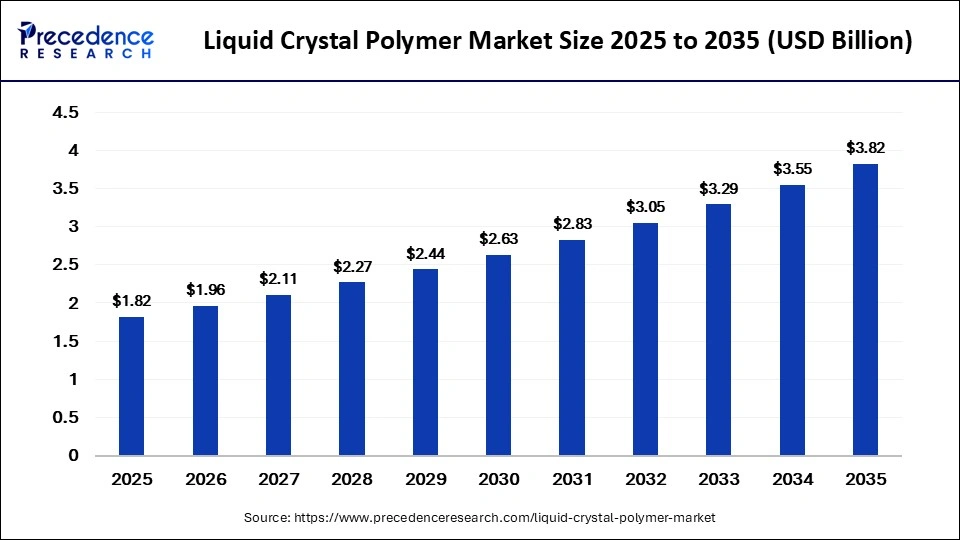
Liquid Crystal Polymer Market Gains Momentum Amid Growing Demand for Advanced High-Performance Materials
Introduction
The demand for lightweight, durable, and high-performance materials is transforming multiple industries, from electronics and automotive to aerospace and healthcare. Among these advanced materials, Liquid Crystal Polymers (LCPs) have emerged as a preferred choice due to their exceptional thermal stability, chemical resistance, electrical properties, and mechanical strength.
As manufacturers increasingly focus on miniaturization, precision engineering, and next-generation electronic devices, liquid crystal polymers are becoming essential components in modern industrial applications. Their unique molecular structure enables superior performance in demanding environments, making them ideal for connectors, sensors, semiconductor packaging, flexible circuits, and aerospace components. The growing adoption of advanced manufacturing technologies is expected to further accelerate market growth over the coming decade.
Read Also: AI in Product Lifecycle Management Market
Market Overview
The global liquid crystal polymer market was valued at USD 1.82 billion in 2025 and is expected to grow from USD 1.96 billion in 2026 to approximately USD 3.82 billion by 2035, registering a CAGR of 7.90% during the forecast period. The market expansion is fueled by technological advancements in material science and increasing demand for high-performance polymers across healthcare, electronics, automotive, aerospace, and industrial sectors.
LCP materials offer excellent dimensional stability, low moisture absorption, outstanding dielectric properties, and resistance to high temperatures. These characteristics make them increasingly valuable in applications where reliability and performance are critical.
What Makes Liquid Crystal Polymers Unique?
Liquid crystal polymers occupy a unique position between conventional plastics and crystalline materials. Their molecular arrangement allows them to exhibit exceptional mechanical and thermal properties while maintaining lightweight characteristics.
Key advantages include:
- High heat resistance
- Superior chemical resistance
- Excellent electrical insulation
- Low dielectric constant
- High dimensional stability
- Minimal moisture absorption
- Lightweight construction
- Exceptional strength-to-weight ratio
These properties have made LCPs indispensable in advanced electronic devices, automotive systems, medical instruments, and aerospace applications.
Key Market Drivers
Rapid Expansion of the Electronics Industry
The electronics sector remains the primary growth engine for the liquid crystal polymer market. Increasing production of miniaturized electronic devices, sensors, connectors, semiconductor packages, and high-frequency communication components is driving significant demand for LCP materials. Their excellent dielectric performance and thermal stability make them ideal for next-generation electronic applications.
Rising Demand for Miniaturized Components
Modern electronic devices continue to become smaller while requiring greater functionality and reliability. LCP materials support the development of compact connectors, chip carriers, high-frequency antennas, and precision components due to their dimensional stability and processing capabilities.
Growth of 5G and Advanced Communication Infrastructure
The global deployment of 5G networks is creating substantial opportunities for LCP manufacturers. LCP films are increasingly used in high-frequency communication systems, antennas, and advanced circuit substrates because of their superior signal transmission properties and low dielectric losses.
Increasing Adoption in Automotive Electronics
As electric vehicles and autonomous driving technologies gain traction, manufacturers require advanced materials capable of supporting sensors, radar systems, connectors, and electronic control units. Liquid crystal polymers offer the performance characteristics needed for these demanding automotive applications.
Emerging Market Trends
Growing Use in Aerospace Applications
Liquid crystal polymer films are increasingly utilized in aerospace communication systems and RF antennas due to their ability to support high-frequency signal transmission while maintaining stability under extreme conditions. This trend is creating new opportunities within aerospace and defense sectors.
Expansion of Flexible Electronics
The rise of wearable devices, foldable displays, and flexible electronic circuits is boosting demand for LCP films. Their durability and ability to maintain performance under dynamic conditions make them attractive for advanced electronics manufacturing.
AI-Driven Material Development
Artificial intelligence is increasingly being used to predict molecular behavior, optimize material performance, and accelerate the development of next-generation liquid crystal polymer formulations. This trend is expected to enhance product innovation and reduce development timelines.
Segment Analysis
Thermotropic LCP Leads by Type
The thermotropic liquid crystal polymer segment dominated the market with a 91% share in 2025 and is projected to maintain its leadership throughout the forecast period. These materials exhibit liquid crystalline properties when heated, making them highly suitable for precision electronics and miniaturized components. Their widespread use in consumer electronics and automotive systems continues to drive growth.
Resin Segment Dominates by Form
By form, the resin segment accounted for 62% of market revenue in 2025. Strong demand for injection-molded components and electrical applications has supported the segment’s leadership position. LCP resins are extensively used in connectors, electronic housings, and precision-engineered components.
Films Segment Exhibits Fastest Growth
The films segment is expected to grow at the fastest CAGR of 9.3% through 2035. Rising adoption in flexible electronics, communication systems, and display technologies is fueling demand for advanced LCP films.
Electronics & Semiconductor Industry Remains Largest End User
The electronics and semiconductor segment captured 52% of the market in 2025. Growing demand for semiconductor packaging, high-performance connectors, and advanced electronic components continues to support segment growth. LCP materials provide the thermal resistance and electrical performance required in modern semiconductor applications.
Regional Analysis
Asia Pacific Dominates the Global Market
Asia Pacific held the largest market share of 46% in 2025 and is expected to register the fastest growth rate of 9.2% through 2035. Rapid industrialization, expanding electronics manufacturing, and growing automotive production across countries such as China, Japan, South Korea, and India are driving regional market growth.
China remains the leading contributor within the region, supported by substantial investments in electronics manufacturing and advanced materials research.
North America Maintains Strong Position
North America accounted for 24% of global market revenue in 2025. The region benefits from strong demand for high-performance materials across semiconductor manufacturing, healthcare, automotive, and aerospace industries. Increasing investments in 5G infrastructure and advanced electronics continue to support market expansion.
Europe Witnesses Growing Adoption
Europe represented 21% of the global market in 2025. The region’s focus on electric vehicles, lightweight materials, sustainable manufacturing, and advanced aerospace technologies is creating favorable conditions for liquid crystal polymer adoption.
Challenges Facing the Market
Despite strong growth prospects, several challenges could limit market expansion:
- High material costs compared to conventional engineering plastics
- Complex manufacturing processes
- Significant research and development investments
- Limited adoption among cost-sensitive industries
- High initial setup costs for advanced processing technologies
Addressing these challenges through innovation and cost optimization will be crucial for broader market penetration.
Competitive Landscape
The liquid crystal polymer market is semi-consolidated, with leading manufacturers focusing on innovation, sustainability, and advanced material development. Companies are investing heavily in research and development to enhance product performance, improve processing efficiency, and expand application areas.
Strategic partnerships, mergers, acquisitions, and collaborations are becoming increasingly common as manufacturers seek to strengthen their market presence and capitalize on emerging opportunities in electronics, healthcare, aerospace, and automotive industries.
Future Outlook
The future of the liquid crystal polymer market appears highly promising. The continued expansion of consumer electronics, semiconductor manufacturing, electric vehicles, aerospace systems, and healthcare technologies will create substantial demand for advanced polymer materials.
As industries increasingly prioritize miniaturization, performance optimization, and lightweight designs, liquid crystal polymers are expected to play a pivotal role in next-generation product development. Innovations in AI-assisted material design, flexible electronics, and high-frequency communication technologies will further strengthen market growth opportunities.
Conclusion
Liquid crystal polymers have evolved into a critical material category supporting some of the world’s most advanced technologies. Their exceptional combination of thermal stability, chemical resistance, electrical performance, and mechanical strength makes them indispensable across a wide range of industries.
With the market projected to reach USD 3.82 billion by 2035, driven by electronics, automotive, aerospace, and healthcare applications, liquid crystal polymers are set to remain at the forefront of advanced materials innovation. Companies investing in high-performance polymer technologies today will be well-positioned to capitalize on the growing demand for next-generation industrial and electronic solutions.
Get a Sample Copy: https://www.precedenceresearch.com/sample/8441
For inquiries regarding discounts, bulk purchases, or customization requests, please contact us at sales@precedenceresearch.com
