
Europe L7 Electric Micro Cars Market Size, Growth, Trends, and Forecast 2025 to 2034
The Europe L7 electric micro cars market is experiencing significant growth as consumers, municipalities, and governments increasingly prioritize sustainable urban mobility solutions. The market volume is projected to increase from 27,151 units in 2025 to approximately 73,556 units by 2034, registering a CAGR of 10.48% during the forecast period. Growing urbanization, rising environmental concerns, and supportive government initiatives are driving the adoption of compact electric vehicles across Europe.
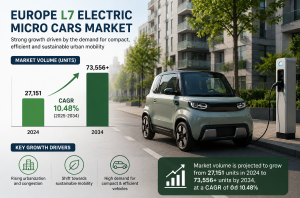
L7 electric micro cars are emerging as an efficient alternative to conventional passenger vehicles, particularly in densely populated urban centers where congestion, parking limitations, and emission reduction goals continue to shape transportation strategies.
Europe L7 Electric Micro Cars Market Scope
| Market Scope | Details |
|---|---|
| Market Volume 2024 | 29,996 Units |
| Market Volume 2025 | 27,151 Units |
| Market Volume 2034 | 73,556 Units |
| CAGR (2025-2034) | 10.48% |
| Largest Market | Germany |
| Fastest Growing Market | United Kingdom |
| Forecast Period | 2025–2034 |
Download the Sample: https://www.precedenceresearch.com/sample/5700
Urban Mobility Transformation Accelerates Demand for Electric Micro Cars
- European cities are increasingly adopting low-emission transportation policies, creating strong demand for compact electric vehicles. L7 electric micro cars offer an ideal solution for urban commuters seeking affordable, environmentally friendly, and space-efficient transportation.
- Their compact design allows easy maneuverability through congested city streets while significantly reducing parking challenges. As fuel prices continue to rise and governments promote carbon-neutral mobility, consumers are increasingly turning toward electric micro vehicles for everyday transportation needs.
- The growing popularity of personal mobility solutions is expected to support long-term market expansion throughout the forecast period.
Artificial Intelligence Enhances Performance and User Experience
- Artificial intelligence is becoming an important component of modern electric micro cars. AI-powered technologies are improving vehicle performance, predictive maintenance, battery management, and driving assistance capabilities.
- Manufacturers are integrating intelligent systems that optimize charging schedules, monitor battery health, and provide personalized driving experiences. AI-driven analytics also help improve energy efficiency while supporting advanced safety features and autonomous driving development.
- As Europe continues investing in connected mobility ecosystems, AI is expected to play a critical role in the next generation of electric micro vehicles.
Government Policies and Sustainability Goals Fuel Market Growth
- Europe’s ambitious carbon neutrality objectives are creating favorable conditions for electric vehicle adoption. Governments across the region are introducing incentives, tax benefits, and subsidies to encourage consumers to switch from conventional vehicles to electric alternatives.
- Low-emission zones, stricter environmental regulations, and investments in charging infrastructure are further accelerating market development. These initiatives are particularly benefiting compact electric vehicle categories such as L7 micro cars, which align closely with urban sustainability goals.
- The transition toward greener transportation systems is expected to remain one of the strongest drivers of market growth.
Benefits of L7 Electric Micro Cars
- L7 electric micro cars are becoming increasingly popular across Europe due to their ability to provide sustainable, cost-effective, and practical transportation solutions. These compact vehicles produce zero tailpipe emissions, helping reduce urban air pollution and support regional carbon reduction goals. Their smaller size and lightweight design also require less energy compared to conventional passenger vehicles, making them an environmentally friendly mobility option.
- Affordability is another major advantage of L7 electric micro cars. They generally have lower purchase prices, reduced maintenance costs, and lower operating expenses than traditional cars. Electric powertrains contain fewer moving parts, resulting in less wear and tear and minimizing long-term maintenance requirements. Additionally, government incentives, tax benefits, and subsidies available in several European countries further improve affordability for consumers.
- Convenience plays a crucial role in driving adoption. L7 electric micro cars are ideal for navigating crowded city streets and can easily fit into limited parking spaces. Their compact dimensions make them highly suitable for urban commuting, short-distance travel, and daily errands. With advancements in battery technology and charging infrastructure, these vehicles are becoming an increasingly practical solution for modern urban mobility.
Technological Advancements Unlock New Opportunities
- Continuous innovation in battery technologies, lightweight materials, and connected vehicle systems is significantly improving the performance of electric micro cars.
- Modern lithium-ion batteries offer longer driving ranges, faster charging capabilities, and enhanced durability. Manufacturers are also integrating regenerative braking systems, smart connectivity features, and advanced safety technologies to improve user experience.
- As technology continues to evolve, electric micro cars are becoming increasingly attractive to a broader consumer base, creating new growth opportunities for manufacturers and investors.
Extended Range Vehicles Gain Popularity
- While medium-range micro cars remain popular for daily city commuting, consumers are increasingly demanding vehicles capable of traveling longer distances on a single charge.
- Extended-range electric micro cars provide greater flexibility and convenience, making them suitable for both urban and suburban transportation. Improvements in battery performance and charging infrastructure are expected to further strengthen demand for longer-range models over the coming years.
- This trend is encouraging manufacturers to develop next-generation vehicles with enhanced range capabilities and improved energy efficiency.
Role of Artificial Intelligence in Electric Micro Cars – Smarter Driving and Battery Optimization
Artificial Intelligence (AI) is transforming the capabilities of L7 electric micro cars by enhancing vehicle intelligence, efficiency, and user experience. AI-powered systems analyze real-time driving data to optimize vehicle performance, improve energy consumption, and provide smarter driving assistance. Features such as adaptive navigation, predictive route planning, collision warnings, and driver behavior analysis help make urban commuting safer and more efficient.
One of the most significant applications of AI is battery optimization. Advanced AI algorithms continuously monitor battery health, charging patterns, temperature conditions, and energy usage to maximize battery lifespan and performance. AI can recommend optimal charging schedules, predict maintenance requirements, and improve energy management, helping drivers achieve greater driving range and lower operating costs.
AI is also supporting the development of connected and semi-autonomous mobility solutions. Smart vehicle systems can communicate with charging stations, traffic management networks, and other connected devices to improve route efficiency and reduce congestion. As electric micro cars continue to evolve, AI will play an increasingly important role in delivering safer, more sustainable, and highly personalized urban transportation experiences.
Recent Developments in the Europe L7 Electric Micro Cars Market
- May 2024: Eli Electric Vehicles launched the street-legal Eli ZERO, a two-seater electric micro car designed for urban transportation.
- October 2024: Citroën unveiled the next-generation Citroën Ami at the Paris Motor Show, scheduled for commercial launch in 2025.
- February 2024: Renault announced plans to introduce the fully electric Twingo by 2026, targeting an affordable price point below €20,000.
- July 2024: Wings EV introduced the Robin, an L7-class electric quadricycle offering a range of up to 90 km on a single charge.
- September 2024: Germany introduced new tax incentives aimed at boosting electric vehicle adoption and supporting the country’s green mobility transition.
Read More: Digestive Health Products Market
Europe L7 Electric Micro Cars Market Companies
- Renault
- Fiat
- Aixam
- Volkswagen
- Micro Mobility Systems AG
- TAZZARI EV
- Renault Group
- Space Options Limited (Siticars.com)
- Ariel Motor Company Ltd.
Segments Covered in the Report
By Range Per Charge
- Short Range (30-60 KM)
- Medium Range (61-100 KM)
- Extended Range (Above 100 KM)
By Battery Type
- Lead Acid Battery
- Lithium-Ion Battery
- Others
By Seats
- 2 Seats
- 4 Seats
By Geography
- Germany
- United Kingdom
- France
- Italy
- Spain
- Rest of Europe
Looking Ahead
The future of the Europe L7 electric micro cars market appears highly promising as urban mobility continues evolving toward cleaner, smarter, and more sustainable transportation solutions. Growing government support, advancements in battery technologies, increasing AI integration, and rising consumer demand for affordable personal mobility are expected to drive market expansion over the next decade.
As European cities prioritize emission reduction and efficient transportation infrastructure, L7 electric micro cars are positioned to become a key component of future urban mobility ecosystems. Companies that focus on innovation, connectivity, and sustainability are likely to lead the market through 2034 and beyond.
You can place an order or ask any questions. Please feel free to contact us at sales@precedenceresearch.com | +1 804 441 9344

- Europe L7 Electric Micro Cars Market Size, Growth, Trends, and Forecast 2025 to 2034 - June 19, 2026
- Digestive Health Products Market Expands as Consumers Prioritize Gut Health and Preventive Wellness - June 18, 2026
- Small Caliber Ammunition Market Size is Set for Steady Growth Through 2035 - June 17, 2026
