
High-Bandwidth Memory Market Size to Reach USD 59.16 Billion by 2034 – Driven by AI, Cloud Computing, and Advanced Semiconductor Integration
Asia Pacific dominates the HBM manufacturing landscape while North America emerges as fastest-growing market, propelled by AI acceleration and data center expansions.
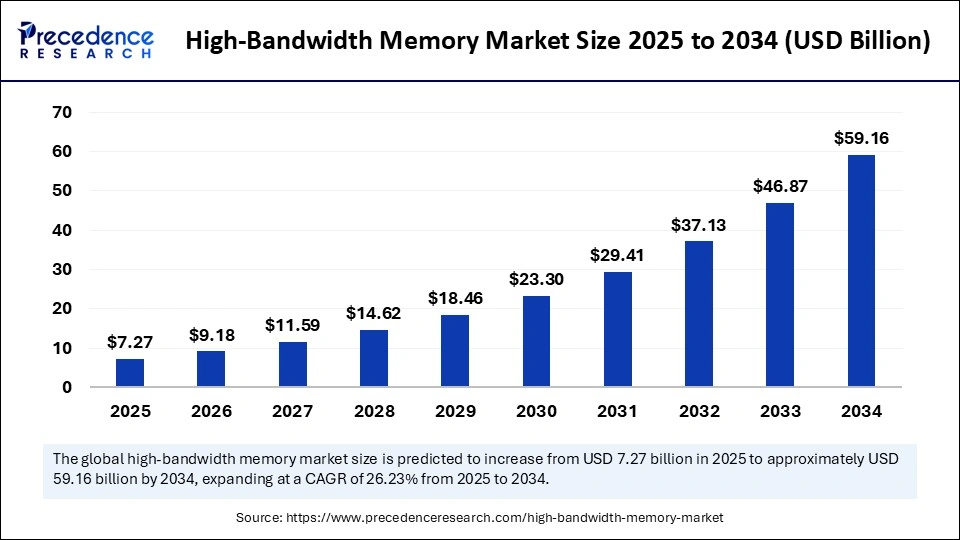
The global high-bandwidth memory market is anticipated to grow from USD 7.27 billion in 2025 to an astounding USD 59.16 billion by 2034, expanding at a CAGR of 26.23%. This exponential growth is attributed to the rising adoption of advanced computing systems, artificial intelligence (AI), and graphics processing technologies that demand ultra-fast data transfer. With architectures increasingly constrained by bandwidth rather than FLOPS, high-bandwidth memory (HBM) is emerging as the cornerstone of next-generation computational design.
High-Bandwidth Memory Market Key Insights
-
The market size stands at USD 7.27 billion in 2025 and will surpass USD 59.16 billion by 2034.
-
Asia Pacific leads with a 2025 valuation of USD 3.27 billion, projected to reach USD 26.92 billion by 2034.
-
North America is the fastest-growing region due to AI infrastructure and GPU innovation.
-
HBM2 currently dominates with a 50% share, while HBM3 is the fastest-growing memory type.
-
GPUs command a 40% market share, followed by use in AI and HPC systems.
-
Major players include SK Hynix, Micron Technology, and Samsung Electronics, leading massive multibillion-dollar investments in HBM production capacity.
AI’s Transformative Role in HBM Evolution
Artificial intelligence represents the strongest growth driver in the high-bandwidth memory market. As model complexity and dataset sizes surge, traditional DRAM fails to deliver the latency and throughput needed for training and inference. HBM enables faster model training, lower power consumption, and efficient parallelism, allowing GPUs and accelerators to seamlessly process terabytes of data .
Moreover, the synergy between AI hardware and HBM architectures is redefining performance economics. Leading AI accelerators and generative models—from data centers to edge computing—are being built around HBM-driven chipsets. This shift cements HBM’s role as the backbone of computational intelligence, powering innovations across sectors like healthcare AI, autonomous driving, and quantum simulation.
What’s Fueling Market Growth?
The market’s momentum is anchored in rising AI workloads, heterogenous chip design, and 3D-stacked DRAM adoption. Modern compute platforms have shifted from FLOPS-based to bandwidth-centric architectures, making memory speed the new performance bottleneck. High-bandwidth memory alleviates this by providing multi-terabyte-per-second throughput through vertically stacked DRAM dies interconnected by TSVs.
Additionally, the modernization of data center infrastructure, exponential growth in gaming realism, and the advent of exascale computing amplify the need for faster, low-latency memory modules.
What Opportunities Await the HBM Market?
Can Cost Reduction Democratize High-Performance Memory?
Cost optimization is the golden opportunity. Through yield improvements in TSV stacking, modular interposer design, and organic substrate innovation, manufacturers can lower production barriers and make HBM accessible for mid-tier accelerators and edge devices. This transition would enable AI startups, automotive OEMs, and smaller HPC centers to integrate HBM for advanced data handling.
Will GPUs Continue to Dominate?
Indeed, GPUs hold an unshakable 40% market share. The integration of HBM with GPU cores delivers enhanced performance for gaming, 3D design, and real-time simulation. The marriage between GPU acceleration and AI analytics fuels enduring demand, as semiconductor leaders embed higher memory stacks into next-generation processors.
Market Scope
| Report Coverage | Details |
| Market Size in 2025 | USD 7.27 Billion |
| Market Size in 2026 | USD 9.18 Billion |
| Market Size by 2034 | USD 59.16 Billion |
| Market Growth Rate from 2025 to 2034 | CAGR of 26.23% |
| Dominating Region | Asia Pacific |
| Fastest Growing Region | North America |
Regional Outlook
Asia Pacific — The Manufacturing Powerhouse
Asia Pacific leads the market with USD 3.27 billion in 2025, projected to reach USD 26.92 billion by 2034 (CAGR 26.38%). This dominance stems from robust semiconductor fabrication capabilities and advanced packaging ecosystems in China, South Korea, and Japan. The region’s commitment to AI chip design, coupled with competitive OSAT infrastructure, positions it as the epicenter of HBM innovation.
North America — Fastest-Growing Powerhouse
North America, led by the U.S. and Canada, is set to grow at the fastest pace due to heavy investment in AI accelerators, GPU design, and packaging R&D. Hyperscale demand from major cloud companies drives domestic HBM integration. Massive investments from firms like Micron Technology (USD 200 billion) underscore regional capability expansion.
Europe continues to evolve as a center for HPC and quantum R&D integration, while India emerges in design ecosystems supporting signal analysis and thermal optimization within North America’s extended value chain.
Top Industry Players and Investments
| Company | Investment | Purpose |
|---|---|---|
| SK Hynix | USD 74.5 B | Expanding global capacity for AI/HBM technologies |
| SK Hynix (South Korea) | USD 14.6 B | New fab to boost HBM and memory manufacturing |
| Micron Technology (U.S.) | USD 200 B | Nationwide initiative including HBM packaging |
| Micron Technology (Singapore) | USD 7 B | Advanced HBM facility for AI and HPC segments |
Emerging Trends and Market Dynamics
Why is HBM2 Dominating?
HBM2’s 50% share is owed to its balanced cost-performance ratio and architectural maturity. It drives GPUs, FPGAs, and AI processors with exceptional efficiency.
Why is HBM3 Rising Fast?
HBM3 introduces bandwidths exceeding 800 GB/s per stack, delivering superior computational throughput for AI, exascale computing, and quantum simulations. It represents the next leap in performance architecture.
Why Semiconductors Lead Adoption?
Semiconductors account for 60% of HBM demand, as advanced processors integrate tightly coupled memory systems to overcome physical scaling barriers. Co-development of logic and memory remains crucial for sustained innovation.
Get this report to explore global market size, share, CAGR, and trends, featuring detailed segmental analysis and an insightful competitive landscape overview @ https://www.precedenceresearch.com/sample/6977
You can place an order or ask any questions. Please feel free to contact us at sales@precedenceresearch.com |+1 804 441 9344

- ESG Software Market 2025: Comprehensive Key Players Ecosystem and Revenue Outlook - May 20, 2026
- ESG Software Market Worth Around USD 31.96 Billion by 2035 - May 20, 2026
- Hematopoietic Stem Cell Transplantation Market Size to Attain USD 24.32 Billion by 2035 as Precision Medicine and AI Reshape Blood Cancer Treatment - May 20, 2026
