
Internet of Things (IoT) in Agriculture Market Size to Surge USD 41.29 Bn by 2035
What is the Internet of Things (IoT) in Agriculture Market Size?
The global Internet of Things (IoT) in Agriculture market was valued at USD 17.78 billion in 2025 and is projected to grow from USD 19.47 billion in 2026 to approximately USD 41.29 billion by 2035, registering a CAGR of 8.79% during the forecast period from 2026 to 2035.
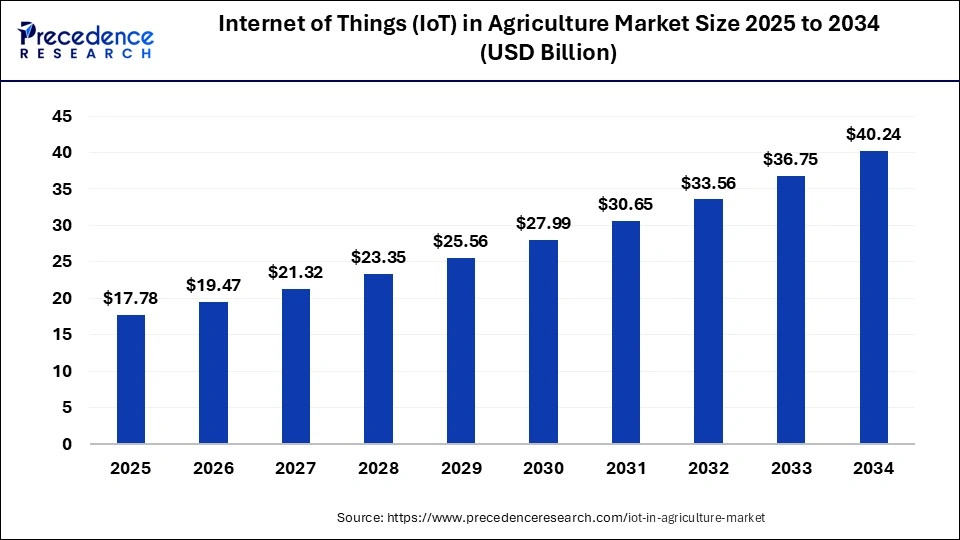
Internet of Things (IoT) in Agriculture Market Key Takeaways
- The monitoring segment will surpass USD 8 billion globally by 2035.
- The smart sensor systems segment will hit USD 3.2 billion globally by 2035.
- The global agriculture drones market will surpass USD 2.21 billion by 2035.
- Asia Pacific region accounted largest revenue share of around 44% in 2025.
Market Overview
The growth of the IoT in Agriculture market is driven by the increasing adoption of Internet of Things (IoT) and Artificial Intelligence (AI) technologies by farmers and cultivators. Rising demand for fresh produce, population growth, shrinking arable land, greater focus on livestock monitoring and disease detection, and the growing use of hydroponics monitoring and feed optimization solutions in developing economies are further supporting market expansion. Additionally, strong government initiatives promoting precision farming practices are accelerating adoption.
Modern technologies such as GPS guidance systems, variable rate technology, IoT, artificial intelligence, and remote sensing have transformed agriculture into a highly data-driven and technology-intensive industry. Smart farming solutions help improve productivity and profitability while enhancing sustainability, protecting the environment, and reducing the consumption of critical resources such as water, fertilizers, and energy.
AI in the Market
Artificial Intelligence (AI) is increasingly enhancing the Internet of Things (IoT) in agriculture by enabling automation and data-driven decision-making. Through machine learning algorithms, AI analyzes data collected from IoT sensors to identify patterns in soil conditions, crop growth, and weather trends. This allows farmers to leverage predictive analytics for yield forecasting, resource optimization, and farm planning.
AI-powered systems also automate labor-intensive agricultural tasks, reducing human error and improving operational efficiency. In livestock management, AI continuously monitors animal health and optimizes feeding practices, leading to better productivity and welfare. Furthermore, AI improves supply chain management by accurately forecasting demand and streamlining logistics, helping to minimize waste. As a result, the integration of AI and IoT is transforming agriculture into a smarter, more efficient, and sustainable industry.
Market Scope
| Report Coverage | Details |
| Market Size in 2025 | USD 17.78 Billion |
| Market Size in 2026 | USD 19.47 Billion |
| Market Size by 2035 | USD 41.29 Billion |
| Growth Rate from 2026 to 2035 | CAGR of 8.79% |
| Base Year | 2025 |
| Forecast Period | 2026 to 2035 |
| Segments Covered | Component, Type, Application, Geography |
Regional Insights
Asia Pacific Internet of Things (IoT) in Agriculture Market Size and Growth 2026 to 2035
The Asia Pacific internet of things (IoT) in agriculture market size is evaluated at USD 8.57 billion in 2025 and is predicted to be worth around USD 19.97 billion by 2035, rising at a CAGR of 8.83% from 2026 to 2035.
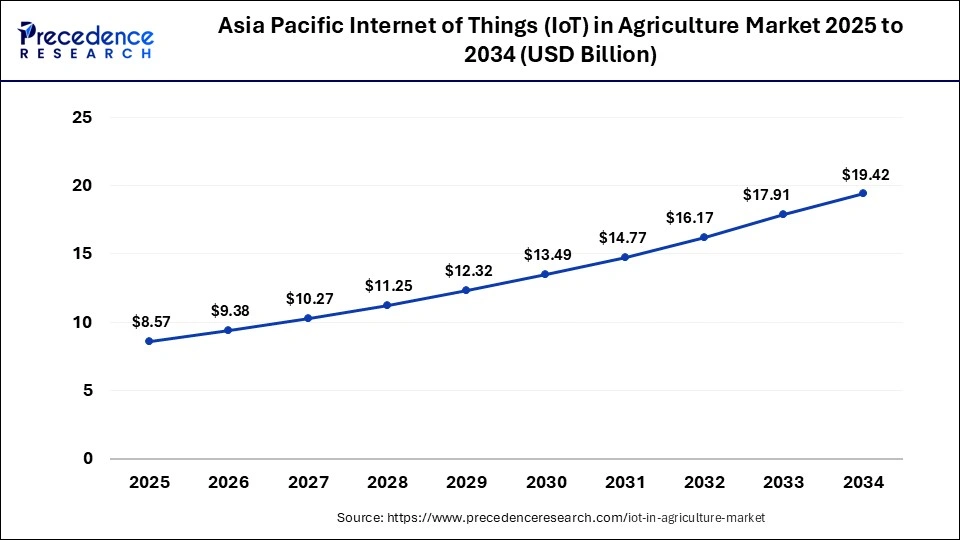
Because of the presence of rising countries basically reliant upon agrarian ability, as well as expanding populated regions like as India and China, Asia-Pacific is anticipated to have the quickest developing CAGR and the best piece of the pie toward the beginning of the projection. This locale’s rising interest is generally because of more prominent information on current agrarian innovation and the execution of ideal unofficial laws to support ranch digitization.
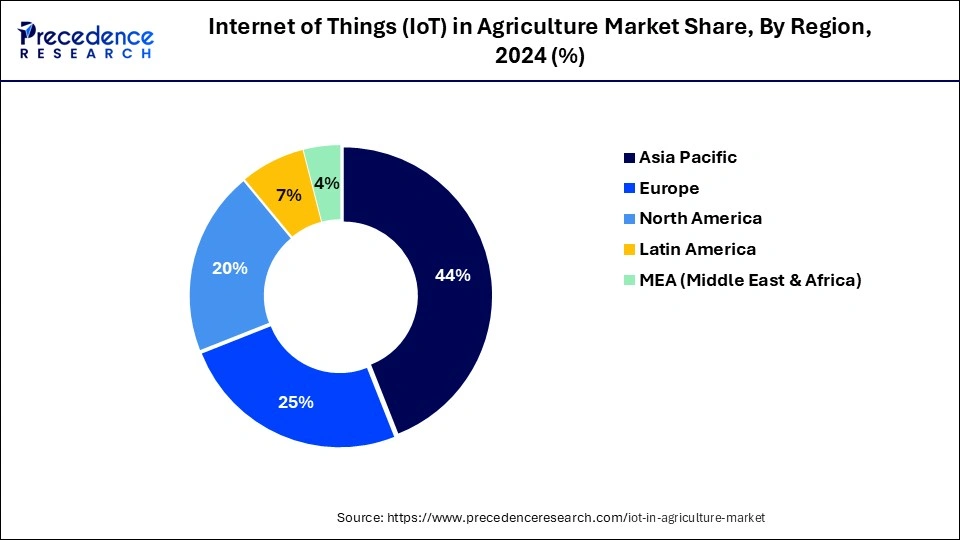
Moreover, as urbanization rises and the requirement for more noteworthy food security develops, so will interest for computerized agribusiness, bringing about IoT suggestions in agrarian districts around here. Besides, expanding buyer request decisions because of higher discretionary cash flow have added to the district’s market improvement all through the anticipated period. Moreover, the extending accessibility of arable land, alongside more noteworthy government strategy support pointed toward making agribusiness the centre point, is probably going to grow the impression of the horticulture IoT market all through the estimate period.
Value Chain Analysis
- Manufacturing: A variety of IoT features/components are procured from sensors, communication modules, and microcontrollers, ensuring cost-effectiveness and reliable agriculture performance.
Key Players: John Deere, Trimble - Further Research and Development (R&D) and Product Design: It involves the development of innovative IoT hardware and software solutions with functional designs for automation and smart data analytics.
Key Players: Robert Bosch GmbH, CropIn - Hardware Manufacturing and Assembly: Manufacture, test, and assemble IoT agricultural devices with the maintenance of quality standards for durability and performance of devices.
Key Players: Deere & Company, Libelium - Marketing and Sales: Sales promotions are carried out for IOTF devices that are agriculturally related in the farmer’s commercial activities, and commercial seeding is carried out to promote market awareness and adoption.
Key Players: Farmers Edge, AGRIVI - Technological Development: We are improving our software altogether in these cases with analytics and through cloud development to arrive at an upward scale in the realm of IoT integration, data processing systems, and agriculture functionality.
Key Players: Microsoft, IBM
Internet of Things (IoT) in Agriculture Market Companies
- Trimble Inc.
- Deere & Company
- AGCO Corporation
- Raven Industries, Inc.
- Komatsu, Ltd
- Farmer Edge Inc.
- CropX, Inc.
- The Climate Corporation
- AgJunction Inc.
- TeeJet Technologies
- Antelliq Corporation
- Topcon Positioning Systems, Inc.
- ICKEY-john
Recent Developments
- In June 2025, Professor Jayashankar Telangana Agricultural University is launching the Agri Robotics IoT Solutions for Agriculture Lab, partnering with BITS Pilani and IIT Hyderabad, funded with Rs 12 crore. (Source: https://timesofindia.indiatimes.com)
- In February 2025, Thailand launched “HandySense B-Farm,” a smart farming platform using sensors, AI, and IoT for improved farm management and efficiency. (Source: https://www.nationthailand.com)
Segments Covered in the Report
By Component
- Hardware
- Irrigation Controllers
- Flow and Application Control Devices
- Variable Rate Controllers
- Soil Sensors
- Water Sensors
- Climate Sensors
- Sensors for Livestock
- Automation and Control Systems
- Sensing and Monitoring Devices
- Guidance and Navigation
- Drones
- Handheld Computers
- Displays
- Smart Harvesters & Forwarders
- RFID Tags and Readers
- LED Grow Lights
- Software
- On-premise
- Cloud-based
- Connectivity & Services
By Type
- Small Farms
- Mid-Sized
- Large
By Application
- Precision Aquaculture
- Precision Farming
- Smart Greenhouses
- Precision Livestock
- Precision Forestry
- Others
By Geography
- North America
- U.S.
- Canada
- Europe
- U.K.
- Germany
- France
- Asia-Pacific
- China
- India
- Japan
- South Korea
- Malaysia
- Philippines
- Latin America
- Brazil
- Rest of Latin America
- Middle East & Africa (MEA)
- GCC
- North Africa
- South Africa
- Rest of the Middle East & Africa
Check this Report too: Artificial Intelligence Robots Market
Get this report to explore global market size, share, CAGR, and trends, featuring detailed segmental analysis and an insightful competitive landscape overview @ https://www.precedenceresearch.com/sample/1856
You can place an order or ask any questions, please feel free to contact us at sales@precedenceresearch.com |+1 804 441 8440

- Internet of Things (IoT) in Agriculture Market Size to Surge USD 41.29 Bn by 2035 - June 12, 2026
- Artificial Intelligence (AI) Robots Market Size to Reach USD 144.38 Bn by 2035 - June 12, 2026
- 3D Printers Market Surges Toward USD 135.27 Billion Valuation by 2035, Driven by Industrial Innovation - June 11, 2026