
Model Evaluation and Benchmarking Tools Market to Reach USD 9.57 Billion by 2035
The global model evaluation and benchmarking tools market is rapidly emerging as a core layer of the artificial intelligence ecosystem, ensuring that AI systems are accurate, reliable, fair, and compliant before and after deployment. The market was valued at USD 1.15 billion in 2025 and is expected to reach approximately USD 9.57 billion by 2035, growing at a CAGR of 23.60% from 2026 to 2035.
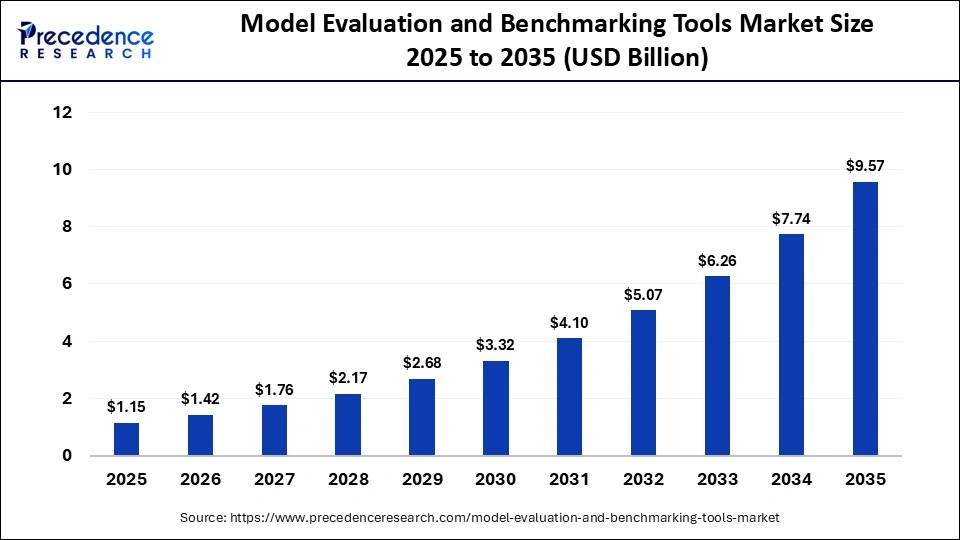
As enterprises scale AI across critical operations, the need for continuous validation, real-time monitoring, and standardized benchmarking frameworks is becoming indispensable. These tools are now embedded across the AI lifecycle—from model training to deployment and optimization—forming the backbone of responsible and scalable AI adoption.
Read Also: AI IP and Licensing Market
Quick Insights: What Defines the Market Landscape?
The market is projected to grow from USD 1.15 billion in 2025 to USD 9.57 billion by 2035, reflecting strong AI-driven demand.
North America led with a 42% share in 2025 due to mature AI ecosystems and governance frameworks.
Cloud-based platforms dominated deployment with a 65% share driven by scalability and MLOps integration.
Model validation and testing platforms accounted for 28% of the market in 2025.
Large language models (LLMs) contributed 35% of evaluation demand due to generative AI expansion.
Market Dynamics: What Is Driving the Growth of AI Evaluation Tools?
Why Is Enterprise AI Expansion Fueling Demand?
The rapid expansion of enterprise AI deployments is significantly increasing the need for robust evaluation frameworks. Organizations must ensure models perform reliably in real-world environments, making benchmarking tools essential for maintaining accuracy, robustness, and consistency.
How Are Real-Time Monitoring Tools Transforming AI Operations?
Emerging tools now enable real-time monitoring and lifecycle validation, allowing organizations to automatically assess models, detect anomalies, and prevent performance degradation across production environments.
Why Is Standardization of AI Evaluation Becoming Critical?
The growing institutionalization of AI has led to increased adoption of standardized evaluation frameworks, with more than 60% of enterprises integrating formal evaluation processes into workflows.
AI in the Market: How Is Artificial Intelligence Enhancing Its Own Evaluation?
Artificial intelligence is not only being evaluated—it is also improving evaluation itself. AI-powered systems enable automated benchmarking, anomaly detection, and predictive performance analysis, significantly reducing manual intervention.
Moreover, AI is helping standardize evaluation across industries by enabling data-driven comparisons of models across datasets, use cases, and environments, creating a more consistent and scalable validation ecosystem.
Opportunity & Trends: What Questions Are Shaping the Future of the Market?
Why Is the Shift Toward Real-World Benchmarking Accelerating?
Organizations are moving away from static benchmarks toward dynamic, scenario-based testing environments that better reflect real-world conditions and improve model reliability.
How Is Explainability Driving Market Growth?
The growing demand for transparent and interpretable AI systems is increasing adoption of explainability tools, especially in regulated industries where accountability is critical.
Why Is MLOps Integration Unlocking New Opportunities?
Integration with MLOps pipelines enables continuous testing, monitoring, and optimization, making evaluation tools a central component of AI lifecycle management.
Regional Analysis: Which Markets Are Leading?
North America: The Innovation Leader
North America accounted for 42% of the global market, driven by strong AI ecosystems, advanced infrastructure, and early adoption of governance frameworks.
Asia Pacific: The Fastest-Growing Region
Asia Pacific is expected to grow at a CAGR of 27.5%, fueled by rapid AI adoption, government initiatives, and expanding digital ecosystems.
Europe: Regulation-Driven Growth
Europe continues to grow steadily due to strict AI regulations and emphasis on transparency and compliance.
Competitive Landscape: Who Are the Key Players?
Leading companies in the market include:
- Microsoft Corporation
- Google LLC
- Amazon Web Services, Inc.
- IBM Corporation
- OpenAI, Inc.
- Hugging Face, Inc.
- DataRobot, Inc.
- Scale AI, Inc.
- Weights & Biases, Inc.
- Domino Data Lab, Inc.
Recent Developments
- Launch of agentic AI benchmarking frameworks and public leaderboards for model evaluation
- Introduction of advanced evaluation systems for AI-generated code and climate models
Challenges and Cost Pressures: What Are the Key Barriers?
Despite strong growth, the market faces several challenges:
- High implementation and operational costs
- Integration complexity within AI pipelines
- Lack of standardized global benchmarks
- Shortage of skilled AI validation professionals
Case Study: Real-Time AI Monitoring in Enterprise MLOps
A global enterprise integrated real-time evaluation tools into its MLOps pipeline, enabling continuous monitoring of model accuracy, bias, and drift. This resulted in improved operational efficiency and reduced deployment risks, demonstrating the critical role of continuous benchmarking in enterprise AI success.
Conclusion: The Rise of Responsible AI Infrastructure
The model evaluation and benchmarking tools market is becoming a core infrastructure layer for responsible AI deployment.
As organizations scale AI adoption, the need for continuous validation, transparency, and performance optimization will intensify. With strong growth driven by generative AI, MLOps integration, and regulatory pressure, this market is poised to define the future of AI trust, reliability, and governance.
Get a Sample Copy: https://www.precedenceresearch.com/sample/8326
For inquiries regarding discounts, bulk purchases, or customization requests, please contact us at sales@precedenceresearch.com
