
Multichannel Order Management Market to Reach USD 13.01 Billion by 2035
The global multichannel order management market is witnessing strong expansion as businesses increasingly adopt unified platforms to streamline order processing, inventory synchronization, and fulfillment across diverse sales channels. The market size stood at USD 3.90 billion in 2025 and is projected to grow from USD 4.40 billion in 2026 to USD 13.01 billion by 2035, registering a CAGR of 12.80% during the forecast period.
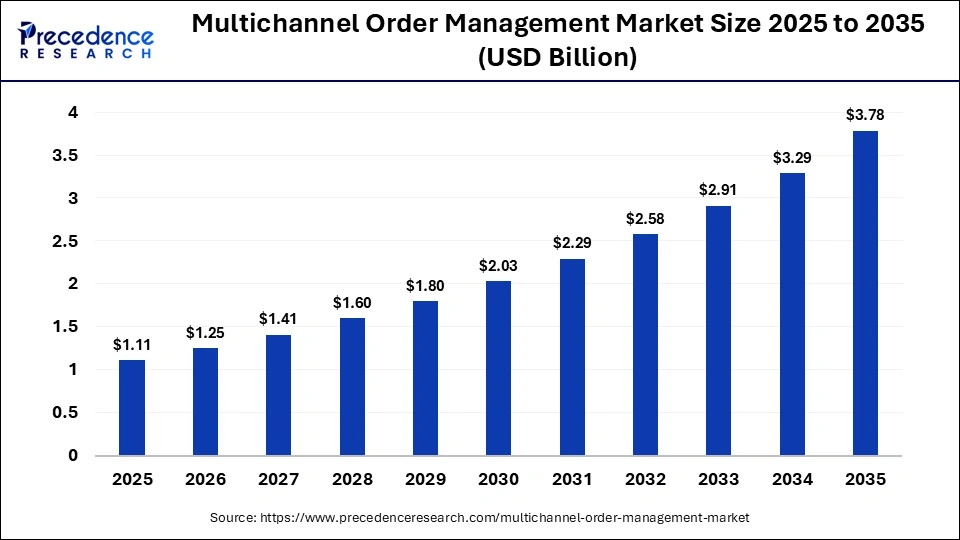
The surge in e-commerce, rising consumer expectations for seamless shopping experiences, and the growing need for real-time inventory visibility are key drivers accelerating market growth. Modern order management systems are evolving into intelligent, AI-powered platforms that enable businesses to deliver faster, more accurate, and highly efficient fulfillment operations.
Read Also: SaaS Customer Relationship Management (CRM) Market
Quick Insights
The multichannel order management market generated USD 3.90 billion in 2025 and is expected to reach USD 13.01 billion by 2035, growing at a CAGR of 12.80%. North America led the market with a 38% share, while Asia Pacific is projected to grow at the fastest CAGR of 15.5%. Software platforms dominated with a 70% share, cloud deployment accounted for 65%, large enterprises held 65%, and retail & e-commerce contributed the highest share at 40%.
Why is Multichannel Order Management Becoming Critical in the Digital Commerce Era?
Modern consumers interact with brands across multiple touchpoints, including online marketplaces, mobile apps, and physical stores. Managing orders across these fragmented channels requires centralized systems capable of real-time synchronization.
Multichannel order management solutions address this complexity by consolidating orders, inventory, and fulfillment processes into a unified platform. This enables businesses to reduce manual errors, prevent stockouts, and deliver faster, more reliable customer experiences.
How is Artificial Intelligence Transforming Order Management Systems?
Artificial intelligence is playing a transformative role in the evolution of multichannel order management platforms. AI-powered systems analyze real-time data such as inventory levels, shipping costs, and customer locations to optimize order routing and fulfillment decisions.
Additionally, AI-driven demand forecasting enables businesses to anticipate customer needs by analyzing historical data, seasonal trends, and external factors. This reduces overstocking and stockouts while improving operational efficiency. Automation of routine processes such as order entry and invoice handling further enhances productivity and reduces human errors.
What are the Key Growth Drivers of the Market?
The rapid growth of e-commerce and omnichannel retail strategies is a major driver of market expansion. Businesses are increasingly integrating multiple sales channels to deliver seamless customer experiences and improve engagement.
Another key driver is the widespread adoption of cloud-based solutions. Cloud platforms offer scalability, cost efficiency, and real-time data access, enabling organizations to manage complex supply chains more effectively.
What Trends and Opportunities are Shaping the Market?
Is AI-Powered Demand Forecasting Reshaping Inventory Management?
Yes, AI and machine learning technologies are enabling predictive demand sensing, helping businesses optimize inventory levels and reduce lost sales.
Are Cloud-Based Platforms Accelerating Market Adoption?
Absolutely. Cloud-based solutions dominate the market due to their flexibility, scalability, and seamless integration capabilities with third-party systems.
Is Automation Transforming Warehouse Operations?
Yes, intelligent automation is streamlining warehouse processes such as picking, packing, and inventory updates, improving efficiency and reducing operational costs.
Regional Analysis
North America dominated the market in 2025, supported by advanced e-commerce infrastructure, high adoption of AI technologies, and the presence of leading technology providers.
Asia Pacific is expected to grow at the fastest rate, driven by rapid digital transformation, expansion of e-commerce ecosystems, and increasing adoption of cloud-based solutions among SMEs in countries such as India and China.
Europe also holds a significant share, fueled by the growing adoption of omnichannel retail strategies and digital commerce platforms.
Segmental Analysis
By Component
| Component | 2025 Share | Growth Trend |
|---|---|---|
| Software Platforms | 70% | Dominant |
| Services | 30% | Growing |
Software platforms dominate due to their ability to centralize operations and enable AI-driven order orchestration.
By Deployment Mode
| Deployment Mode | 2025 Share | Growth Trend |
|---|---|---|
| Cloud-Based | 65% | Leading |
| On-Premise | 20% | Stable |
| Hybrid | 15% | Growing |
Cloud-based solutions lead due to scalability, cost-effectiveness, and real-time integration capabilities.
By Organization Size
| Organization Size | 2025 Share | Growth Trend |
|---|---|---|
| Large Enterprises | 65% | Dominant |
| SMEs | 35% | Fastest Growing |
SMEs are emerging as a high-growth segment due to increasing digital adoption and demand for cost-effective cloud solutions.
By Industry Vertical
| Industry | 2025 Share | Growth Trend |
|---|---|---|
| Retail & E-commerce | 40% | Dominant |
| Consumer Goods & FMCG | 15% | Strong |
| Healthcare & Pharma | 10% | Growing |
| Manufacturing | 10% | Moderate |
| Automotive | 8% | Stable |
| Electronics | 7% | Growing |
Retail & e-commerce leads due to the need for real-time inventory synchronization and faster delivery models.
By Application
| Application | 2025 Share | Growth Trend |
|---|---|---|
| Order Fulfillment Optimization | 30% | Dominant |
| Inventory Synchronization | 25% | Strong |
| Omnichannel Experience Management | 20% | Fastest Growing |
| Returns & Reverse Logistics | 15% | Growing |
| Demand Forecasting & Analytics | 10% | Stable |
Order fulfillment optimization leads due to increasing demand for speed, accuracy, and operational efficiency.
Competitive Landscape and Key Companies
The multichannel order management market is highly competitive, with major players focusing on AI integration, automation, and cloud-native platforms. Key companies include:
- IBM Corporation
- Oracle Corporation
- Salesforce, Inc.
- SAP SE
- Manhattan Associates
- HCL Technologies
- Zoho Corporation
- Brightpearl
These companies are investing in AI-powered order orchestration, predictive analytics, and automation technologies to enhance supply chain efficiency and customer experience.
What Challenges Could Impact Market Growth?
Are Integration Complexities Slowing Adoption?
Yes, integrating multichannel systems with legacy ERP and supply chain platforms can be complex and costly, posing challenges for organizations.
Are High Implementation Costs a Barrier?
High initial investment and maintenance costs can limit adoption, particularly among small and medium enterprises.
Case Study: Omnichannel Retail Transformation
Retail companies implementing multichannel order management systems have significantly improved inventory accuracy and delivery efficiency. By integrating online and offline channels, these businesses have enhanced customer satisfaction and optimized supply chain performance—demonstrating the strategic value of unified commerce platforms.
Conclusion
The multichannel order management market is rapidly evolving as a core component of modern commerce. With advancements in AI, cloud computing, and automation, businesses are transforming their supply chain operations and customer engagement strategies. The market is expected to witness strong growth through 2035, driven by the continued expansion of e-commerce and digital transformation initiatives.
