
Data Center Chillers Market to Reach USD 11.26 Billion by 2035
The global data center chillers market is gaining strong momentum as the rapid expansion of cloud computing, artificial intelligence (AI), and high-performance computing increases demand for advanced cooling infrastructure. The market was valued at USD 4.80 billion in 2025 and is projected to grow from USD 5.23 billion in 2026 to USD 11.26 billion by 2035, expanding at a CAGR of 8.90% during the forecast period.
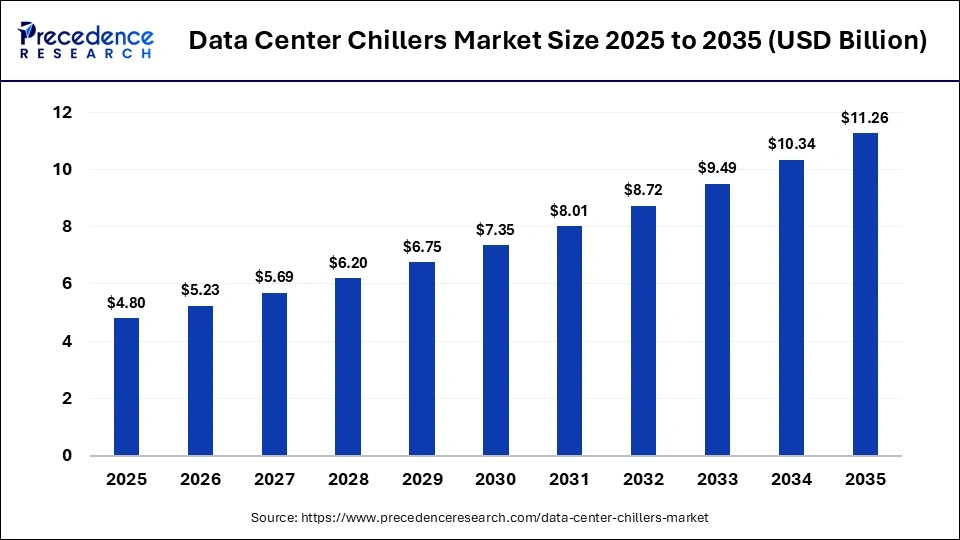
The surge in data generation, coupled with the increasing complexity of digital workloads, is placing immense pressure on data center infrastructure. As a result, efficient thermal management systems such as advanced chillers are becoming mission-critical for ensuring performance, reliability, and energy efficiency.
Read Also: Energy Management Software Market
Quick Insights
The data center chillers market reached USD 4.80 billion in 2025 and is expected to hit USD 11.26 billion by 2035, growing at a CAGR of 8.90%. North America dominated with around 40% share, while Asia Pacific is projected to grow at the fastest CAGR of 11.5%. Air-cooled chillers led with approximately 45% share, systems above 2000 kW accounted for nearly 45%, and hyperscale data centers contributed about 40% of total demand.
Why Are Data Center Chillers Becoming Mission-Critical Infrastructure?
As digital transformation accelerates across industries, data centers are handling increasingly dense workloads powered by AI, big data analytics, and real-time processing. These high-performance environments generate substantial heat, making efficient cooling essential to avoid system failures and downtime.
Data center chillers play a central role in maintaining optimal operating temperatures, ensuring system reliability, and improving energy efficiency. Without effective cooling, data centers risk operational disruptions and increased maintenance costs.
How is Artificial Intelligence Impacting Cooling Systems?
Artificial intelligence is influencing the market in two significant ways. First, AI workloads themselves are increasing heat generation due to higher compute density, which is driving demand for high-capacity cooling solutions.
Second, AI is being integrated into cooling systems to enhance efficiency. AI-enabled thermal management systems analyze real-time temperature and workload data to optimize cooling performance, reduce energy consumption, and prevent overheating—enhancing overall reliability.
What are the Key Growth Drivers of the Market?
The rapid expansion of hyperscale data centers is one of the primary growth drivers. Large technology companies are investing heavily in data infrastructure to support cloud computing, AI applications, and digital services.
Another key driver is the increasing focus on sustainability. Organizations are adopting energy-efficient cooling technologies to reduce power consumption and meet environmental regulations, further accelerating the adoption of advanced chiller systems.
What Trends and Opportunities are Shaping the Market?
Is the Rise of Hyperscale Data Centers Driving Demand?
Yes, hyperscale facilities dominate the market, accounting for around 40% share, as they require large-capacity, high-efficiency cooling systems to manage massive workloads.
Are Hybrid and Liquid Cooling Systems Creating New Opportunities?
Absolutely. The growing demand for energy efficiency is encouraging the adoption of hybrid systems that combine air- and water-cooled technologies, as well as integration with liquid cooling solutions.
Is Edge Computing Driving Innovation in Cooling Design?
Yes, the rise of edge data centers is creating demand for compact, modular, and energy-efficient chiller systems designed for distributed environments.
Expert Perspective
A Principal Consultant at Precedence Research states:
“The future of data center infrastructure will depend heavily on intelligent cooling systems. As AI workloads increase, energy-efficient chillers will become critical for maintaining performance and achieving sustainability goals.”
Regional Analysis
North America dominated the global market in 2025, driven by strong investments in hyperscale data centers, advanced infrastructure, and high adoption of AI technologies.
Asia Pacific is expected to grow at the fastest rate, supported by rapid digitalization, increasing cloud adoption, and expanding data center infrastructure in countries such as India, China, and Japan.
Europe also holds a significant share, with strong emphasis on energy efficiency and sustainable data center operations.
Segmental Analysis
By Chiller Type
| Type | Market Position |
|---|---|
| Air-Cooled Chillers | Dominant (45%) |
| Water-Cooled Chillers | Strong Growth |
| Hybrid Chillers | Fastest Growing |
Air-cooled chillers dominate due to lower installation complexity, while water-cooled systems are gaining traction for high-density environments.
By Cooling Capacity
| Capacity | Market Trend |
|---|---|
| Below 500 kW | Moderate |
| 500–2000 kW | Stable |
| Above 2000 kW | Dominant (45%) |
High-capacity chillers are widely used in hyperscale data centers to handle intensive workloads.
By Data Center Type
| Type | Market Position |
|---|---|
| Hyperscale | Leading (40%) |
| Colocation | Growing |
| Enterprise | Moderate |
| Edge | Fastest Growing |
Hyperscale data centers dominate due to large-scale investments in cloud and AI infrastructure.
By Application
| Application | Market Trend |
|---|---|
| IT & Telecom | Dominant (30%) |
| Cloud Service Providers | Fastest Growing |
| BFSI | Stable |
| Healthcare | Growing |
Cloud service providers are expected to witness the fastest growth due to increasing adoption of AI and big data technologies.
Competitive Landscape and Key Companies
The data center chillers market is highly competitive, with companies focusing on innovation, energy efficiency, and sustainability. Key players include:
- Johnson Controls International plc
- Daikin Industries Ltd.
- Trane Technologies plc
- Carrier Global Corporation
- Mitsubishi Electric Corporation
- Vertiv Group Corp.
- Schneider Electric SE
- STULZ GmbH
- LG Electronics Inc.
These companies are investing in advanced cooling technologies, AI-enabled systems, and eco-friendly refrigerants to strengthen their market position.
What Challenges Could Impact Market Growth?
Are High Capital Costs a Barrier?
Yes, the installation and maintenance of advanced chiller systems require significant investment, which can be challenging for smaller operators.
Is Energy Consumption Still a Concern?
Balancing cooling efficiency with energy consumption remains a key challenge, particularly as data centers scale to support AI-driven workloads.
Case Study: Cooling AI-Powered Hyperscale Data Centers
Leading hyperscale operators are deploying high-capacity, AI-integrated chiller systems to manage increasing thermal loads. These solutions enable real-time optimization of cooling performance, reduce operational costs, and improve overall system reliability.
Conclusion
The data center chillers market is becoming a critical pillar of global digital infrastructure. With the rapid rise of AI, cloud computing, and data-intensive applications, the demand for efficient and scalable cooling solutions will continue to drive market growth through 2035.
Get Sample Copy: https://www.precedenceresearch.com/sample/8352
For inquiries regarding discounts, bulk purchases, or customization requests, please contact us at sales@precedenceresearch.com
