
Human Centric Lighting Market Size to Hit USD 75.00 Billion by 2035
The global human centric lighting market is witnessing strong growth driven by smart lighting systems, wellness-focused infrastructure, and rising adoption in commercial and residential sectors.
Human Centric Lighting Market Overview
The global human centric lighting (HCL) market is witnessing rapid expansion due to increasing demand for lighting systems that enhance human well-being, productivity, and comfort. Human centric lighting is designed to mimic natural daylight patterns, dynamically adjusting brightness and color temperature throughout the day to support circadian rhythms.
The market is expected to grow significantly over the forecast period, driven by rising adoption of smart lighting technologies, sustainable building initiatives, and growing awareness of health-focused interior environments.
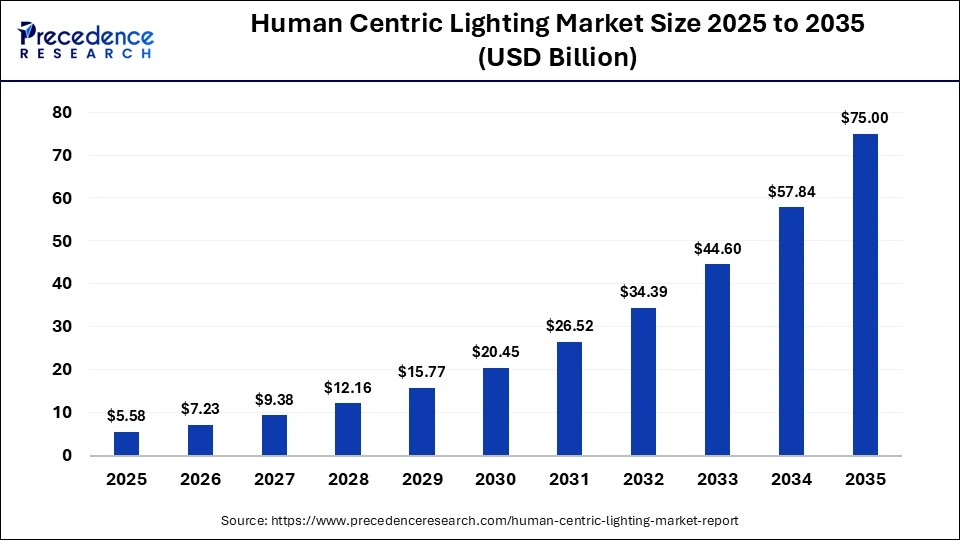
In 2025, the global market size was valued at approximately USD 5.58 billion, and it is projected to reach nearly USD 75.00 billion by 2035, growing at a CAGR of 29.68% (2026–2035).
Read Also: Generative AI in Coding Market
What is Human Centric Lighting?
Human centric lighting refers to advanced lighting systems that adjust light intensity and color temperature based on human biological needs. These systems are widely used in:
- Offices and corporate spaces
- Healthcare facilities
- Educational institutions
- Residential buildings
- Industrial environments
The goal is to improve alertness, sleep quality, mood, and productivity by aligning artificial lighting with natural circadian rhythms.
Key Market Drivers
1. Rising Adoption of Smart Lighting Systems
The integration of IoT, sensors, and smart controls is enabling automated lighting adjustments based on occupancy and daylight conditions. This is significantly boosting HCL adoption in smart buildings.
2. Growing Focus on Employee Wellness
Organizations are increasingly investing in lighting solutions that improve employee productivity, reduce fatigue, and enhance workplace satisfaction, especially in commercial offices.
3. Expansion of Smart Cities & Green Buildings
Governments and private developers are focusing on energy-efficient infrastructure and green building certifications, driving demand for adaptive lighting systems.
4. Increasing Healthcare Applications
Hospitals and clinics are adopting human centric lighting to improve patient recovery, reduce stress, and create more comfortable environments.
Market Challenges
Despite strong growth, the market faces several challenges:
- High initial installation costs
- Complex system integration with legacy infrastructure
- Limited awareness in developing regions
- Cybersecurity risks in connected lighting systems
Market Segmentation
By Product Type
- Fixtures (largest share)
- Controllers
- Sensors
- Software & services
- Drivers and microcontrollers
Fixtures dominate due to widespread use in residential and commercial installations.
By Installation Type
- New installations (dominant segment)
- Retrofit installations (fastest growing)
New construction projects account for major adoption, while retrofit systems are gaining traction in upgrading existing buildings.
By Application
- Commercial (largest segment)
- Residential
- Healthcare
- Education
- Industrial
Commercial spaces lead the market due to strong demand for productivity-enhancing environments.
Regional Insights
Europe – Market Leader
Europe holds the largest share of the human centric lighting market, driven by strict energy efficiency regulations and advanced smart building adoption.
Asia-Pacific – Fastest Growing Region
Rapid urbanization, infrastructure development, and smart city initiatives are accelerating growth in countries like China, India, and Japan.
North America – Strong Innovation Hub
High adoption of IoT-based lighting systems and advanced smart home technologies supports market growth in the region.
Emerging Trends
AI-Powered Lighting Systems
Artificial intelligence is being integrated into lighting controls to automate adjustments based on user behavior and environmental conditions.
IoT and Connected Lighting
Connected lighting systems enable remote monitoring, predictive maintenance, and energy optimization.
Human Wellness Integration
Lighting systems are increasingly being designed to support mental health, sleep regulation, and cognitive performance.
Sustainable Lighting Solutions
Energy-efficient LED-based systems are reducing carbon footprints and supporting global sustainability goals.
Competitive Landscape
The market is highly competitive with major players focusing on innovation, smart technologies, and strategic partnerships.
Key Companies Include:
- Signify Holding
- Siemens AG
- Schneider Electric
- Lutron Electronics
- OSRAM
- ABB Ltd.
- Eaton Corporation
- Acuity Brands
- Zumtobel Group
- Honeywell International
These companies are investing heavily in IoT-enabled lighting systems and AI-integrated solutions.
Future Outlook
The human centric lighting market is expected to witness exponential growth due to increasing demand for smart infrastructure, wellness-focused design, and energy-efficient lighting systems.
As smart cities expand and workplaces evolve, human centric lighting will become a core component of modern building design, supporting both productivity and sustainability.
Conclusion
The global human centric lighting market is undergoing a significant transformation driven by technological advancements, increasing health awareness, and rising adoption of smart building systems. With strong growth projections and expanding applications across industries, HCL is set to become a key pillar of future lighting infrastructure.
Get a Sample Copy: https://www.precedenceresearch.com/sample/8227
For inquiries regarding discounts, bulk purchases, or customization requests, please contact us at sales@precedenceresearch.com
