
Acid Proof Lining Market Size to Reach USD 11.18 Billion by 2035
The global acid proof lining market is projected to reach USD 11.18 billion by 2035, driven by increasing demand for corrosion-resistant materials across chemical processing, oil & gas, mining, and power generation industries. Explore key trends, regional insights, growth drivers, and future opportunities.
Introduction
The global acid proof lining market is witnessing strong growth as industries increasingly prioritize corrosion protection, industrial safety, and long-term infrastructure durability. Acid proof linings are essential protective systems used to shield industrial equipment, storage tanks, pipelines, reactors, chimneys, and processing vessels from highly corrosive chemicals, acids, and harsh operating environments.
Industries such as chemical processing, fertilizers, oil & gas, mining, power generation, and wastewater treatment rely heavily on acid-resistant lining systems to prevent structural damage, minimize maintenance costs, and improve operational efficiency. The growing focus on industrial asset preservation, stricter environmental regulations, and increasing investments in heavy industrial infrastructure are significantly accelerating market demand worldwide.
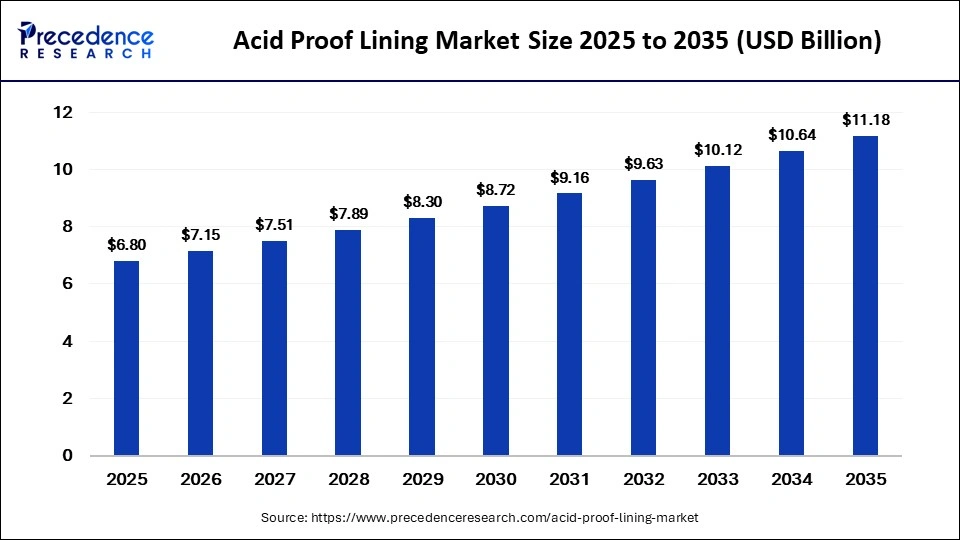
According to Precedence Research, the global acid proof lining market size accounted for USD 6.80 billion in 2025 and is projected to increase from USD 7.15 billion in 2026 to approximately USD 11.18 billion by 2035, expanding at a CAGR of 5.10% during the forecast period.
Read Also: AI in Healthcare Governance and Safety Market
Acid Proof Lining Market Overview
Acid proof linings are specialized protective coatings and barrier systems designed to resist chemical corrosion, thermal stress, abrasion, and acidic exposure in industrial environments. These lining systems are manufactured using materials such as ceramic bricks, carbon bricks, rubber, thermoplastics, fluoropolymers, vinyl esters, and epoxy-based compounds.
The primary objective of acid proof linings is to extend equipment lifespan, reduce operational downtime, improve workplace safety, and prevent environmental contamination caused by leaks or corrosion failures. These linings are widely used in industrial tanks, chimneys, reactors, drains, floors, and pipelines exposed to aggressive chemicals and corrosive substances.
The growing industrialization across emerging economies and increasing investments in infrastructure modernization continue to create substantial opportunities for market expansion.
Key Market Statistics
Major Market Highlights
- The acid proof lining market is projected to grow at a CAGR of 5.10% from 2026 to 2035.
- Asia-Pacific accounted for 42% of global market share in 2025.
- Ceramic brick lining dominated the material segment with 28% market share in 2025.
- Rubber lining held the highest product type share of 30% in 2025.
- Storage tanks represented 28% of market demand in 2025.
- Chemical processing contributed 32% of end-use industry share in 2025.
- Fluoropolymer lining is projected to witness the fastest CAGR of 7.2% through 2035.
- Middle East & Africa is expected to grow at the fastest regional CAGR of 6.2% during the forecast period.
Key Market Drivers
Rising Demand for Corrosion-Resistant Industrial Infrastructure
Industrial sectors dealing with highly corrosive chemicals increasingly require durable acid-resistant lining systems to protect critical infrastructure and maintain operational reliability.
Acid proof linings help industries prevent corrosion-related failures, minimize maintenance costs, and extend equipment service life. Growing investments in chemical plants, refineries, mining operations, and wastewater treatment facilities are significantly driving market demand globally.
Industries are increasingly viewing acid-proof lining solutions as long-term capital preservation tools rather than short-term maintenance expenses.
Expansion of Chemical Processing Industry
The chemical processing sector held 32% market share in 2025 because of the extensive use of corrosive chemicals and aggressive processing environments.
Chemical plants require robust lining systems capable of handling sulfuric acid, phosphoric acid, hydrochloric acid, alkalis, and solvents under high-temperature operating conditions. Increasing global demand for chemicals, specialty materials, fertilizers, and petrochemicals is creating substantial opportunities for advanced lining technologies.
Strict environmental regulations regarding hazardous material handling are also accelerating investments in high-performance containment systems.
Growth in Oil & Gas and Refinery Infrastructure
The expansion of refinery and petrochemical infrastructure continues to support strong demand for acid-resistant lining systems.
Acid proof linings are widely used in storage tanks, process vessels, chimneys, and drainage systems within refineries and petrochemical plants to improve operational safety and reduce corrosion risks.
Operators increasingly prioritize long-term infrastructure reliability and reduced maintenance downtime, further supporting market growth.
Increasing Focus on Industrial Safety and Environmental Compliance
Governments and regulatory agencies worldwide are implementing stricter industrial safety and environmental protection regulations.
Industries are increasingly adopting acid-proof lining systems to prevent hazardous chemical leaks, minimize environmental contamination, and comply with workplace safety standards.
The growing emphasis on sustainable industrial operations is expected to accelerate market demand over the next decade.
Impact of Artificial Intelligence on Acid Proof Lining Industry
Artificial intelligence is increasingly transforming corrosion monitoring, predictive maintenance, and material innovation within the acid proof lining industry.
AI-enabled sensors and analytics systems can monitor corrosion behavior, chemical exposure, and thermal stress in real time, helping operators identify potential failures before they occur. AI-driven predictive maintenance systems improve operational efficiency by reducing unplanned downtime and optimizing maintenance schedules.
AI technologies are also accelerating the development of advanced polymers, coatings, and high-performance corrosion-resistant materials through simulation-based material research and performance prediction.
Market Trends
Increasing Adoption of Smart Corrosion Monitoring Systems
Industrial operators are increasingly integrating IoT-enabled monitoring systems and AI-based analytics into corrosion protection infrastructure.
Smart corrosion monitoring systems provide real-time insights into asset health, allowing predictive maintenance and improved operational reliability.
The shift toward Industry 4.0 technologies is becoming a major trend across heavy industrial sectors.
Growing Demand for Fluoropolymer and Thermoplastic Linings
Advanced polymer-based lining systems are witnessing strong demand due to superior chemical resistance, lightweight properties, and longer operational lifespan.
The fluoropolymer lining segment is projected to grow at the fastest CAGR of 7.2% during the forecast period.
Thermoplastic linings are also gaining traction in chemical storage and wastewater management applications because of their flexibility and corrosion resistance.
Rising Investments in Sustainable and Low-VOC Coatings
Environmental regulations are encouraging manufacturers to develop eco-friendly and low-emission lining systems.
Water-based and low-VOC acid proof coatings are increasingly replacing traditional solvent-based systems in regions with strict environmental standards.
Sustainable corrosion protection technologies are expected to become a major innovation focus within the industry.
Increasing Adoption in Water Treatment Infrastructure
The growing global demand for desalination and wastewater treatment facilities is creating strong opportunities for acid proof lining systems.
Corrosion-resistant linings are increasingly used in water treatment tanks, pipelines, and chemical containment systems to ensure infrastructure durability and operational safety.
Market Restraints
Skilled Labor Shortage
Installing and maintaining acid proof lining systems requires highly specialized technical expertise.
The shortage of trained professionals capable of handling advanced lining applications continues to create operational challenges and project delays.
Improper installation may result in lining failures, increased maintenance costs, and reduced equipment reliability.
High Initial Installation Costs
Advanced acid-resistant lining systems often involve significant upfront costs related to specialized materials, installation equipment, and labor requirements.
Small and medium-sized industrial operators may face budget constraints when implementing high-performance corrosion protection systems.
Raw Material Price Volatility
Fluctuating prices of polymers, specialty chemicals, ceramics, and industrial raw materials continue to affect production costs and profit margins.
Global supply chain disruptions and geopolitical uncertainties may further impact material availability and pricing stability.
Complex Maintenance and Repair Procedures
Repairing damaged acid-proof linings can be technically challenging and time-consuming.
Industries often require scheduled shutdowns during repair activities, which may affect operational productivity and increase downtime costs.
Emerging Opportunities
Expansion of Mining and Metal Processing Industries
Mining and metal processing operations increasingly require durable corrosion-resistant systems capable of handling aggressive chemical environments.
Acid-proof lining solutions are gaining strong demand in ore processing plants, smelting facilities, and chemical extraction systems.
Growth in Fertilizer Manufacturing
The fertilizers segment is projected to witness a CAGR of 6% through 2035 due to rising global fertilizer production capacity.
Fertilizer plants require highly durable lining systems capable of resisting sulfuric and phosphoric acid exposure while supporting continuous industrial operations.
Development of Advanced Composite Materials
Innovations in fiber-reinforced polymers, glass-flake epoxy systems, and hybrid ceramic coatings are creating new opportunities for improved corrosion resistance and operational efficiency.
Advanced material science is expected to play a crucial role in future market expansion.
Infrastructure Growth in Emerging Economies
Rapid industrialization across Asia-Pacific, Latin America, and the Middle East is generating strong demand for corrosion-resistant industrial infrastructure.
Government investments in industrial modernization, petrochemical expansion, and wastewater treatment facilities continue supporting long-term market growth.
Segmental Analysis
By Material
Ceramic Brick Lining Dominance
Ceramic brick lining dominated the market with 28% share in 2025 because of its superior resistance to high-temperature acidic environments.
These systems are widely used in chemical processing plants and fertilizer manufacturing facilities.
Fluoropolymer Lining Growth
Fluoropolymer lining held 15% market share in 2025 and is projected to witness the fastest CAGR of 7.2% during the forecast period due to exceptional chemical resistance and thermal stability.
Thermoplastic Lining Expansion
Thermoplastic lining continues gaining traction due to its lightweight structure, flexibility, and suitability for chemical storage applications.
By Product Type
Rubber Lining Leadership
Rubber lining accounted for 30% market share in 2025 because of its cost-effectiveness, abrasion resistance, and versatility across industrial applications.
Vinyl Ester Lining Growth
Vinyl ester lining is projected to grow at a CAGR of 6.2% through 2035 due to superior corrosion resistance and improved curing performance.
By Application
Storage Tanks Segment Dominance
Storage tanks represented 28% of global demand in 2025 because industries increasingly require corrosion-resistant storage systems for hazardous chemicals.
Pipelines and Drains Expansion
The pipelines and drains segment is expected to grow at the fastest CAGR of 5.8% due to increasing industrial wastewater transportation requirements.
By End-Use Industry
Chemical Processing Leadership
Chemical processing dominated the market with 32% share in 2025 due to increasing investments in industrial chemical manufacturing infrastructure.
Fertilizers Segment Growth
The fertilizers segment is expected to witness the fastest CAGR of 6% during the forecast period.
Regional Analysis
Asia-Pacific
Asia-Pacific dominated the acid proof lining market with 42% share in 2025 due to rapid industrialization, expanding chemical manufacturing activities, and increasing refinery investments.
China and India remain major growth engines because of rising infrastructure development, petrochemical expansion, and growing mining operations.
India is emerging as a major market due to strong growth in chemicals, pharmaceuticals, mining, and oil & gas industries.
North America
North America continues to witness stable market growth supported by refinery modernization, industrial safety regulations, and advanced manufacturing investments.
The United States remains a major market for high-performance corrosion protection systems.
Europe
Europe increasingly focuses on sustainable industrial infrastructure, environmental compliance, and advanced corrosion-resistant technologies.
Germany, France, and Italy remain important markets due to strong chemical and industrial manufacturing sectors.
Middle East & Africa
The Middle East & Africa region is projected to witness the fastest CAGR of 6.2% during the forecast period.
Large-scale investments in petrochemical plants, desalination facilities, and refinery infrastructure are driving demand for advanced acid-resistant lining systems.
Saudi Arabia remains a major regional market because of extensive oil & gas and water treatment investments.
Key Companies in the Acid Proof Lining Market
Major companies operating in the market include:
- Koch Knight
- Stebbins Engineering
- Axalta Coating Systems
- Sherwin-Williams
- Hempel
- BASF
- Ashland
- Carboline
- Saint-Gobain
- PPG Industries
Get a Sample Copy: https://www.precedenceresearch.com/sample/8412
For inquiries regarding discounts, bulk purchases, or customization requests, please contact us at sales@precedenceresearch.com
