
AI in Healthcare Governance and Safety Market Size to Reach USD 19.65 Billion by 2035
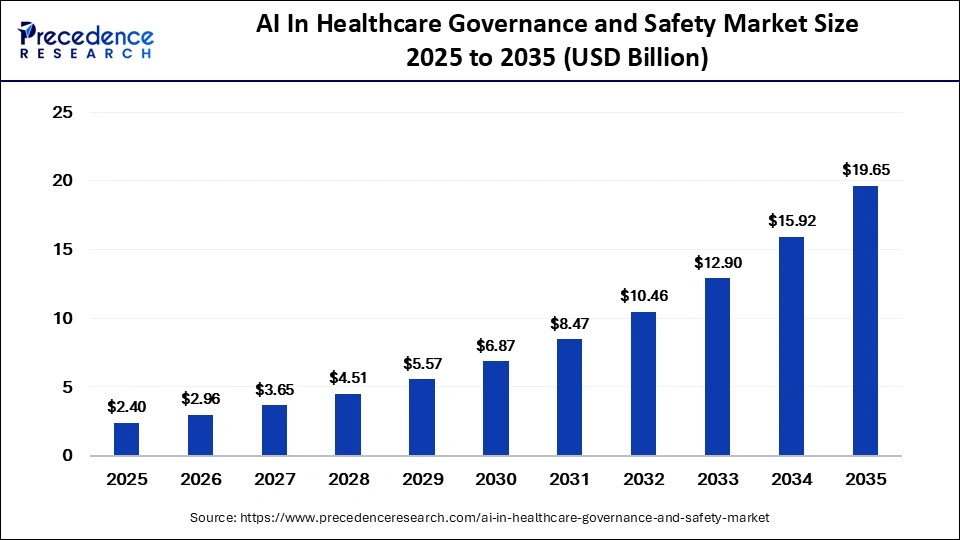
The global AI in healthcare governance and safety market is projected to reach USD 19.65 billion by 2035, driven by growing demand for ethical AI deployment, patient safety monitoring, regulatory compliance, and cybersecurity in healthcare systems.
Read Also: Injection Molding Market
Introduction
Artificial intelligence is rapidly transforming healthcare delivery, diagnostics, clinical decision-making, patient monitoring, and administrative operations. However, as AI adoption accelerates across hospitals, healthcare systems, and medical devices, concerns surrounding patient safety, algorithmic bias, transparency, cybersecurity, and regulatory compliance are becoming increasingly critical.
Healthcare organizations are now prioritizing AI governance frameworks and safety monitoring systems to ensure responsible AI deployment while maintaining patient trust and regulatory compliance. AI governance solutions help hospitals validate AI models, monitor algorithm performance, detect biases, improve auditability, and strengthen cybersecurity protection.
The increasing integration of AI-powered medical software, predictive analytics, wearable devices, and automated clinical systems is fueling strong demand for governance and oversight technologies worldwide.
According to Precedence Research, the global AI in healthcare governance and safety market size was valued at USD 2.40 billion in 2025 and is projected to increase from USD 2.96 billion in 2026 to approximately USD 19.65 billion by 2035, expanding at a CAGR of 23.40% during the forecast period.
AI in Healthcare Governance and Safety Market Overview
AI governance in healthcare refers to the frameworks, policies, technologies, and oversight systems used to ensure that artificial intelligence applications operate safely, ethically, transparently, and in compliance with healthcare regulations.
Healthcare AI governance systems typically include:
- AI model validation platforms
- Clinical risk management tools
- Regulatory compliance monitoring systems
- AI audit trail generation
- Bias detection and explainable AI technologies
- Cybersecurity and data privacy protection
- Continuous performance monitoring systems
These governance frameworks help healthcare providers minimize risks associated with AI-driven clinical decisions while improving accountability and operational transparency.
The market is expanding rapidly as hospitals, insurers, pharmaceutical companies, and regulators increasingly recognize the importance of responsible AI adoption.
Key Market Statistics
Major Market Highlights
- The AI in healthcare governance and safety market is expected to grow at a CAGR of 23.40% from 2026 to 2035.
- North America currently dominates the global market.
- Europe is projected to witness the fastest regional growth during the forecast period.
- Clinical risk management accounted for 24% market share in 2025.
- Regulatory compliance represented 22% market share in 2025.
- AI model governance is projected to grow at the fastest CAGR of 30.5% through 2035.
- Over 1,000 AI-enabled medical devices had received FDA approval by the end of 2024.
- Nearly 70% of U.S. health systems implemented AI governance frameworks in 2025, up from approximately 40% in 2024.
- AI adoption exceeded 88% across U.S. health systems in 2025.
Key Market Drivers
Rapid Adoption of AI in Healthcare Systems
Healthcare providers are increasingly integrating AI technologies into diagnostics, predictive analytics, clinical decision support systems, imaging platforms, and patient monitoring infrastructure.
As AI becomes deeply embedded within healthcare operations, organizations require governance systems capable of ensuring safety, transparency, and accountability across AI lifecycles. AI governance frameworks help monitor model performance, validate clinical outputs, and reduce operational risks.
The rapid expansion of AI-powered healthcare ecosystems is one of the strongest drivers accelerating market growth globally.
Growing Focus on Patient Safety and Clinical Risk Management
Patient safety remains one of the most important priorities in healthcare AI deployment.
Clinical risk management accounted for 24% market share in 2025 because healthcare organizations increasingly rely on governance systems to reduce adverse clinical events and improve patient outcomes.
AI governance platforms enable hospitals to monitor AI decision-making in real time, identify algorithmic anomalies, and detect potential safety risks before they impact patients.
Recent incidents involving AI-enabled surgical navigation systems and diagnostic devices have further highlighted the need for stronger oversight and governance mechanisms. Reuters reported multiple incidents involving AI-assisted medical devices between 2021 and 2025, including software malfunctions and incorrect body-part identification during surgical procedures.
Increasing Regulatory Pressure and Compliance Requirements
Healthcare AI operates in one of the world’s most heavily regulated industries.
Governments and regulators are introducing stricter frameworks governing AI safety, transparency, bias mitigation, cybersecurity, and explainability. Regulations such as the EU AI Act and FDA guidance on AI-enabled medical devices are accelerating demand for compliance management solutions.
Healthcare organizations increasingly require governance systems capable of:
- Maintaining audit trails
- Monitoring AI model drift
- Supporting explainable AI
- Ensuring transparency in clinical decisions
- Managing lifecycle compliance
Regulatory compliance represented 22% market share in 2025 and continues to expand rapidly.
Rising Healthcare Cybersecurity Threats
The increasing digitization of healthcare infrastructure is creating significant cybersecurity challenges.
Hospitals and healthcare providers are experiencing growing risks related to data breaches, ransomware attacks, AI manipulation, and unauthorized access to patient records. AI governance systems help organizations strengthen cybersecurity monitoring, detect anomalies, and protect sensitive healthcare data.
The rising frequency of cyberattacks targeting healthcare institutions continues to accelerate investments in governance and security platforms.
Impact of Artificial Intelligence on Healthcare Governance and Safety
Artificial intelligence itself is transforming governance and safety operations within healthcare environments.
AI-powered governance systems continuously monitor algorithm behavior, identify model drift, validate clinical outputs, and detect potential biases in healthcare datasets. Machine learning systems can automatically flag unsafe AI behaviors and generate real-time alerts for clinicians and compliance teams.
Advanced governance frameworks increasingly integrate:
- Automated risk scoring
- Continuous model monitoring
- Predictive compliance analytics
- Explainable AI dashboards
- Bias detection tools
- Post-market surveillance systems
Researchers have also proposed operational infrastructures such as AEGIS, designed to support safe continuous learning for adaptive medical AI systems under FDA and EU regulatory requirements.
Market Trends
Expansion of AI Governance Frameworks
Healthcare organizations are rapidly implementing formal AI governance frameworks to manage ethical, operational, and regulatory risks.
Recent research identified 77 healthcare AI governance frameworks globally, though only 13% included all critical governance components such as oversight mechanisms, lifecycle assessment, and accountability structures.
This trend is accelerating demand for enterprise-level governance platforms and structured oversight systems.
Rising Adoption of Explainable AI
Explainable AI (XAI) technologies are becoming increasingly important within healthcare governance systems.
Hospitals and regulators require AI systems capable of explaining clinical recommendations and algorithmic outputs in transparent and interpretable ways. Explainable AI improves clinician trust, regulatory acceptance, and patient confidence.
The expansion of explainable AI ecosystems is significantly supporting growth of the AI model governance segment.
Growth of AI Safe Zones in Hospitals
Hospitals are increasingly establishing “AI safe zones,” controlled environments where approved healthcare AI systems can be tested and monitored before enterprise-wide deployment.
These environments help healthcare organizations reduce shadow AI risks, improve compliance readiness, and evaluate AI safety under supervised conditions.
Increasing Use of Post-Market Surveillance Systems
Post-market monitoring of AI-enabled medical devices is becoming a major industry priority.
Healthcare providers and regulators increasingly require continuous monitoring systems capable of identifying safety failures, software anomalies, and model performance degradation after deployment.
Continuous AI surveillance is expected to become a standard requirement for future healthcare AI deployments.
Market Restraints
Lack of Standardized Governance Frameworks
Despite rapid AI adoption, many healthcare organizations still lack standardized governance structures.
Research shows that most existing governance frameworks remain difficult to apply within real-world clinical settings and often lack effective oversight mechanisms.
The absence of universal standards may slow broader market adoption.
High Implementation Costs
Deploying enterprise-grade AI governance systems requires substantial investments in infrastructure, cybersecurity, analytics platforms, and compliance technologies.
Smaller healthcare organizations may face financial limitations when implementing advanced governance ecosystems.
Shortage of Skilled AI Governance Professionals
Healthcare organizations increasingly require professionals with expertise in:
- AI ethics
- Healthcare regulation
- Data science
- Clinical governance
- Cybersecurity
- Compliance management
The limited availability of cross-disciplinary talent remains a major market challenge.
Regulatory Complexity Across Jurisdictions
Global healthcare systems operate under highly fragmented regulatory environments.
Research analyzing 43 healthcare AI policy documents across five jurisdictions found significant divergence in enforcement, oversight, reimbursement, and regulatory maturity.
This complexity increases compliance burdens for multinational healthcare organizations.
Emerging Opportunities
Expansion of AI Lifecycle Management Platforms
AI lifecycle management solutions are emerging as one of the fastest-growing segments within healthcare governance.
Healthcare providers increasingly require systems capable of monitoring AI models throughout development, deployment, validation, retraining, and retirement phases.
This creates substantial opportunities for governance software providers and compliance technology companies.
Growing Demand for Explainable and Ethical AI
Ethical AI adoption is becoming a major priority across global healthcare systems.
Organizations increasingly seek governance solutions capable of ensuring fairness, transparency, accountability, and bias mitigation across clinical AI applications.
The demand for ethical AI frameworks is expected to increase substantially over the next decade.
Expansion of Telehealth and Wearable Healthcare Infrastructure
The growth of connected healthcare ecosystems, telemedicine platforms, and wearable devices is creating new governance challenges related to data privacy, interoperability, and AI monitoring.
Patient safety monitoring held 18% market share in 2025 and is projected to grow strongly during the forecast period.
Government Investments in Responsible AI
Governments worldwide are increasing investments in safe AI deployment, healthcare cybersecurity, and AI compliance infrastructure.
Initiatives supporting trustworthy healthcare AI are expected to create substantial market opportunities globally.
Segmental Analysis
By Application
Clinical Risk Management Dominance
Clinical risk management dominated the market with 24% share in 2025 due to rising demand for AI-driven patient safety monitoring and adverse event prevention systems.
Regulatory Compliance Growth
The regulatory compliance segment accounted for 22% market share and continues expanding due to evolving global healthcare AI regulations.
AI Model Governance Expansion
AI model governance is projected to witness the fastest CAGR of 30.5% through 2035 because organizations increasingly require explainable AI and continuous algorithm supervision systems.
Patient Safety Monitoring
Patient safety monitoring is growing rapidly due to increasing adoption of wearable health devices and connected healthcare ecosystems.
Regional Analysis
North America
North America currently dominates the AI in healthcare governance and safety market due to advanced healthcare infrastructure, strong AI adoption, and proactive regulatory initiatives.
The United States leads the region with extensive deployment of AI-enabled medical devices, predictive analytics systems, and governance platforms. FDA oversight of healthcare AI continues driving demand for compliance technologies.
The region also benefits from strong investments in healthcare cybersecurity and AI ethics research.
Europe
Europe is expected to witness the fastest growth during the forecast period due to the implementation of the EU AI Act and increasing focus on ethical AI governance.
Healthcare providers across Germany, France, and the United Kingdom are rapidly implementing governance systems to support compliance readiness and AI transparency.
Asia-Pacific
Asia-Pacific is witnessing strong market expansion due to rapid healthcare digitization, growing AI investments, and increasing telehealth adoption.
Countries such as China, Japan, India, and South Korea are investing heavily in healthcare AI infrastructure and governance technologies.
Key Companies in the AI in Healthcare Governance and Safety Market
Major companies operating in the market include:
- IBM
- Microsoft
- Oracle
- NVIDIA
- Amazon Web Services
- Philips
- Siemens Healthineers
- GE HealthCare
- Epic Systems
These companies are focusing on AI lifecycle management, explainable AI, cybersecurity protection, clinical governance platforms, and healthcare compliance technologies.
Get a Sample Copy: https://www.precedenceresearch.com/sample/8411
For inquiries regarding discounts, bulk purchases, or customization requests, please contact us at sales@precedenceresearch.com
