
Injection Molding Market Size to Hit USD 588.71 Billion by 2035
The global injection molding market is undergoing rapid transformation as industries increasingly demand lightweight, durable, and cost-effective manufacturing solutions. Injection molding has become one of the most widely adopted industrial production methods for creating high-volume plastic and metal components with precision, consistency, and scalability.
Industries including automotive, packaging, healthcare, electronics, aerospace, and consumer goods are significantly increasing investments in advanced injection molding technologies to improve production efficiency, reduce material waste, and support sustainable manufacturing practices. The growing integration of robotics, artificial intelligence, smart manufacturing systems, and recyclable materials is further reshaping the industry landscape.
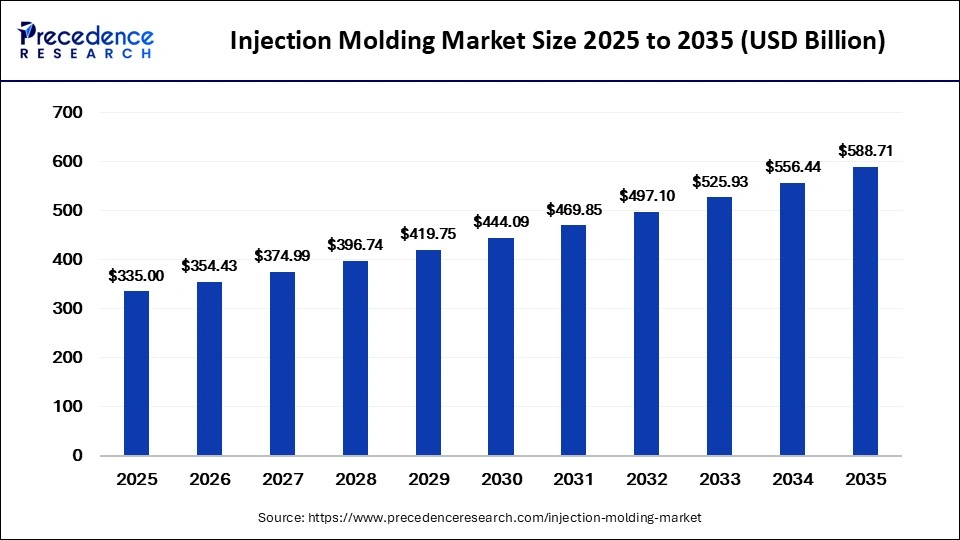
According to industry research, the global injection molding market size was estimated at approximately USD 298.7 billion in 2024 and is projected to reach nearly USD 462.4 billion by 2033, expanding at a CAGR of 5.0% during the forecast period.
Read Also: Metal Coil Lamination Market
Injection Molding Market Overview
Injection molding is a manufacturing process used to produce parts by injecting molten material into a mold cavity under high pressure. The process is widely utilized for manufacturing plastic products, metal components, medical devices, automotive parts, packaging materials, and industrial equipment.
The technology offers several advantages, including high production speed, dimensional accuracy, low material waste, design flexibility, and cost efficiency for mass production. Modern injection molding systems increasingly incorporate automation, predictive analytics, AI-driven quality inspection, and smart factory integration to improve operational performance.
The market continues to evolve as manufacturers seek advanced molding techniques capable of supporting lightweight designs, sustainable materials, and increasingly complex industrial applications.
Key Market Statistics
Major Market Highlights
- The global injection molding market is expected to grow at a CAGR of 5.0% through 2033.
- Asia-Pacific accounted for 41% of global market share in 2024.
- Plastics represented 98.2% of material segment share in 2024.
- Packaging applications accounted for 32.2% of total market demand in 2024.
- Medical injection molding is projected to grow at a CAGR of 5.9% through 2033.
- Polypropylene accounted for 34.97% of raw material demand in 2025.
- India’s injection molded plastics market is expected to reach USD 38.13 billion by 2030.
- AI-powered defect detection systems are significantly reducing manufacturing defects and improving production accuracy.
Key Market Drivers
Rising Demand for Lightweight Automotive Components
The automotive industry remains one of the largest consumers of injection-molded products worldwide.
Manufacturers are increasingly replacing metal components with lightweight injection-molded plastics to improve fuel efficiency, reduce emissions, and support electric vehicle development. Injection molding enables the production of complex automotive parts with superior precision and durability while reducing overall vehicle weight.
The rapid growth of electric vehicles is further accelerating demand for advanced molded components used in battery housings, dashboards, interior trims, connectors, and structural systems.
Expansion of Packaging Industry
The packaging sector accounted for 32.2% of market share in 2024 because of increasing global demand for lightweight, durable, and customizable packaging solutions.
Injection molding is widely used for manufacturing containers, caps, closures, food packaging, pharmaceutical packaging, and protective shipping components. The rapid expansion of e-commerce and consumer packaged goods industries continues to support market growth.
Manufacturers are also investing heavily in recyclable and biodegradable plastic materials to comply with sustainability regulations and reduce environmental impact.
Growing Healthcare and Medical Device Manufacturing
Healthcare applications are becoming one of the fastest-growing areas within the injection molding market.
Medical injection molding is increasingly used for manufacturing syringes, surgical instruments, diagnostic devices, drug delivery systems, catheters, and disposable medical products. Rising healthcare expenditure, aging populations, and increasing demand for precision medical devices are major growth drivers.
The medical injection molding market alone is projected to reach USD 39.74 billion by 2033.
Advancements in Smart Manufacturing and Automation
Manufacturers are increasingly integrating Industry 4.0 technologies into injection molding operations.
Automation systems, robotics, AI-powered monitoring, predictive maintenance, and real-time analytics are improving production efficiency, reducing downtime, and enhancing product consistency. Smart manufacturing technologies enable manufacturers to optimize cycle times and reduce material waste.
The adoption of intelligent manufacturing systems is expected to become a major competitive differentiator over the next decade.
Impact of Artificial Intelligence on Injection Molding
Artificial intelligence is rapidly transforming injection molding operations through predictive analytics, process optimization, and automated quality control.
AI-powered computer vision systems can detect product defects, warpage, and dimensional inconsistencies in real time, helping manufacturers reduce defect rates significantly. Research studies show that explainable AI and machine learning algorithms can reduce injection molding defects from 1% to as low as 0.13% in optimized environments.
Deep reinforcement learning systems are also being used to optimize process parameters dynamically while balancing production quality and profitability. Some AI optimization models have demonstrated up to 135 times faster processing speeds compared to traditional optimization techniques.
AI-driven predictive maintenance is increasingly helping manufacturers reduce operational downtime and improve equipment efficiency.
Market Trends
Increasing Adoption of Sustainable Materials
Sustainability has become one of the most important trends in the injection molding industry.
Manufacturers are increasingly adopting recyclable plastics, biodegradable polymers, and bio-based materials to reduce environmental impact and comply with evolving regulations. Polypropylene continues to dominate due to its recyclability, chemical resistance, and cost efficiency.
The growing focus on circular economy initiatives is expected to accelerate innovation in eco-friendly molding materials.
Growth of Metal Injection Molding (MIM)
Metal injection molding is emerging as one of the fastest-growing segments due to rising demand for precision-engineered components across medical, aerospace, and electronics industries.
MIM technology allows manufacturers to produce highly complex metal components with excellent dimensional accuracy and reduced production costs.
Rising Integration of Robotics and Smart Factories
Smart factory technologies are transforming manufacturing environments globally.
Manufacturers increasingly rely on robotic arms, IoT-enabled monitoring systems, AI-driven inspection tools, and automated material handling systems to improve productivity and reduce labor dependency.
This trend is especially strong in high-volume automotive and electronics manufacturing facilities.
Expansion of Precision Molding Applications
Industries such as healthcare, aerospace, and electronics increasingly require ultra-precision molded components with tight tolerances and complex geometries.
Advanced injection molding technologies are enabling manufacturers to produce miniaturized and high-performance components for specialized industrial applications.
Market Restraints
High Initial Capital Investment
Injection molding facilities require substantial investments in machinery, tooling systems, molds, robotics, and quality control infrastructure.
Smaller manufacturers often face financial challenges when upgrading to advanced automated production systems.
Environmental Concerns Regarding Plastic Waste
The growing global focus on plastic waste reduction and environmental sustainability presents challenges for traditional plastic injection molding operations.
Increasing regulations related to plastic recycling, waste management, and emissions may increase operational complexity and compliance costs.
Raw Material Price Volatility
Fluctuating prices of polymers, petrochemical feedstocks, and specialty materials continue to impact manufacturing costs and profit margins.
Supply chain disruptions and geopolitical uncertainties may further affect raw material availability and pricing stability.
Complexity in Mold Design and Maintenance
Producing highly complex molds requires technical expertise, precision engineering, and regular maintenance.
Tooling limitations and mold wear can affect long-term production consistency and operational efficiency.
Emerging Opportunities
Growth of Electric Vehicles
The rapid expansion of EV manufacturing is creating substantial opportunities for lightweight molded components used in batteries, interiors, connectors, and thermal management systems.
Automotive OEMs increasingly require advanced materials capable of improving performance while reducing vehicle weight.
Expansion of Healthcare Infrastructure
Rising healthcare investments worldwide are significantly increasing demand for disposable medical devices and precision healthcare components.
Injection molding remains one of the most cost-effective and scalable manufacturing technologies for medical production.
Industry 4.0 and AI Integration
AI-powered predictive analytics, robotics, digital twins, and IoT-enabled manufacturing systems are creating new opportunities for intelligent injection molding operations.
Manufacturers adopting smart manufacturing technologies are expected to achieve significant competitive advantages.
Increasing Demand in Emerging Economies
Rapid industrialization across India, China, Southeast Asia, and Latin America is driving strong demand for injection-molded products across automotive, electronics, packaging, and consumer goods industries.
Government manufacturing initiatives such as “Make in India” are further supporting regional market expansion.
Segmental Analysis
By Material
Plastics Segment Dominance
Plastics dominated the market with 98.2% share in 2024 because of their lightweight properties, cost efficiency, and design flexibility.
Polypropylene Leadership
Polypropylene accounted for 34.97% market share in 2025 due to its chemical resistance, recyclability, and low production cost.
Metal Injection Molding Growth
Metal injection molding is expected to witness rapid growth because of increasing demand for precision-engineered components in aerospace, medical, and electronics applications.
By Application
Packaging Segment Leadership
Packaging represented 32.2% market share in 2024 because of increasing demand for high-volume plastic packaging solutions.
Medical Segment Growth
The medical segment is projected to witness the fastest growth due to rising healthcare infrastructure investments and increasing demand for disposable medical products.
Automotive Applications Expansion
Automotive applications continue to expand rapidly because of lightweighting trends and EV production growth.
Regional Analysis
Asia-Pacific
Asia-Pacific dominated the injection molding market with 41% share in 2024.
China, India, Japan, and South Korea remain major manufacturing hubs due to cost-effective production capabilities, abundant labor availability, and expanding industrial infrastructure.
China leads the regional market because of its large-scale manufacturing ecosystem and strong automotive and electronics sectors.
North America
North America continues to witness strong growth driven by advanced manufacturing technologies, medical device production, and automation adoption.
The United States remains a major market for precision molding technologies and high-performance industrial applications.
Europe
Europe focuses heavily on sustainable manufacturing, precision engineering, and recyclable materials.
Germany remains a leading market due to strong automotive manufacturing and Industry 4.0 integration.
India
India is emerging as a major injection molding manufacturing hub due to rapid healthcare expansion, electronics production growth, and government industrial initiatives.
India’s injection molded plastics market is projected to reach USD 38.13 billion by 2030.
Key Companies in the Injection Molding Market
Major companies operating in the market include:
- Haitian International
- ENGEL Holding GmbH
- ARBURG GmbH
- Milacron
- Sumitomo Heavy Industries
- Wittmann Battenfeld
- Fanuc
- Nissei Plastic Industrial
- Husky Technologies
- JSW Plastics Machinery
These companies are investing heavily in AI-driven manufacturing systems, robotics, sustainable materials, and smart factory technologies to strengthen their market positions.
Get a Sample Copy: https://www.precedenceresearch.com/sample/8410
For inquiries regarding discounts, bulk purchases, or customization requests, please contact us at sales@precedenceresearch.com
