
AI in Product Lifecycle Management Market Size to Surge USD 75.72 Billion by 2035
The global AI in Product Lifecycle Management market is projected to grow from USD 10.69 billion in 2026 to USD 75.72 billion by 2035, driven by Industry 4.0 adoption, generative AI, digital twins, and cloud-based PLM solutions.
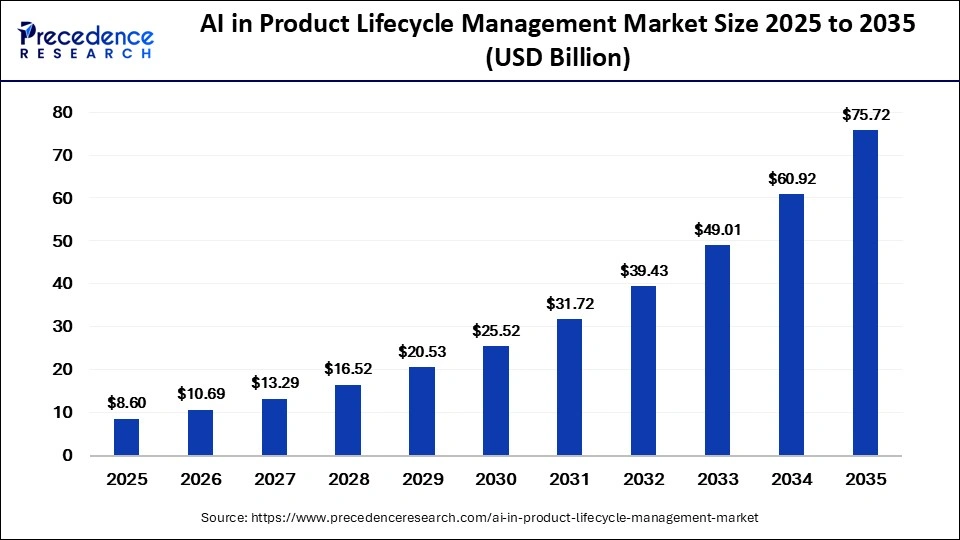
AI in Product Lifecycle Management Market: Transforming Product Innovation Through Artificial Intelligence
Introduction
Artificial Intelligence (AI) is reshaping the future of Product Lifecycle Management (PLM) by enabling organizations to optimize every stage of the product journey—from ideation and design to manufacturing, maintenance, and end-of-life management. As enterprises accelerate their digital transformation initiatives, AI-powered PLM platforms are becoming critical tools for enhancing productivity, reducing operational costs, and improving decision-making.
The integration of machine learning, predictive analytics, natural language processing, digital twins, and generative AI into PLM systems is allowing manufacturers and product developers to streamline operations while accelerating innovation. As a result, the AI in Product Lifecycle Management market is emerging as one of the fastest-growing segments within the broader enterprise software landscape.
Read Also: Human Centric Lighting Market
Market Overview
The global AI in Product Lifecycle Management market was valued at USD 8.60 billion in 2025 and is expected to grow from USD 10.69 billion in 2026 to approximately USD 75.72 billion by 2035, expanding at a CAGR of 24.30% during the forecast period. The rapid adoption of AI-enabled PLM software, increasing implementation of Industry 4.0 technologies, and growing demand for intelligent product development solutions are fueling market expansion.
Organizations are increasingly leveraging AI to improve collaboration across engineering, manufacturing, quality management, and supply chain functions. This shift is creating new opportunities for software vendors and technology providers operating in the PLM ecosystem.
Why AI is Revolutionizing Product Lifecycle Management
Traditional PLM systems primarily function as repositories for product-related information. AI transforms these systems into intelligent platforms capable of analyzing vast datasets, predicting outcomes, and automating complex workflows.
Key benefits include:
- Faster product development cycles
- Improved engineering accuracy
- Predictive maintenance capabilities
- Enhanced product quality management
- Automated compliance monitoring
- Better supply chain visibility
- Reduced operational costs
- Improved cross-functional collaboration
By integrating AI into PLM processes, organizations can achieve higher efficiency while responding more effectively to evolving market demands.
Key Market Drivers
Industry 4.0 Adoption Accelerating Demand
The ongoing adoption of Industry 4.0 technologies is creating significant demand for AI-powered lifecycle management solutions. Smart factories generate enormous volumes of data from connected machines, sensors, and digital systems. AI-enabled PLM platforms help manufacturers analyze this information and transform it into actionable insights.
Growing Use of Predictive Analytics
Predictive analytics has become a major driver of AI adoption within PLM systems. Manufacturers increasingly rely on AI algorithms to forecast equipment failures, optimize maintenance schedules, and improve product performance. These capabilities reduce downtime while improving operational efficiency.
Expansion of Digital Twin Technologies
Digital twins allow organizations to create virtual representations of physical products and processes. AI enhances these digital models by providing real-time monitoring, simulation, and predictive capabilities. As digital twin adoption increases across industries, demand for AI-integrated PLM platforms continues to grow.
Rising Need for Quality and Compliance Management
Industries operating under strict regulatory requirements are increasingly adopting AI-driven PLM systems. These solutions automate inspections, identify anomalies, and streamline compliance monitoring, helping organizations maintain quality standards while reducing administrative burdens.
Emerging Trends Shaping the Market
Generative AI Becoming a Game Changer
Generative AI is rapidly transforming product development by enabling engineers and designers to create concepts, specifications, documentation, and product designs using natural language prompts. The generative AI segment is projected to record the fastest growth rate, with a CAGR of 37.2% through 2035.
Rise of Intelligent Product Design
AI-assisted design tools are helping organizations accelerate innovation cycles while improving product quality. These tools can analyze design alternatives, recommend improvements, and automate repetitive engineering tasks, significantly reducing development timelines.
Enhanced Knowledge Management
Organizations are leveraging AI-powered knowledge management systems to centralize product data and improve accessibility across departments. This trend is enhancing collaboration between engineering, manufacturing, and supply chain teams.
Segment Analysis
Software Segment Dominates the Market
By component, the software segment accounted for 76% of market revenue in 2025. The growing deployment of AI-powered PLM platforms and increasing reliance on cloud-native software solutions continue to strengthen this segment’s leadership position.
Cloud-Based Deployment Leads Adoption
Cloud-based deployment captured 56% of the market share in 2025 and is expected to grow at the fastest pace during the forecast period. Organizations are increasingly choosing cloud PLM platforms due to their scalability, flexibility, and ability to support remote collaboration.
Machine Learning Maintains Leadership
Machine learning accounted for 31% of market revenue in 2025. Its widespread use in predictive engineering, manufacturing analytics, and performance forecasting has made it the leading AI technology within PLM solutions.
Product Design & Development Remains Largest Application
The product design and development segment held a 29% market share in 2025. Growing demand for faster innovation and AI-assisted engineering solutions continues to drive growth in this application area.
Regional Insights
North America Leads Global Market
North America accounted for 38% of global revenue in 2025, making it the largest regional market. The region benefits from advanced manufacturing infrastructure, strong AI adoption, and the presence of leading technology companies.
Asia Pacific Emerges as Fastest-Growing Region
Asia Pacific is expected to register the highest CAGR of 29.6% through 2035. Rapid industrialization, increasing investment in digital transformation, and expanding manufacturing activities are driving regional market growth.
Europe Maintains Strong Growth
Europe continues to witness growing adoption of AI-powered PLM solutions, supported by stringent regulatory standards, advanced manufacturing initiatives, and increasing investment in industrial automation.
Competitive Landscape
The competitive environment is characterized by continuous technological innovation, strategic partnerships, mergers, acquisitions, and product launches. Market participants are increasingly focusing on integrating advanced AI capabilities, cloud computing, and digital twin technologies into their PLM platforms.
Companies are investing heavily in generative AI, predictive analytics, and autonomous decision-support systems to strengthen their market position and meet evolving customer requirements.
Challenges Impacting Market Growth
Despite promising growth prospects, several challenges remain:
- High implementation and integration costs
- Data privacy and cybersecurity concerns
- Complexity of legacy system integration
- Limited availability of AI-skilled professionals
- Data quality and governance challenges
Addressing these obstacles will be essential for maximizing the value of AI-powered PLM solutions.
Future Outlook
The future of AI in Product Lifecycle Management appears highly promising. As enterprises continue embracing digital transformation, AI-enabled PLM systems will become increasingly important for driving innovation, operational efficiency, and competitive advantage.
The convergence of generative AI, machine learning, cloud computing, and digital twins is expected to create a new generation of intelligent lifecycle management platforms capable of autonomous decision-making and continuous optimization.
Organizations that invest early in AI-driven PLM technologies will be better positioned to reduce product development costs, accelerate time-to-market, and improve product quality in an increasingly competitive business environment.
Conclusion
The AI in Product Lifecycle Management market is undergoing a transformative evolution driven by advancements in artificial intelligence, smart manufacturing, and digital engineering. With the market projected to reach USD 75.72 billion by 2035, AI-powered PLM solutions are set to redefine how products are designed, developed, manufactured, and managed.
As businesses seek greater efficiency, innovation, and agility, AI will continue to play a pivotal role in shaping the future of product lifecycle management across industries worldwide.
Get a Sample Copy: https://www.precedenceresearch.com/sample/8440
