
Non-Invasive Prenatal Testing Market Size, Growth Trends, and Forecast 2026 to 2035
The global non-invasive prenatal testing market size was valued at USD 7.18 billion in 2025 and is projected to grow from USD 8.05 billion in 2026 to approximately USD 20.89 billion by 2035, registering a CAGR of 11.27% during the forecast period. The market is witnessing remarkable expansion due to the growing demand for safe, accurate, and early prenatal screening, increasing maternal age, rising awareness of fetal genetic disorders, and continuous advancements in genetic testing technologies such as next-generation sequencing (NGS) and cell-free DNA (cfDNA) analysis. The widespread adoption of personalized medicine, supportive healthcare policies, and expanding access to prenatal care are further strengthening market growth across developed and emerging economies.
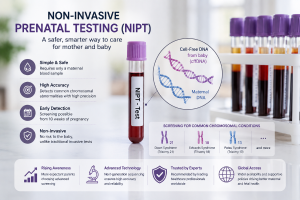
Non-Invasive Prenatal Testing Market Overview
Non-Invasive Prenatal Testing (NIPT) is an advanced prenatal genetic screening method that analyzes cell-free fetal DNA (cfDNA) circulating in the mother’s bloodstream to assess the risk of chromosomal abnormalities in the developing fetus. Unlike invasive procedures such as amniocentesis and chorionic villus sampling (CVS), NIPT requires only a maternal blood sample, eliminating the risk of miscarriage while providing highly accurate screening results.
The test is widely used for detecting Down syndrome (Trisomy 21), Edwards syndrome (Trisomy 18), Patau syndrome (Trisomy 13), sex chromosome abnormalities, and selected microdeletion syndromes. With growing awareness among healthcare providers and expectant parents regarding the benefits of early fetal screening, NIPT has become one of the fastest-growing segments within prenatal diagnostics.
Technological advancements in genomic sequencing, bioinformatics, and artificial intelligence have significantly enhanced test sensitivity, specificity, and turnaround times. Increasing healthcare expenditure, rising maternal age, expanding access to prenatal care, and supportive reimbursement policies in developed countries continue accelerating market adoption worldwide.
Non-Invasive Prenatal Testing Market Size and Forecast
| Year | Market Size (USD Billion) |
|---|---|
| 2025 | 7.18 |
| 2026 | 8.05 |
| 2035 | 20.89 |
| CAGR (2026–2035) | 11.27% |
Download the Sample: https://www.precedenceresearch.com/sample/3362
Non-Invasive Prenatal Testing Market Value Chain Analysis
Research & Technology Development
- Leading biotechnology companies invest heavily in research and development to improve sequencing technologies, develop advanced bioinformatics platforms, enhance genetic interpretation software, and expand the range of detectable chromosomal abnormalities. Continuous innovation helps improve diagnostic accuracy while reducing testing costs.
Raw Material & Reagent Manufacturing
- Manufacturers supply high-quality sequencing reagents, DNA extraction kits, laboratory consumables, microfluidic components, sequencing instruments, and quality control materials that form the foundation of accurate prenatal genetic testing. Maintaining regulatory compliance and product consistency is essential throughout this stage.
Clinical Laboratory Testing
- Certified molecular diagnostic laboratories receive maternal blood samples, isolate fetal DNA, perform genomic sequencing using advanced platforms, analyze complex genetic information, and generate highly accurate clinical reports. Laboratory automation continues improving testing efficiency and reducing turnaround times.
Healthcare Providers & Genetic Counseling
- Obstetricians, gynecologists, maternal-fetal medicine specialists, and genetic counselors play an essential role in recommending NIPT, interpreting results, educating expectant parents, and guiding follow-up diagnostic decisions when necessary.
Distribution & Healthcare Networks
- Testing services are distributed through hospitals, diagnostic laboratories, fertility clinics, prenatal care centers, and expanding telemedicine platforms, making advanced prenatal screening increasingly accessible across both urban and rural populations.

