
Medical Carts and Workstations Market Size to Attain USD 28.11 Billion by 2035
The global medical carts and workstations market was valued at USD 5.15 billion in 2025 and is projected to grow from USD 6.13 billion in 2026 to approximately USD 28.11 billion by 2035. The market is expected to expand at a compound annual growth rate (CAGR) of 18.50% during the forecast period from 2026 to 2035.
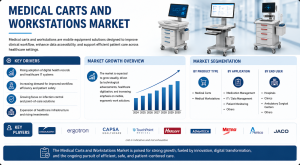
Medical Carts and Workstations Market Overview
The global medical carts and workstations market is experiencing significant growth as healthcare organizations increasingly invest in digital infrastructure and connected healthcare technologies. Hospitals and healthcare providers are focusing on improving operational efficiency, reducing clinical errors, and enhancing patient safety through the adoption of mobile healthcare solutions. Medical carts and workstations have become an essential part of these modernization efforts by enabling clinicians to access electronic health records, administer medications, monitor patients, and complete clinical documentation without leaving the patient’s bedside.
The growing demand for point-of-care healthcare services, expanding use of electronic health records (EHRs), rising adoption of telemedicine, and increasing implementation of smart hospital initiatives are major factors driving market expansion. In addition, continuous technological advancements such as AI-powered workstations, cloud connectivity, Internet of Things (IoT) integration, and long-lasting battery systems are further accelerating market growth.
Get Sample Link: https://www.precedenceresearch.com/sample/1920
Medical Carts and Workstations Market Key Takeaways
- North America dominated the global medical carts and workstations market, accounting for more than 43% of the total revenue in 2025.
- Based on end user, emergency clinics held the largest market share, contributing over 38% of global revenue in 2025.
- By type, the emergency carts segment emerged as the leading category, capturing more than 42% of the market share.
- By product, mobile computing carts led the market, generating over 75% of the worldwide revenue in 2025.
What Are Medical Carts and Workstations?
Medical carts and workstations are specially designed platforms that improve healthcare delivery by combining mobility, storage, computing, and clinical functionality. They allow healthcare professionals to carry medical equipment, medications, and digital tools while accessing patient information in real time.
Modern medical carts commonly include:
- Mobile computing systems
- Electronic Health Record (EHR) integration
- Medication dispensing drawers
- Barcode medication administration
- Battery-powered workstations
- Wireless networking
- Diagnostic equipment holders
- RFID asset tracking
- Adjustable ergonomic work surfaces
- Secure storage compartments
These systems reduce unnecessary movement, improve workflow efficiency, and enhance communication among healthcare professionals.
Why Medical Carts Have Become Essential in Modern Healthcare
Healthcare providers today manage larger patient volumes while facing increasing pressure to improve clinical efficiency and reduce operational costs. Medical carts enable clinicians to perform documentation, medication administration, and patient monitoring without returning repeatedly to nursing stations.
The benefits include:
- Faster access to patient information
- Improved medication safety
- Reduced documentation errors
- Better workflow efficiency
- Enhanced patient satisfaction
- Improved staff productivity
- Greater mobility throughout healthcare facilities
These advantages make medical carts indispensable across hospitals, ambulatory surgical centers, physician offices, emergency departments, and long-term care facilities.
Technological Innovations Driving the Market
Rapid technological advancements are transforming medical carts into intelligent healthcare platforms.
Emerging technologies include:
- Artificial Intelligence (AI)
- Internet of Things (IoT)
- Cloud computing
- RFID asset tracking
- Voice recognition software
- Predictive analytics
- Remote patient monitoring
- Wireless charging technologies
These innovations improve workflow efficiency while reducing clinician workload.
Impact of Internet of Things (IoT) and Connected Healthcare
The Internet of Things (IoT) is revolutionizing healthcare by enabling connected medical devices to communicate seamlessly across hospital networks. IoT-enabled medical carts can integrate with patient monitors, infusion pumps, diagnostic devices, and hospital information systems, providing clinicians with real-time access to critical patient data.
Connected workstations support continuous patient monitoring by collecting and transmitting vital signs such as heart rate, blood pressure, oxygen saturation, and temperature. Automated alerts notify healthcare providers of abnormal readings, allowing faster intervention and improving patient outcomes.
IoT also enhances hospital asset management by using RFID tags and wireless sensors to track the location and status of medical carts and equipment. This reduces equipment loss, improves resource utilization, and minimizes delays during emergencies.
Predictive maintenance is another major benefit. Intelligent sensors monitor battery health, hardware performance, and equipment usage, enabling maintenance before failures occur and reducing downtime.
Read More: Nootropics Market
Artificial Intelligence in Medical Workstations
Artificial Intelligence is gradually becoming an integral part of modern healthcare workstations.
AI-powered systems can:
- Automate clinical documentation
- Recommend treatment options
- Predict patient deterioration
- Improve workflow management
- Reduce administrative workload
- Support clinical decision-making
As AI capabilities continue advancing, intelligent medical workstations will become even more valuable in improving healthcare efficiency.
Medical Carts and Workstations Market Challenges
Despite strong growth prospects, the market faces several challenges.
- High Capital Investment: Advanced medical workstations require significant upfront investment, limiting adoption among smaller healthcare facilities.
- Maintenance Costs: Battery replacement, software updates, equipment servicing, and cybersecurity maintenance increase long-term ownership costs.
- Cybersecurity Risks: Connected medical carts handle sensitive patient information, requiring robust cybersecurity measures such as encryption, secure authentication, and remote device management.
Medical Carts and Workstations Market Competitive Landscape
The market is highly competitive, with manufacturers focusing on innovation, ergonomic design, digital integration, and battery technologies.
Leading companies include:
- Ergotron
- Capsa Healthcare
- Advantech
- Enovate Medical
- Harloff Manufacturing
- TouchPoint Medical
- JACO Inc.
- Medline Industries
- McKesson Medical-Surgical
- ITD GmbH
Future Outlook
The future of the medical carts and workstations market remains highly promising. Growing investments in digital healthcare, artificial intelligence, IoT, cloud computing, and smart hospitals will continue driving demand for intelligent mobile workstations.
Healthcare providers increasingly recognize that mobile clinical workstations improve productivity, reduce medical errors, enhance patient safety, and support better healthcare outcomes. As healthcare systems continue evolving toward connected and patient-centered care, medical carts will become even more sophisticated, integrating predictive analytics, autonomous navigation, remote diagnostics, and real-time clinical decision support.
𝐘𝐨𝐮 𝐜𝐚𝐧 𝐩𝐥𝐚𝐜𝐞 𝐚𝐧 𝐨𝐫𝐝𝐞𝐫 𝐨𝐫 𝐚𝐬𝐤 𝐚𝐧𝐲 𝐪𝐮𝐞𝐬𝐭𝐢𝐨𝐧𝐬, 𝐩𝐥𝐞𝐚𝐬𝐞 𝐟𝐞𝐞𝐥 𝐟𝐫𝐞𝐞 𝐭𝐨 𝐜𝐨𝐧𝐭𝐚𝐜𝐭 𝐮𝐬 𝐚𝐭 𝐬𝐚𝐥𝐞𝐬@𝐩𝐫𝐞𝐜𝐞𝐝𝐞𝐧𝐜𝐞𝐫𝐞𝐬𝐞𝐚𝐫𝐜𝐡.𝐜𝐨𝐦
