
U.S. Off-Road Vehicles Market Size, Trends Analysis, and Forecast 2026 to 2035
The U.S. Off-Road Vehicles Market is witnessing steady growth as consumers increasingly embrace outdoor recreation, adventure tourism, agricultural mechanization, and utility-based transportation. The market was valued at USD 11.82 billion in 2025 and is projected to grow from USD 12.37 billion in 2026 to approximately USD 18.47 billion by 2035, registering a CAGR of 4.56% during the forecast period.
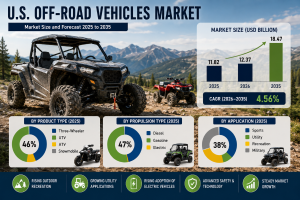
The market is primarily driven by the rising popularity of all-terrain vehicles (ATVs), utility task vehicles (UTVs), side-by-side vehicles, dirt bikes, and snowmobiles across recreational, agricultural, construction, forestry, mining, military, and industrial applications. Technological advancements such as electric propulsion systems, GPS navigation, connected vehicle technologies, improved suspension systems, and enhanced safety features are transforming the off-road vehicle landscape. Furthermore, increasing consumer spending on outdoor activities, expansion of adventure tourism, and government support for recreational trail development continue to create favorable conditions for long-term market growth.
U.S. Off-Road Vehicles Market Overview
The U.S. Off-Road Vehicles Market encompasses a broad range of specialized vehicles engineered to operate efficiently across rough, uneven, and unpaved terrain where conventional passenger vehicles cannot perform effectively. These vehicles include All-Terrain Vehicles (ATVs), Utility Task Vehicles (UTVs), Side-by-Side Vehicles (SxS), Snowmobiles, Dirt Bikes, Three-Wheelers, and Off-Road Trucks, each designed for specific recreational, agricultural, industrial, commercial, and defense applications.
Unlike traditional road vehicles, off-road vehicles feature rugged suspension systems, four-wheel-drive capabilities, reinforced chassis structures, specialized tires, and high ground clearance that enable them to navigate sand dunes, forests, rocky landscapes, muddy trails, snow-covered regions, and mountainous terrain. Their versatility has made them indispensable across farming operations, ranches, mining sites, construction projects, forestry management, emergency response services, military operations, and outdoor recreational activities.
The U.S. remains one of the world’s largest off-road vehicle markets due to its extensive trail networks, strong outdoor recreation culture, growing adventure tourism, and expanding commercial applications. Manufacturers continue introducing technologically advanced vehicles equipped with intelligent navigation systems, digital dashboards, GPS tracking, smartphone connectivity, electric drivetrains, and enhanced safety technologies, significantly improving user experience while supporting sustainable mobility initiatives.
U.S. Off-Road Vehicles Market Size and Forecast
The U.S. Off-Road Vehicles Market is expected to experience stable expansion throughout the forecast period, supported by rising recreational vehicle ownership, increasing utility applications, and technological innovation.
| Year | Market Size |
|---|---|
| 2025 | USD 11.82 Billion |
| 2026 | USD 12.37 Billion |
| 2035 | USD 18.47 Billion |
| CAGR (2026–2035) | 4.56% |
Steady market expansion reflects growing consumer demand for outdoor recreation, increasing investments in agriculture and construction equipment, and rising adoption of electric and connected off-road vehicles. Commercial fleet operators, government agencies, defense organizations, and utility providers are also increasing investments in versatile off-road transportation solutions capable of operating in challenging environments.
Download the Sample: https://www.precedenceresearch.com/sample/4099
U.S. Off-Road Vehicles Market Value Chain Analysis
- Research & Product Development: Continuous innovation drives the evolution of off-road vehicles. Manufacturers invest heavily in lightweight materials, electric propulsion systems, battery technologies, autonomous navigation, digital connectivity, advanced suspension systems, and safety engineering. Research efforts focus on improving vehicle durability, fuel efficiency, operator comfort, and environmental performance while meeting increasingly stringent emissions regulations.
- Component Manufacturing: The manufacturing ecosystem includes suppliers of engines, electric motors, batteries, transmissions, drivetrains, tires, braking systems, suspension components, electronic control units, GPS modules, and safety equipment. High-quality components are essential for ensuring reliable performance in extreme operating conditions.
- Vehicle Assembly: Original equipment manufacturers (OEMs) integrate mechanical, electrical, and digital systems into complete vehicles designed for diverse applications. Production emphasizes durability, ergonomic design, performance optimization, and compliance with safety standards while incorporating customer-specific features for recreational and commercial use.
- Distribution & Dealer Networks: Manufacturers distribute vehicles through extensive dealership networks, specialty retailers, agricultural equipment suppliers, and online platforms. Dealers provide financing, customization, maintenance services, spare parts, and after-sales support that enhance customer satisfaction and brand loyalty.
- End Users: End users include recreational enthusiasts, farmers, ranchers, forestry operators, mining companies, military organizations, construction contractors, utility providers, emergency responders, tourism operators, and government agencies utilizing off-road vehicles for a wide variety of operational requirements.
What Factors are Driving the Growth of the U.S. Off-Road Vehicles Market?
- Rising Outdoor Recreation: Growing participation in camping, trail riding, hunting, fishing, off-road racing, and adventure tourism continues increasing demand for recreational off-road vehicles across the United States.
- Agricultural Mechanization: Farmers and ranchers increasingly rely on UTVs and ATVs for transporting equipment, inspecting crops, livestock management, fencing, irrigation maintenance, and general farm operations.
- Commercial Applications: Construction companies, mining operators, forestry services, oil & gas companies, and utility providers utilize off-road vehicles for transportation, material handling, inspections, and maintenance in remote locations.
- Electric Vehicle Innovation: Advancements in battery technology and electric drivetrains are expanding the availability of environmentally friendly off-road vehicles with improved torque, reduced maintenance requirements, and lower operating costs.
U.S. Off-Road Vehicles Market Major Growth Factors
Expanding Adventure Tourism
- Growth of outdoor recreation
- Off-road parks and trail systems
- ATV rental businesses
- Motorsports events
Commercial Demand
- Agriculture
- Construction
- Forestry
- Mining
- Utility operations
Technological Advancements
- Electric propulsion
- GPS navigation
- Smart connectivity
- Advanced suspension systems
Consumer Lifestyle Changes
- Higher disposable income
- Outdoor recreation preferences
- Adventure sports participation
- Family leisure activities
How Artificial Intelligence is Transforming the U.S. Off-Road Vehicles Market
- Artificial Intelligence (AI) is emerging as one of the most transformative technologies within the off-road vehicle industry by enabling intelligent vehicle operation, predictive maintenance, autonomous navigation, and real-time operational monitoring.
- Modern off-road vehicles generate enormous amounts of operational data through embedded sensors, onboard computers, GPS systems, engine management units, battery monitoring systems, suspension sensors, cameras, and connectivity platforms. AI algorithms analyze this data continuously to optimize vehicle performance under changing terrain and environmental conditions.
- Machine learning models can predict mechanical failures before they occur by monitoring engine temperature, oil pressure, battery condition, suspension wear, tire pressure, fuel consumption, and drivetrain performance. Predictive maintenance reduces repair costs, minimizes equipment downtime, and extends overall vehicle lifespan.
- AI also significantly improves driver safety by supporting obstacle detection, rollover prevention, terrain recognition, adaptive suspension control, emergency braking assistance, and intelligent route planning. Commercial fleet operators increasingly utilize AI-powered fleet management platforms that optimize vehicle scheduling, monitor driver behavior, improve fuel efficiency, and reduce operational expenses.
- As autonomous mobility technologies continue advancing, AI is expected to play an even greater role in future off-road vehicles, particularly within mining, agriculture, military, forestry, and construction sectors where autonomous equipment can improve productivity while reducing labor shortages and operational risks.
Key Benefits of AI in Off-Road Vehicles
- Intelligent Navigation: AI-powered navigation systems analyze terrain data, weather conditions, and GPS information to recommend the safest and most efficient routes. This improves operational efficiency while reducing travel time across rugged landscapes.
- Predictive Maintenance: Machine learning continuously monitors vehicle health to identify potential mechanical issues before failures occur. Predictive maintenance reduces repair costs, minimizes downtime, and extends vehicle lifespan.
- Enhanced Safety: AI assists operators by detecting obstacles, monitoring vehicle stability, preventing rollovers, and providing real-time alerts in hazardous operating conditions, significantly improving driver safety.
- Fleet Management: Commercial operators benefit from AI-enabled fleet management platforms that optimize vehicle utilization, monitor fuel efficiency, schedule maintenance, and improve overall operational productivity.
How Government Initiatives are Supporting Market Growth
- Federal and state governments continue supporting the off-road vehicle market through investments in recreational infrastructure, public trail systems, conservation projects, and rural transportation development.
- Programs managed by the U.S. Forest Service, Bureau of Land Management, and state recreation departments expand public access to designated off-road trails while promoting responsible vehicle usage and environmental conservation. Tourism initiatives encouraging outdoor recreation also contribute to increasing demand for ATVs, UTVs, and side-by-side vehicles.
- In addition, government incentives supporting electrification, emissions reduction, and advanced manufacturing encourage manufacturers to invest in electric off-road vehicles and sustainable production technologies. Defense modernization programs further stimulate demand for specialized off-road vehicles capable of supporting tactical mobility and emergency response operations.
Recent Developments in U.S. Off-Road Vehicles Market
- 2025: Kandi Technologies commenced local manufacturing of electric golf carts at its Texas facility.
- 2025: Argus Research initiated coverage of Kandi Technologies, highlighting its expansion into electric UTVs.
- 2024: Toyota announced the launch of the Land Cruiser 250 Series featuring a powerful turbocharged engine and enhanced off-road capabilities.
Top Leading Companies of U.S. Off-Road Vehicles Market
- Polaris Inc.
- Arctic Cat Inc.
- Yamaha Motor Corporation
- Honda Motor Co., Ltd.
- Kawasaki Motors Corp., U.S.A.
- Can-Am (BRP)
- Suzuki Motor Corporation
- John Deere
- Textron Inc.
- Kubota Corporation
- Kymco
- CFMOTO
- Mahindra & Mahindra Limited
- Massimo Motor
- American Landmaster
Segment Insights
By Product Type
- Three-Wheeler: The three-wheeler segment accounted for the largest market share in 2025 due to its affordability, maneuverability, and popularity among recreational users.
- Utility Task Vehicles (UTVs): UTVs are expected to witness the fastest growth as commercial industries increasingly adopt versatile vehicles for agriculture, construction, mining, and utility operations.
By Propulsion Type
- Diesel: Diesel vehicles remain preferred for heavy-duty commercial applications because of their durability, torque output, and fuel efficiency.
- Gasoline: Gasoline-powered vehicles are projected to grow rapidly due to lower purchase costs, easier maintenance, and widespread use in recreational applications.
By Application
- Sports: Sports applications continue dominating the market due to increasing participation in motorsports, trail riding, and outdoor adventure activities.
- Military: Military demand is growing rapidly as defense organizations modernize tactical mobility fleets for challenging operational environments.
Read More: U.S. Vehicle-to-Grid Technology Market
Segments Covered in the Report
By Product Type
- All-Terrain Vehicle (ATV)
- Utility Terrain Vehicle (UTV)
- Snowmobile
- Three-Wheeler
By Propulsion Type
- Gasoline
- Diesel
- Electric
By Application
- Utility
- Sports
- Recreation
- Military
Future Outlook
The U.S. Off-Road Vehicles Market is expected to maintain steady growth through 2035, driven by increasing demand for recreational mobility, commercial utility vehicles, and advanced off-road technologies. Rising investments in electric propulsion, AI-powered vehicle intelligence, connected mobility, and sustainable manufacturing will continue reshaping the industry.
Manufacturers are expected to focus on lightweight designs, autonomous capabilities, enhanced safety systems, and digital connectivity while expanding their product portfolios to address the growing needs of agriculture, construction, defense, mining, and outdoor recreation. As consumer interest in adventure tourism and outdoor lifestyles continues to rise, the U.S. off-road vehicles market is well positioned for long-term expansion, offering significant opportunities for innovation and investment.
You can place an order or ask any questions. Please feel free to contact us at sales@precedenceresearch.com | +1 804 441 9344

