
U.S. Vehicle-to-Grid Technology Market Size, Growth Trends, and Analysis 2026 to 2035
The U.S. Vehicle-to-Grid Technology Market is entering a period of rapid expansion as electric vehicles evolve beyond transportation into valuable distributed energy resources. The market size is estimated at USD 1.85 billion in 2025 and is projected to grow from USD 2.45 billion in 2026 to approximately USD 30.84 billion by 2035, registering a remarkable CAGR of 32.49% during the forecast period.
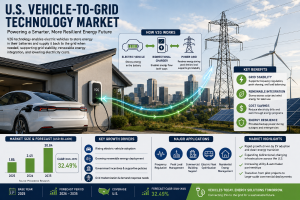
The market is primarily driven by the rapid adoption of electric vehicles, increasing investments in distributed energy resources, growing deployment of bidirectional charging infrastructure, and rising demand for grid stability as renewable energy integration accelerates across the United States. Government incentives, smart grid modernization, and collaborations between utilities, automakers, and charging infrastructure providers are further supporting commercial deployment of V2G technology.
U.S. Vehicle-to-Grid Technology Market Overview
Vehicle-to-Grid (V2G) technology enables electric vehicles (EVs) to exchange electricity with the power grid through bidirectional charging systems. Unlike conventional EV charging, V2G allows vehicles not only to draw electricity from the grid but also to return stored energy when electricity demand is high. This transforms EV batteries into mobile energy storage assets capable of supporting grid reliability, renewable energy integration, and peak demand management.
The technology plays an increasingly important role in the modernization of America’s electricity infrastructure by supporting demand response programs, frequency regulation, emergency backup power, and distributed energy resource (DER) management.
As utilities continue modernizing transmission networks and renewable energy installations increase across the country, V2G technology is emerging as one of the most promising solutions for balancing electricity supply and demand while improving overall energy resilience.
U.S. Vehicle-to-Grid Technology Market Size and Forecast
| Year | Market Size |
|---|---|
| 2025 | USD 1.85 Billion |
| 2026 | USD 2.45 Billion |
| 2035 | USD 30.84 Billion |
| CAGR (2026–2035) | 32.49% |
Download the Sample: https://www.precedenceresearch.com/sample/3738
U.S. Vehicle-to-Grid Technology Market Value Chain Analysis
- Research & Technology Development: Leading companies continue investing in bidirectional charging technologies, smart grid communication systems, battery optimization software, AI-powered energy management platforms, and cybersecurity solutions to improve V2G performance.
- Hardware Manufacturing: Manufacturers develop bidirectional chargers, inverters, communication controllers, smart meters, transformers, and power electronics that enable safe electricity exchange between vehicles and the grid.
- Software Development: Advanced software platforms coordinate charging schedules, monitor battery health, forecast electricity demand, optimize energy trading, and enable virtual power plant (VPP) participation.
- Charging Infrastructure Deployment: Utilities and charging network operators install residential, commercial, fleet, and public charging stations capable of supporting bidirectional power transfer.
- Utilities & Grid Operators: Electric utilities integrate V2G assets into demand response programs, renewable energy balancing systems, and grid stability operations while compensating EV owners for supplying electricity.
How AI is Transforming the U.S. Vehicle-to-Grid Technology Market
Artificial Intelligence is fundamentally transforming vehicle-to-grid technology by enabling intelligent energy management across increasingly complex electricity networks. AI algorithms continuously analyze vast amounts of real-time information, including electricity demand, renewable energy generation, weather forecasts, electricity prices, battery conditions, charging behavior, and traffic patterns to optimize energy exchange between electric vehicles and the grid.
Machine learning enables charging systems to determine the most cost-effective charging times while maximizing battery health and minimizing energy losses. Predictive analytics also allow utilities to forecast peak electricity demand and proactively utilize connected EV batteries to stabilize grid operations.
Artificial intelligence further supports predictive maintenance by identifying early signs of equipment failure, reducing operational downtime, improving charging infrastructure reliability, and lowering maintenance costs. As AI continues evolving, future V2G ecosystems will become increasingly autonomous, allowing millions of connected vehicles to function collectively as intelligent distributed energy resources.
Key Benefits of AI Integration
- Intelligent Energy Management: AI enables real-time optimization of electricity distribution by automatically scheduling charging and discharging activities based on electricity demand, renewable energy availability, and market pricing. This improves energy efficiency while reducing operational costs for utilities and EV owners.
- Battery Health Optimization: Advanced AI models continuously monitor battery temperature, charging cycles, voltage fluctuations, and degradation patterns. These insights help extend battery lifespan by preventing excessive charging, reducing wear, and optimizing overall battery utilization.
- Smart Grid Coordination: Artificial intelligence enables seamless coordination between utilities, charging stations, renewable energy sources, and electric vehicles. Automated decision-making allows rapid response to grid disturbances while improving electricity reliability and reducing blackout risks.
- Predictive Maintenance: AI-powered monitoring systems continuously analyze charger performance, detect equipment anomalies, predict maintenance requirements, and reduce unexpected infrastructure failures. This minimizes downtime and improves customer satisfaction.
How Government Initiatives are Supporting Market Growth
- Government support remains one of the strongest growth drivers for the U.S. vehicle-to-grid technology market. Federal and state governments continue introducing policies aimed at accelerating transportation electrification, renewable energy integration, and electricity grid modernization.
- The Infrastructure Investment and Jobs Act allocated billions of dollars toward EV charging infrastructure, creating favorable conditions for deployment of advanced bidirectional charging systems. The U.S. Department of Energy has funded numerous demonstration projects showcasing V2G applications across commercial fleets, school buses, municipal transportation, and residential communities.
- Several states have introduced utility incentive programs, tax credits, clean transportation initiatives, and renewable energy mandates encouraging consumers and businesses to adopt vehicle-grid integration technologies. These initiatives reduce upfront investment costs while encouraging commercialization of innovative V2G business models.
- Additionally, government-funded research programs continue advancing battery technology, cybersecurity standards, interoperability protocols, and smart grid integration, ensuring long-term market development.
What Factors are Driving the Growth of the U.S. Vehicle-to-Grid Technology Market?
Increasing Electric Vehicle Adoption: Growing EV sales significantly expand the available battery storage capacity that can participate in grid services.
Renewable Energy Expansion: Solar and wind energy require flexible storage systems, making V2G an ideal solution for balancing intermittent power generation.
Smart Grid Modernization: Utilities are investing heavily in digital grid infrastructure capable of supporting distributed energy resources.
Bidirectional Charging Infrastructure: Rapid deployment of advanced charging stations enables two-way electricity transfer between EVs and the power grid.
U.S. Vehicle-to-Grid Technology Market Major Growth Factors
Rising EV Sales
- Increasing EV ownership
- Fleet electrification
- Commercial vehicle adoption
- Government incentives
Grid Modernization
- Smart grid deployment
- Digital energy infrastructure
- Renewable energy integration
- Grid flexibility
Utility Partnerships
- Automaker collaborations
- Utility pilot programs
- Fleet management solutions
- Demand response services
Technology Advancements
- AI-powered charging
- Advanced software platforms
- Improved battery management
- Cloud-based monitoring systems
Latest Trends in the U.S. Vehicle-to-Grid Technology Market
- Expansion of Bidirectional Charging Networks: Utilities and charging companies are rapidly deploying V2G-enabled charging stations across residential, commercial, and public locations.
- Renewable Energy Integration: Electric vehicles increasingly function as distributed storage systems supporting solar and wind power generation.
- Utility and Automaker Collaborations: Strategic partnerships between Tesla, Nuvve, Nissan, Ford, utilities, and charging providers are accelerating commercialization.
- Commercial Fleet Deployment: School buses, logistics fleets, transit vehicles, and municipal EVs are becoming early adopters of V2G technology.
Sustainability Trends Transforming the Industry
The V2G industry supports carbon reduction by improving renewable energy utilization and reducing dependence on fossil-fuel peaker plants.
Green Energy Integration
- Increased renewable energy usage
- Lower carbon emissions
- Peak demand reduction
- Cleaner electricity supply
Energy Efficiency
- Intelligent charging
- Reduced energy waste
- Improved grid utilization
- Enhanced battery efficiency
Circular Energy Systems
- Distributed energy resources
- Vehicle battery reuse
- Virtual power plants
- Sustainable electricity management
Growing Demand for Grid Flexibility Driving Market Expansion
- As renewable energy capacity expands across the United States, electricity grids require flexible energy storage solutions capable of balancing intermittent power generation.
- Vehicle-to-grid technology enables millions of EV batteries to collectively function as a decentralized energy storage network, improving electricity reliability while reducing infrastructure investment requirements.
- Growing investments in smart grids, AI-powered energy management, and distributed energy resources continue strengthening long-term market growth.
U.S. Vehicle-to-Grid Technology Market Opportunities
- Commercial Fleet Electrification: Electric school buses, delivery vehicles, and public transportation fleets present major V2G deployment opportunities.
- AI-Based Energy Management: Artificial intelligence will improve charging optimization, battery management, and grid participation.
- Renewable Energy Storage: Growing solar and wind installations increase demand for flexible battery storage solutions.
- Utility Demand Response Programs: Utilities continue expanding compensation programs encouraging EV owners to participate in grid balancing services.
Recent Developments in the Market
- March 2026: Xos announced plans to begin production of V2G-enabled electric school buses for the North American market.
- February 2026: Tesla introduced its Powershare Grid Support Program, allowing Cybertruck owners in select Texas markets to supply electricity back to the grid and earn bill credits.
- August 2025: Eaton and ChargePoint launched the ChargePoint Express Grid high-power DC V2X charging infrastructure supporting passenger vehicles and heavy-duty fleets.
- January 2025: Nuvve Holding Corp. introduced new bidirectional charging solutions ranging from 20 kW to 360 kW for commercial fleets and microgrid applications.
Leading Companies in the U.S. Vehicle-to-Grid Technology Market
- ABB
- AC Propulsion, Inc.
- Edison International
- EV Grid, Inc.
- Fermata Energy
- Hitachi Ltd.
- Honda Motor Co., Ltd.
- NRG Energy, Inc.
- Nuvve Holding Corp.
- Wallbox Inc.
Read More: Non-Invasive Prenatal Testing Market
Segments Covered in the Report
By Component Type
Hardware
- Bidirectional Chargers (AC, DC)
- Vehicle-side Bidirectional Electronics
- Grid Integration Hardware
Software
- Smart Charging & Energy Management
- Aggregator / Virtual Power Plant Platforms
- Cloud Connectivity Services
Services
- Installation & Commissioning
- Operations & Maintenance
- Energy Trading & Grid Services
Future Outlook
The U.S. Vehicle-to-Grid Technology Market is expected to witness exceptional growth through 2035 as electric vehicles become increasingly integrated into the nation’s energy infrastructure. Continued advancements in bidirectional charging, AI-driven energy management, smart grids, and distributed energy resources will position V2G technology as a critical solution for enhancing grid reliability, supporting renewable energy adoption, and reducing carbon emissions.
As government policies, utility investments, and private-sector collaborations continue to expand, V2G is expected to transition from pilot programs to large-scale commercial deployment. This evolution will create new revenue opportunities for EV owners, strengthen energy resilience, and accelerate the United States’ transition toward a more sustainable and intelligent electricity ecosystem.
You can place an order or ask any questions. Please feel free to contact us at sales@precedenceresearch.com | +1 804 441 9344

