
Unmanned Aerial Vehicle (UAV) Drones Market Surges Toward USD 209.91 Billion by 2035
What is the Unmanned Aerial Vehicle (UAV) Drones Market Size in 2026?
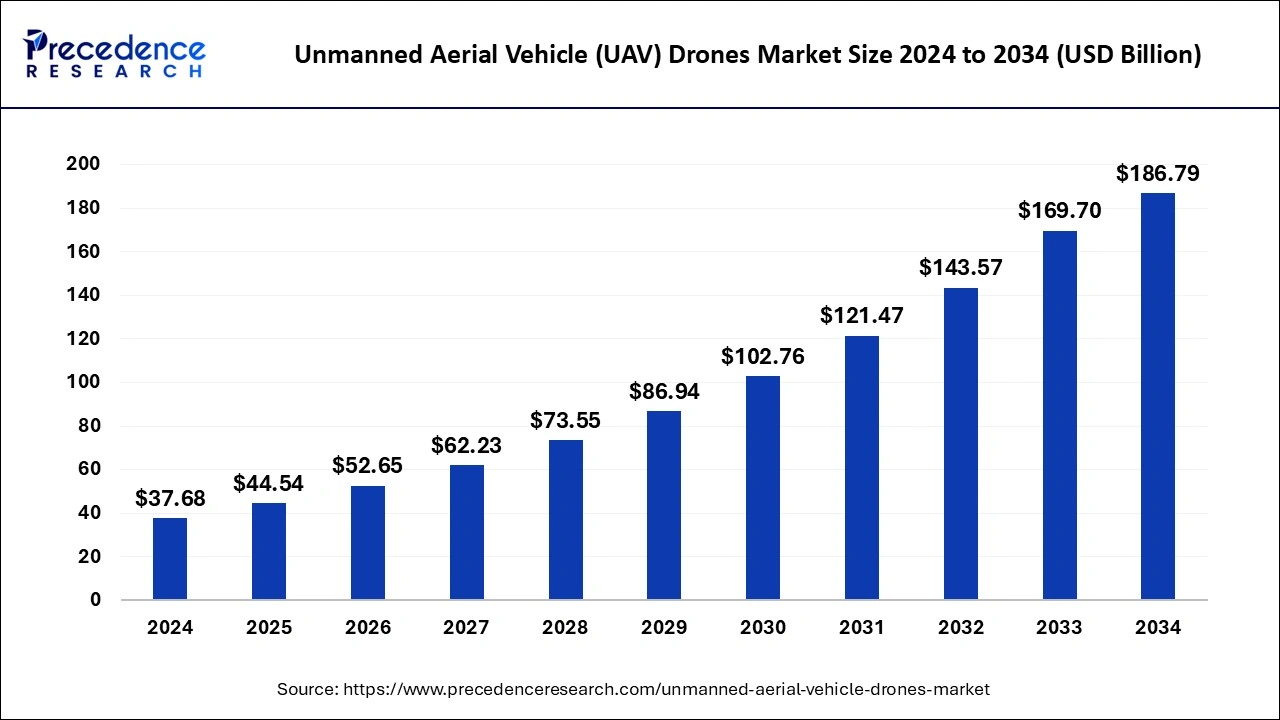
The global unmanned aerial vehicle (UAV) drones market is entering a transformative growth phase, fueled by rapid advancements in artificial intelligence (AI), autonomous navigation, and sensor technologies. The market, valued at USD 44.54 billion in 2025, is projected to grow to USD 209.91 billion by 2035, expanding at a robust CAGR of 16.77% from 2026 to 2035.
From defense modernization to commercial delivery ecosystems, UAV drones are redefining operational efficiency across industries. The emergence of drone-in-a-box solutions, longer battery endurance, and real-time analytics is accelerating adoption globally, especially in high-growth sectors such as agriculture, logistics, and disaster management.
Quick Insights: What’s Powering the Unmanned Aerial Vehicle (UAV) Drones Market?
• The market is expected to grow from USD 52.65 billion in 2026 to USD 209.91 billion by 2035, reflecting strong double-digit expansion.
• Asia Pacific and the Middle East are emerging as high-growth regions due to defense investments and regulatory support.
• Vertical Take-Off and Landing (VTOL) drones dominate due to operational flexibility in confined environments.
• Payload capacity up to 150 kg leads the segment owing to versatility in commercial and defense applications.
• Increasing adoption in agriculture, surveillance, and emergency response is reshaping commercial drone demand.
How is AI Transforming the Unmanned Aerial Vehicle (UAV) Drones Market?
Artificial intelligence is becoming the backbone of next-generation UAV systems. AI-powered analytics enable drones to process massive datasets in real time, improving decision-making in applications such as surveillance, mapping, and predictive maintenance. These capabilities reduce human intervention and significantly enhance mission accuracy.
Moreover, AI-driven autonomy—supported by machine learning and computer vision—is enabling drones to navigate complex environments, avoid obstacles, and operate in GPS-denied zones. Technologies such as Visual SLAM and sensor fusion are unlocking new possibilities in urban air mobility and disaster response, making UAVs smarter, safer, and more efficient.
What are the Key Growth Factors Accelerating Market Expansion?
1. Why is Defense Modernization Fueling UAV Adoption?
Global defense budgets are increasingly allocating funds toward unmanned systems to reduce human risk and enhance surveillance capabilities. UAVs are now integral to intelligence, reconnaissance, and combat missions.
2. How are Commercial Applications Driving Demand?
Industries such as agriculture, logistics, and filmmaking are rapidly adopting drones for cost-effective operations. UAVs provide aerial insights, crop monitoring, and efficient delivery solutions.
3. What Role Does Technological Innovation Play?
Advancements in battery life, payload capacity, and autonomous navigation are making UAVs more reliable and scalable across industries.
Unmanned Aerial Vehicle (UAV) Drones Market Scope
| Report Coverage | Details |
| Market Size in 2025 | USD 44.54 Billion |
| Market Size in 2026 | USD 52.65 Billion |
| Market Size by 2035 | USD 209.91 Billion |
| Market Growth Rate from 2026 to 2035 | CAGR of 16.77% |
| Dominating Region | North America |
| Fastest Growing Region | Asia Pacific |
| Base Year | 2025 |
| Forecast Period | 2026 to 2035 |
| Segments Covered | Type, Application, Component, Payload, and Region |
| Regions Covered | North America, Europe, Asia-Pacific, Latin America, and Middle East & Africa |
Emerging Opportunities & Trends: What’s Next for Unmanned Aerial Vehicle (UAV) Drones?
Is Swarm Technology the Future of Drone Operations?
Yes, coordinated drone fleets are gaining traction in defense and disaster response, enabling large-scale operations with improved efficiency.
Can Hydrogen Fuel Cells Extend Drone Capabilities?
Absolutely. Hydrogen-powered UAVs offer longer flight durations and better energy efficiency, especially for large-scale industrial use.
Will Drone Delivery Become Mainstream?
With increasing investments from e-commerce and logistics companies, drone delivery is expected to revolutionize last-mile connectivity.
Segment Insights
Type Insights
In 2025, vertical take-off and landing (VTOL) drones accounted for the largest share of revenue. These drones use rotors to take off, hover, and land vertically—much like helicopters. This category includes all multi-copter drones and certain hybrid fixed-wing models.
Meanwhile, the medium altitude long endurance (MALE) segment is expected to grow the fastest. MALE drones are designed for long-duration flights and are commonly used for combat and reconnaissance missions.
Payload Insights
Drones with a payload capacity of up to 150 kg dominated the market in 2025. These drones are highly versatile and are widely used for applications such as search and rescue, ground support, traffic monitoring, and intelligence gathering.
On the other hand, drones with payload capacities of up to 600 kg are projected to see the fastest growth in the coming years. Manufacturers are increasingly focusing on developing drones with higher payload capacities to support more advanced operations.
Component Insights
The camera segment held the largest market share in 2025. Cameras are essential for applications like surveillance, security monitoring, infrastructure inspection, and law enforcement operations.
However, the sensor segment is expected to grow at the fastest rate in the future. Advanced sensors, such as inertial measurement units (IMUs), combine data from accelerometers, gyroscopes, and magnetometers to provide accurate information about a drone’s movement, speed, and orientation.
Application Insights
The media and entertainment sector led the market in 2025. Drones have become popular in this field due to their ability to capture high-quality images and videos at lower costs compared to traditional methods.
In contrast, precision agriculture is expected to grow rapidly. Drones are increasingly being used for tasks like soil analysis, crop monitoring, pesticide spraying, and planting. With technologies such as multispectral, hyperspectral, and thermal imaging, drones help farmers monitor crop health and detect issues like fungal infections more effectively.
U.S. UAV Drones Market Overview (2026–2035)
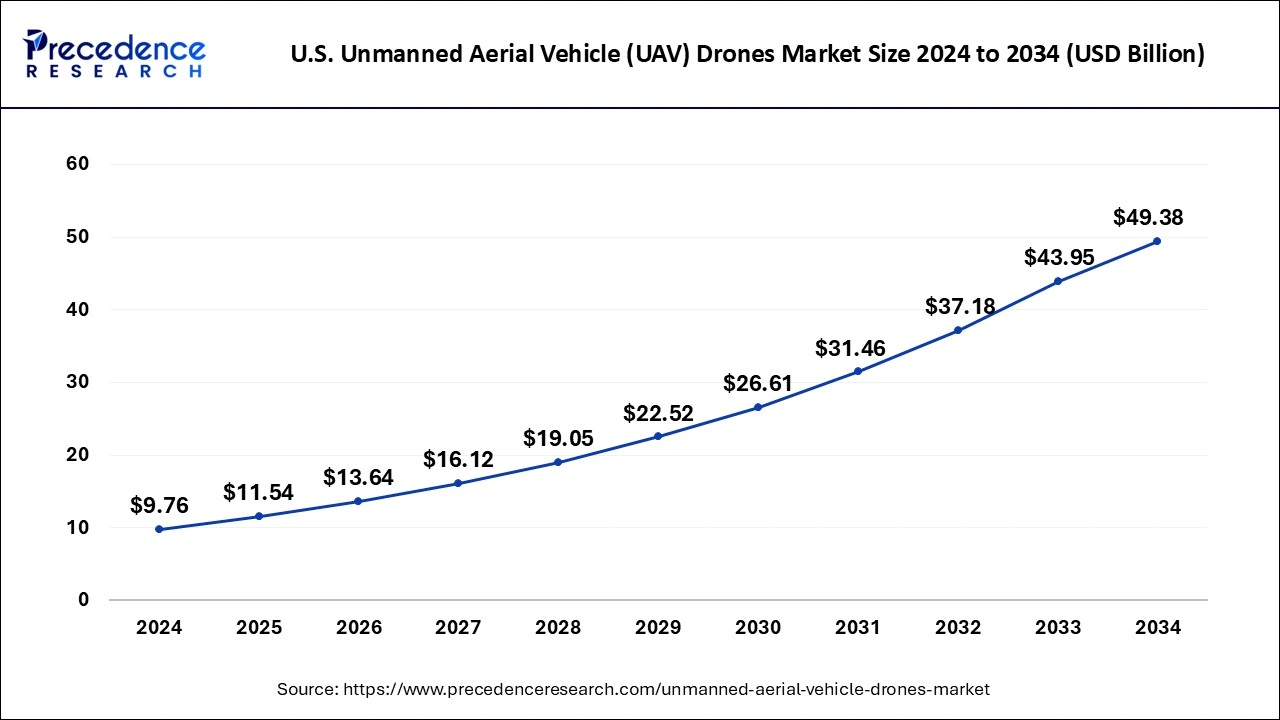
The U.S. Unmanned Aerial Vehicle (UAV) Drones market was valued at USD 11.54 billion in 2025 and is expected to reach approximately USD 55.70 billion by 2035, growing at a CAGR of 17.05% from 2026 to 2035.
Regional Insights
North America
North America currently dominates the UAV drones market, driven by high defense spending, advanced technological infrastructure, and early adoption in commercial sectors. Growth is supported by expanding applications in logistics, public safety, infrastructure inspection, and agriculture, along with evolving regulations for advanced drone operations.
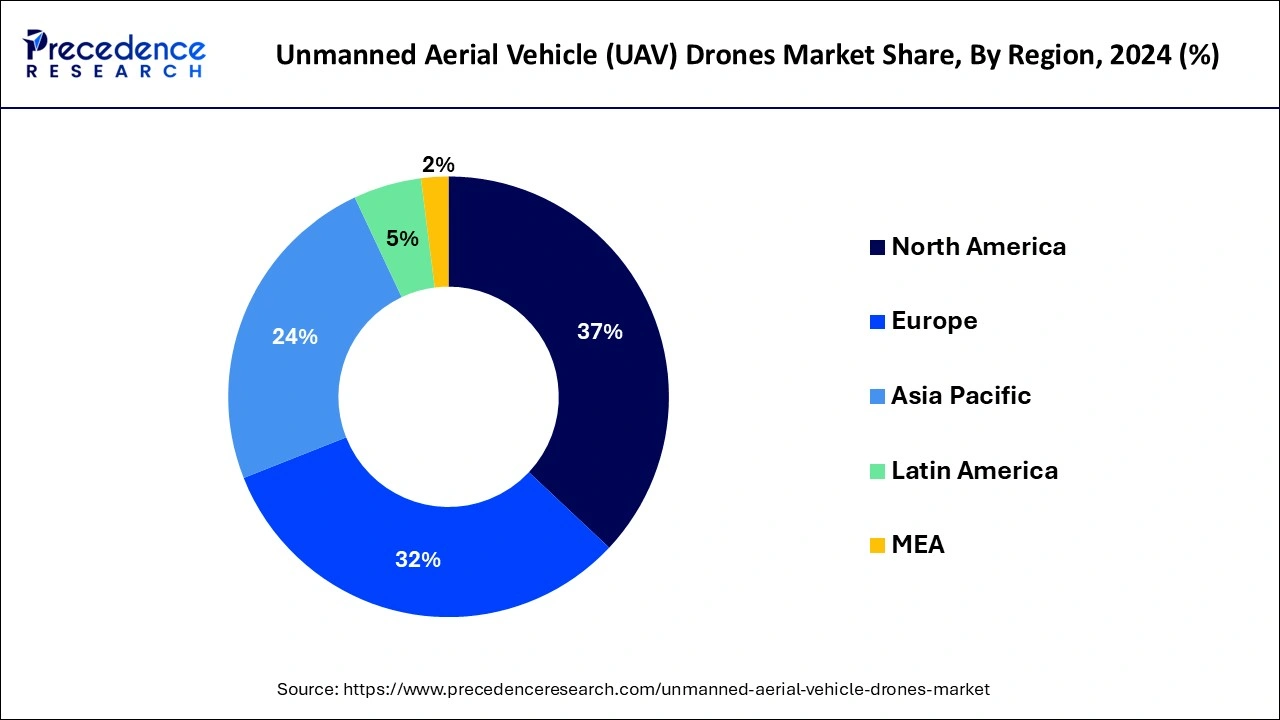
The United States leads the region due to strong innovation, rapid commercial adoption, and significant defense investments. Increased approvals for commercial and long-range drone use are accelerating applications such as agriculture, mapping, surveillance, and last-mile delivery. Additionally, strong venture capital funding and startup activity are fueling innovation in AI-powered and sensor-integrated drones. Military modernization programs are also contributing to continued demand.
Asia Pacific
The Asia Pacific region is experiencing rapid growth, driven by smart city initiatives, industrial expansion, and increased use of drones in agriculture and disaster management. Government-led digital programs and strong manufacturing capabilities are supporting widespread adoption.
In India, the UAV market is growing quickly due to supportive regulations and rising adoption in logistics, defense, and agriculture. Government incentives for local manufacturing and increased startup activity are strengthening the domestic ecosystem. Pilot projects involving drone-based delivery, mapping, and crop spraying are expanding commercial applications, while demand for surveillance and tactical drones continues to rise.
Recent Developments
• In August 2017, a company demonstrated its advanced mission management and control system at a naval technology exercise. This system enables multiple unmanned systems—air, surface, and underwater—to work together and process data from various sensors.
• In April 2017, the company opened a new facility in North Dakota, focused on research and development, mission analysis, operator training, and aircraft maintenance.
Unmanned Aerial Vehicle (UAV) Drones Market Companies
- General Atomics Aeronautical Systems
- Israel Aerospace Industries
- ALCORE Technologies
- BAE Systems
- Nimbus
- VTOL Technologies
- Xiaomi
- ING Robotic Aviation
- PrecisionHawk
- Lockheed Martin
Segments Covered in the Report
By Type
- Fixed Wing Drone
- Rotary Blade Drone
- Hybrid Drone
By Load Capacity
- <2KG
- 2–5 KG
- >5 KG
By Duration
- <30 Minutes
- >30 Minutes
By Range
- Short (<25 Kilometers)
- Long (>25 Kilometers)
By Application
- Aerial Photography
- Agriculture
- Emergency and Disaster Management
- Inspection & Monitoring
- Remote Sensing & Mapping
- Wildlife Research & Preservation
By Geography
- North America
- U.S.
- Canada
- Europe
- U.K.
- Germany
- France
- Asia-Pacific
- China
- India
- Japan
- South Korea
- Malaysia
- Philippines
- Latin America
- Brazil
- Rest of Latin America
- Middle East & Africa (MEA)
- GCC
- North Africa
- South Africa
- Rest of the Middle East & Africa
Get Sample : https://www.precedenceresearch.com/sample/1551
Also Read :https://www.marketstatsinsight.com/single-loop-controller-market/

- Corporate Wellness Market Surges Toward USD 500.09 Billion by 2035 - April 22, 2026
- Portable Medical Devices Market Surges Toward USD 221.71 Billion by 2035 - April 22, 2026
- Infant Incubator Market Set to Surpass USD 3.27 Billion by 2035 - April 22, 2026