
Emotion AI Market Size to Attain USD 311.99 Billion by 2035
What is the Emotion AI Market Size in 2026?
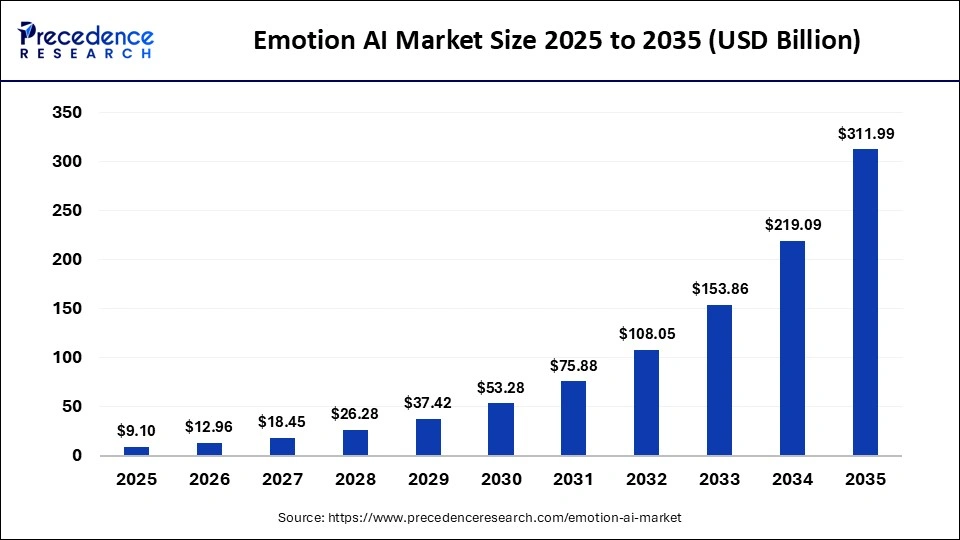
The global emotion AI market size accounted for USD 9.10 billion in 2025 and is predicted to increase from USD 12.96 billion in 2026 to approximately USD 311.99 billion by 2035, expanding at a CAGR of 42.40% from 2026 to 2035. The market is driven by advancements in machine learning and deep learning technologies, along with their expanding deployment across diverse industries.
Key Takeaways
- North America led the emotion AI market in 2025 with approximately 38.30% share.
- The Asia Pacific is projected to experience the fastest growth in the upcoming period.
- By component, the software segment dominated the market in 2025 with about 72% share.
- By component, the hardware segment is the second-largest shareholder and is expected to grow at the fastest rate between 2026 and 2035.
- By technology, the machine learning & deep learning segment led the market with around 55% share in 2025.
- By application, the healthcare & life sciences segment dominated the market with about 30% share in 2025.
- By end user, the enterprise & SMEs segment dominated the market with nearly 58% share in 2025.
Emotion AI Market Trends
- Integration of Emotion AI in Customer Experience Platforms: Emotion AI is increasingly integrated into customer experience platforms, enabling real-time sentiment detection and improving personalized interactions across digital touchpoints.
- Incorporation of Biometrics for Enhanced Emotion Detection: Biometric data, including body temperature, is being integrated into emotion AI systems to enhance accuracy in detecting and analyzing human emotional states.
- Adoption of Emotion AI in Automotive Driver Monitoring Systems: Automakers are adopting emotion AI in driver monitoring systems to assess emotional states and detect drowsiness or distraction, improving overall vehicle safety.
Emotion AI Market Overview
Emotion AI, also referred to as affective AI, is engineered to detect, analyze, and respond to human emotions. It utilizes advanced machine learning algorithms to interpret emotional signals and react suitably . Emotion AI constitutes a segment of artificial intelligence that quantifies, understands, simulates, and responds to human emotions.
Emotion AI recognizes and interprets human feelings from various sources, including facial expressions, vocal tones, and text sentiment. It employs sensors , cameras, and audio systems to gather emotional cues from users. Furthermore, Emotion AI is revolutionizing the way brands engage with their customers.
In recent years, the market has undergone a significant transformation. It is now applied across a broad spectrum of sectors, including automotive, robotics, healthcare, and human behavioral research, driving its growing acceptance in the market. With the latest advancements in artificial intelligence (AI) and machine learning, emotion analysis has seen remarkable improvements in accuracy, efficiency, and scalability.
Segment Insights
Component Insights
Emotion AI Market Share, By Component, 2025-2035 (%)
| Component | 2025 | 2035 |
| Software | 72.00% | 66.00% |
| Hardware | 16.00% | 14.00% |
| Services | 12.00% | 20.00% |
The Software Segment Dominated the Market With a 72% Share in 2025
The software segment dominated the emotion AI market while holding the largest share of 72% in 2025, propelled by the extensive capabilities of software solutions that offer profound insights into human behavior and emotions. A wide array of software categories exists, including emotion recognition software, speech recognition software, facial expression recognition software, and gesture recognition software. These software solutions enable real-time analysis of emotions , sentiment, and toxicity in textual data. Notable software solutions such as Visage SDK, Imentiv AI, and RightFlow are pivotal in fostering the growth of this segment.
The hardware segment was the second-largest shareholder, holding a 16% share of the market in 2025, and is expected to grow at a significant rate in the coming years. The growth of this segment is driven by rising demand for specialized cameras, sensors, and microphones that are customized to specific requirements. Emotion AI utilizes wearable devices and various tools, including cameras, microphones, and skin sensors, to gather physiological and behavioral signals. Devices such as heart rate and skin conductance sensors add depth to emotional insights by tracking physiological responses tied to emotional states. Additionally, advanced microphones that capture and analyze subtle variations in speech are in high demand, driving segmental growth.
Technology Insights
Emotion AI Market Share, By Technology, 2025-2035 (%)
| Technology | 2025 | 2035 |
| Machine Learning & Deep Learning | 55.00% | 48.00% |
| Natural Language Processing (NLP) | 22.00% | 25.00% |
| Computer Vision | 12.00% | 15.00% |
| Speech & Voice Recognition | 11.00% | 12.00% |
The Machine Learning & Deep Learning Segment Led the Market in 2025
The machine learning & deep learning segment led the emotion AI market with the largest share of 55% in 2025. This dominance is driven by the ability of these technologies to enhance traditional emotion recognition practices by more effectively detecting, extracting, classifying, and processing physiological and behavioral signals used to identify emotions. As a core subset of artificial intelligence, machine learning has emerged as a powerful tool for emotion analysis, enabling deeper insight into the complexities of human feelings and their diverse expressions.
The natural language processing (NLP) segment was the second-largest shareholder in 2025, holding a 22% share, and is expected to grow at the fastest rate in the coming years. This is because NLP is becoming an essential part of everyday life due to the widespread use of machine translation tools, voice assistants, and search engines. Moreover, NLP systems can process and interpret textual data from diverse sources, such as social media, forums, and online journals, to identify patterns and linguistic markers associated with mental health conditions, further supporting their adoption and use in emotion AI applications.
Application Insights
The Healthcare & Life Sciences Segment Held a 30% Share of the Market in 2025
The healthcare & life sciences held a dominant position in the emotion AI market in 2025, capturing approximately 30% share. This is primarily due to their crucial role in patient monitoring and mental health assessment. The healthcare industry is poised to gain advantages as emotional AI facilitates the monitoring of patients’ emotional conditions and provides customized interventions. Healthcare professionals can utilize this technology to recognize patterns of emotional distress in patients, which can subsequently assist in formulating more effective treatment strategies.
Market Dynamics
Drivers
Growing Enterprise Digitization Across Industries
Rising enterprise digitization and increasing adoption across financial services, media, healthcare, automotive, and digital platforms are driving the growth of the emotion AI market. This growth is further supported by advancements in machine learning, deep learning , and natural language processing (NLP).
Restraint
Privacy and Ethical Concerns
Privacy concerns over emotional data tracking and analysis, coupled with biases in AI systems, are limiting adoption. Additionally, a lack of transparency in data usage raises ethical issues and undermines user trust.
Opportunity
Expansion of Predictive Analytics Capabilities
Emotion AI-powered predictive analytics allows businesses to gain deeper insights into customer emotions and behavioral patterns. By leveraging this understanding, companies can design highly targeted marketing strategies, optimize the effectiveness of their campaigns, and significantly enhance overall customer engagement by aligning products, services, and communications more closely with individual preferences and emotional responses.
Regional Insights
North America emotion AI Market Size and Growth 2026 to 2035
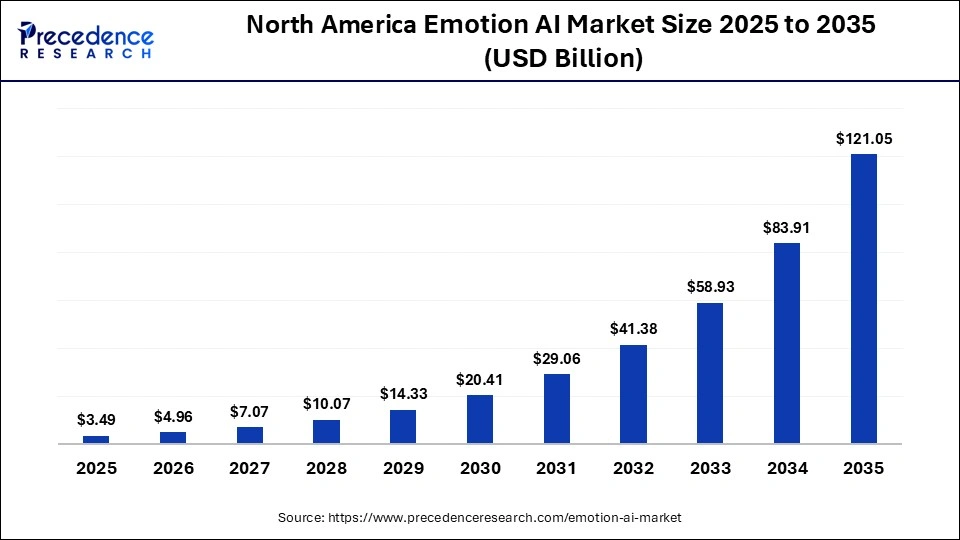
The North America emotion AI market size is estimated at USD 3.49 billion in 2025 and is projected to reach approximately USD 121.05 billion by 2035, with a 42.57% CAGR from 2026 to 2035.
North America Held a 38.30% Share of the Market in 2025
North America dominated the emotion AI market by holding a 38.30% share in 2025. This leadership is underpinned by the region’s strong base of large enterprises and government organizations, all placing a high priority on data security and regulatory compliance. In addition, robust government and private-sector funding for R&D in AI, machine learning, and affective computing technologies are accelerating innovation and adoption across industries. Key companies such as Affectiva, Hume AI, and Cogito Corp are playing a pivotal role in strengthening the regional ecosystem and consolidating North America’s position in the global emotion AI landscape.
Asia Pacific: The Fastest-Growing Region
Asia Pacific held a 22% share of the market in 2025 and is expected to witness the fastest growth throughout the forecast period. This is because the region is emerging as a major hub for AI-powered emotion analytics driven by strong government support, rapid technological progress, and rising demand for AI across industries. The integration of digital solutions and AI/ML has enhanced industrial capabilities, enabling organizations to execute more complex tasks, make intelligent decisions, and adapt quickly to changing environments.
China Market Analysis
China leads the Asia Pacific emotion AI market, supported by strong government backing, advanced digital infrastructure, and a data-rich population. Initiatives such as the “New Generation Artificial Intelligence Development Plan” have accelerated adoption across healthcare, retail, education, and automotive sectors. The rising focus on ethical AI and data privacy helps China maintain a global edge, while companies like Emotibot and Xiaoice further consolidate its regional leadership.
Europe: The Second-Largest Market
Europe is the second-largest market, holding a 28.70% share in 2025, fueled by a strong enterprise foundation, stringent regulations, and proactive government adoption of advanced technologies aimed at enhancing operational efficiency. Organizations are leveraging emotion AI to assess customer emotions and feedback, facilitating more personalized experiences through AI-driven audience segmentation. Meanwhile, leading companies such as Smart Eye and Realeyes are instrumental in fostering growth and innovation within the region.
Germany Market Analysis
Germany is a major contributor to the European emotion AI market. This is because of the expansion of the IT & telecommunication sector, where emotion AI is being adopted to enhance customer experience and service quality. The demand for emotion detection rises alongside advancements in autonomous and intelligent infrastructure. Key players such as audEERING and Beyond Emotion are further strengthening Germany’s position in the regional market.
Emotion AI Market Companies
- Affectiva, Inc. (A Smart Eye Company)
- Google LLC
- NVIDIA Corporation
- Clarifai, Inc.
- Realeyes Ltd.
- Kairos AR, Inc.
- Beyond Verbal
- Sightengine, Inc.
- x.ai
- Eyeris, Inc.
- CloudWalk Technology Inc.
- DeepSense AI
- Cogito Corporation
Check this report to: Super Disintegrants Market
For inquiries regarding discounts, bulk purchases, or customization requests, please contact us at sales@precedenceresearch.com
You can place an order or ask any questions. Please feel free to contact us at sales@precedenceresearch.com |+1 804 441 9344
