
Applied AI in Autonomous Vehicles Market Expanding Toward USD 202.55 Billion by 2035
The global Applied AI in Autonomous Vehicles Market is entering a transformative decade, driven by rapid advancements in machine learning, computer vision, and sensor fusion technologies. The market size is projected to grow from USD 13.20 billion in 2025 to USD 17.34 billion in 2026, and further expand to approximately USD 202.55 billion by 2035, registering a remarkable CAGR of 31.40% from 2026 to 2035.
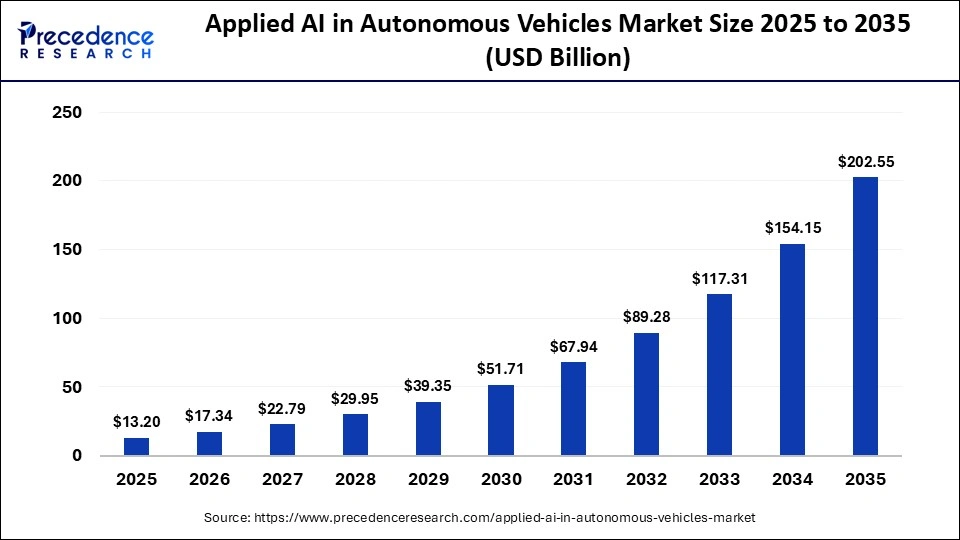
This strong growth trajectory is fueled by increasing demand for safer mobility systems, accelerated development of Level 4 and Level 5 autonomous vehicles, and growing investments from both automotive OEMs and technology companies.
Read Also: DC Load Bank Market
Quick Insights (Market Snapshot 2026–2035)
- The market size is projected at USD 17.34 billion in 2026, up from USD 13.20 billion in 2025.
- It is expected to reach USD 202.55 billion by 2035, reflecting exponential industry scaling.
- The market is growing at a CAGR of 31.40% (2026–2035).
- North America leads the market, supported by strong AI infrastructure and autonomous vehicle deployment.
- Asia Pacific is the fastest-growing region, driven by EV expansion and smart mobility initiatives.
- The machine learning segment dominates AI technologies, powering real-time decision-making systems in vehicles.
- Passenger vehicles account for the largest end-use share (~55%) due to ADAS adoption.
Market Overview: Why is AI Becoming the “Brain” of Autonomous Mobility?
Applied AI in autonomous vehicles refers to the integration of intelligent systems—such as deep learning, real-time perception, and predictive analytics—into vehicle control frameworks. These systems enable cars to interpret surroundings, make decisions, and execute driving actions without human intervention.
In 2026, the market is evolving beyond experimental pilot programs into early-stage commercialization, particularly in robotaxis, autonomous trucking, and advanced driver assistance systems (ADAS). Companies such as Tesla, Waymo, NVIDIA, and Mercedes-Benz are actively scaling AI-driven mobility solutions globally.
How is AI Transforming Autonomous Vehicles?
AI is fundamentally reshaping autonomous driving by enabling real-time environmental perception, predictive behavior modeling, and automated decision-making.
Machine learning and deep learning systems continuously process massive volumes of sensor data from cameras, radar, and LiDAR systems. This allows vehicles to identify pedestrians, predict traffic behavior, and optimize navigation with minimal latency. As a result, AI is significantly reducing human error, which remains the leading cause of road accidents globally.
At the same time, edge AI computing is gaining momentum, allowing vehicles to process data locally rather than relying solely on cloud systems. This improves response time and enhances safety in complex driving conditions.
Why is AI Adoption Accelerating in Autonomous Vehicles?
What is driving the market growth?
The market is expanding due to multiple structural factors:
- Rising demand for road safety and accident reduction
- Rapid adoption of ADAS in passenger vehicles
- Expansion of autonomous ride-hailing and robotaxi fleets
- Increased investment in smart city infrastructure
- Growing integration of AI chips and edge computing systems
- Strong R&D funding from automotive and tech companies
Where Are the Biggest Opportunities in the Market?
Will autonomous mobility replace traditional driving systems?
The shift is not immediate replacement but gradual transformation. Key opportunities include:
- Robotaxi commercialization in urban mobility networks
- Autonomous freight and logistics optimization
- AI-powered fleet management systems
- Advanced predictive maintenance for vehicles
- Integration with smart city transportation ecosystems
The logistics and commercial transport sectors are expected to see some of the earliest large-scale monetization of autonomous AI systems.
Regional Insights: Who is Leading the AI Mobility Revolution?
North America – Why does it dominate the market?
North America holds the largest share of the market, supported by:
- Strong presence of AI innovators and automotive OEMs
- Early deployment of autonomous fleets (Waymo, Tesla)
- Advanced regulatory and testing frameworks
- High investment in AI infrastructure and robotics
Asia Pacific – Why is it growing the fastest?
Asia Pacific is emerging as the fastest-growing region due to:
- Rapid EV adoption in China, Japan, and South Korea
- Government-backed smart mobility programs
- Expanding urban transportation demand
- Strong semiconductor and AI hardware manufacturing base
Segment Analysis: Which Technologies Dominate?
Machine Learning Leads AI Technology Segment
Machine learning holds the largest share as it enables:
- Real-time decision-making
- Predictive driving behavior analysis
- Continuous system learning from road data
Computer Vision Powers Object Detection Systems
Computer vision systems are critical for:
- Detecting pedestrians and vehicles
- Lane tracking and traffic sign recognition
- Environmental mapping and localization
Who Are the Key Players in the Market?
Major companies shaping the Applied AI in Autonomous Vehicles Market include:
- Tesla, Inc.
- NVIDIA Corporation
- Qualcomm Technologies, Inc.
- Waymo
- Mercedes-Benz Group AG
- BMW Group
- Toyota Motor Corporation
These companies are investing heavily in autonomous driving platforms, AI chips, and simulation environments.
Recent Breakthroughs in Autonomous AI
- Expansion of AI-powered robotaxi services across major U.S. cities, accelerating commercialization of autonomous mobility.
- Major partnerships between AI software developers and chip manufacturers to speed up deployment of self-driving systems.
- Automotive leaders increasing investments in “AI-defined vehicles” to integrate autonomy into mainstream production models.
What Challenges Are Restricting Market Growth?
Despite strong momentum, the market faces several challenges:
- High cost of autonomous system integration
- Cybersecurity risks and data vulnerabilities
- Regulatory uncertainty across regions
- Edge-case failures in unpredictable driving scenarios
- Public trust and safety concerns
Case Study: AI in Autonomous Freight Networks
A leading logistics company deployed AI-based autonomous driving systems to optimize long-haul trucking routes. The system used predictive analytics and real-time traffic modeling, reducing fuel consumption and improving delivery efficiency. This deployment demonstrated how AI can immediately deliver ROI in commercial transport applications.
Conclusion
The Applied AI in Autonomous Vehicles Market is entering a hyper-growth phase, driven by technological maturity and strong industrial adoption. With a projected valuation of USD 202.55 billion by 2035, the sector is poised to redefine global transportation systems through intelligent automation, real-time decision-making, and connected mobility ecosystems.
Get Sample Copy: https://www.precedenceresearch.com/sample/8307
For inquiries regarding discounts, bulk purchases, or customization requests, please contact us at sales@precedenceresearch.com
